About low-pressure tires
All-terrain vehicles always attract attention with their limitless possibilities. Almost everyone who deals with them is driven by excitement and the main question is "can it really go anywhere?". For some types of all-terrain vehicles, there are indeed no closed routes. At the same time, as with any vehicle, the basis of cross-country ability is the tires. It is expected that the tires here are unusual. Today, we will tell you a few interesting facts about low-pressure tires.
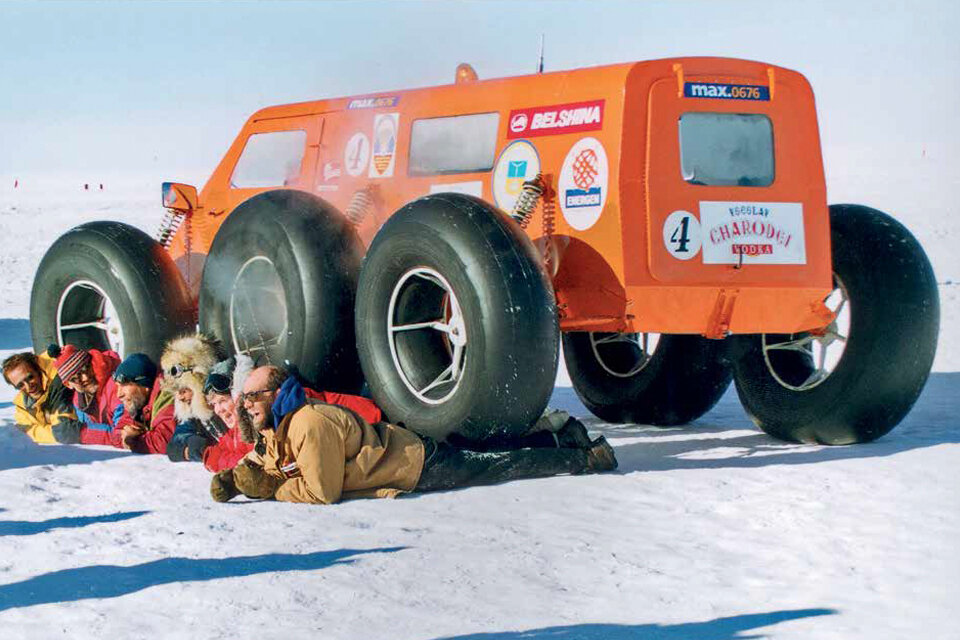
Low-pressure tires provide unprecedented cross-country ability due to a very wide contact patch with the surface and weight distribution. You may have come across photos or videos where all-terrain vehicles drive on something fragile. Some extremists even lie down next to the wheel to literally feel what it's like to have a maximum possible contact patch and low pressure.
It is this principle that is followed by "mud" segment tires. We have already written about the fact that in case of need, the pressure in some models can drop to 0.5 bar, and at first glance, decorative elements located on the sidewalls become additional traction elements in the newly increased contact patch.
The photo accompanying this article shows the well-known all-terrain vehicle "Shepr". Despite the fact that it also has low-pressure tires installed, they work on a different principle. This all-terrain vehicle uses the principle of pneumatic suspension, where the tires are part of the system.
All wheels are connected to each other by an air duct through which exhaust gases from the engine circulate. If necessary, the driver can adjust the gas supply to the tires or to the exhaust pipe, thereby adjusting the pressure. That's how it turns out that the pressure is not constant and depends on the conditions, it is regulated from 0.04 to 0.1 bar.