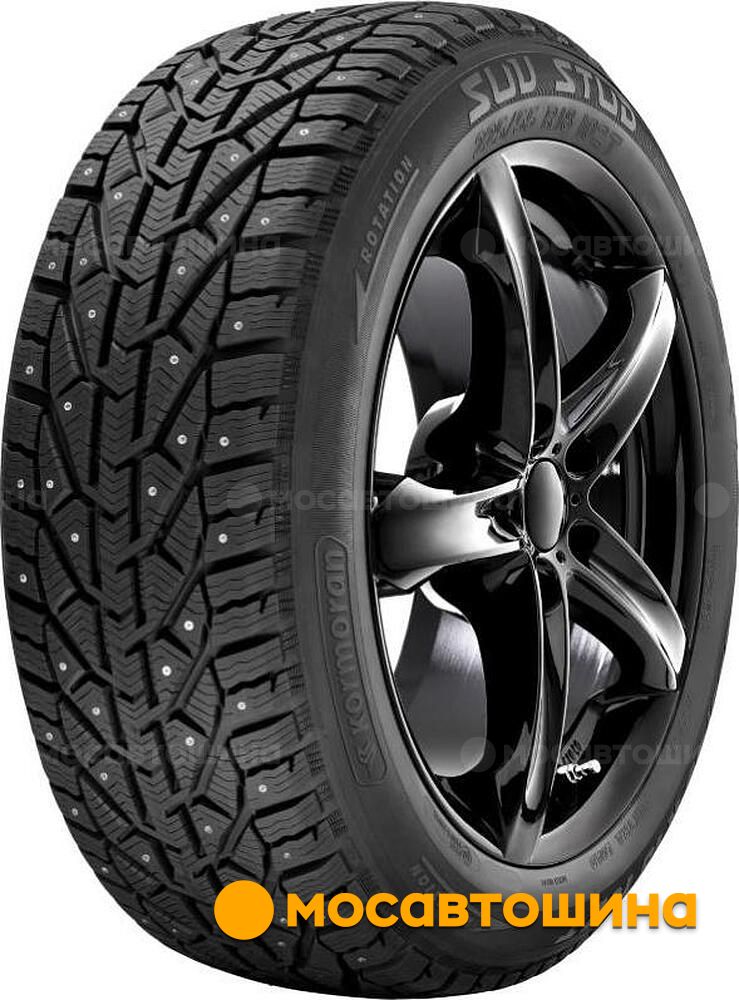
The Orium SUV Ice winter tire, unlike most similar models from other brands, was initially designed for crossovers. This allowed it to best adapt its operational properties to the design features of vehicles with a high center of gravity and increased weight due to the all-wheel drive transmission. This tire was created in parallel with the SUV Winter model and has an identical tread pattern. The key difference is the presence of spikes, which gives it much better traction properties on ice.
Effective winter tread pattern
The tire is equipped with a tread featuring a classic V-shaped arrangement of elements. They are distributed in such a way that when moving, they form several functional areas that improve certain operational properties. In particular, the central part contains a large number of blocks of complex polygonal shape. These elements form numerous edges, most of which are arranged at a significant angle relative to the direction of movement. This provides the tire with resistance to skidding during straight-line movement. This property is further enhanced by the bridges between the blocks, which limit their mobility.
In turn, the shoulder blocks are massive, transversely arranged, and have a significant distance between them. The combination of these factors provides the tire with stability during maneuvering, reduces wear, shortens the braking distance, and improves passability in deep snow.
Increased lamella cutting density
Each tread block has several curved lamellas. These cuts, when in contact with the road surface, form numerous edges, the sharpness and height of which allow the tire to easily grip even the smallest irregularities. This significantly improves the traction properties on rolled snow and ice.
Key features of Orium SUV Ice
- design initially adapted for vehicles with high weight and center of gravity;
- numerous inclined blocks connected by bridges provide directional stability and longitudinal traction properties on snow;
- wide shoulder blocks reduce wear and braking distance, improve traction during maneuvering, and improve passability in snow.
 Enlarge