Due to its long presence in the market, the winter tire Goodyear Medeo M+S cannot be attributed to the novelties of the North American manufacturer. Nevertheless, the technologies and materials used in its design ensure the relevance of its technical characteristics, even despite the presence of numerous competitors on the domestic market, released much later.
S-shaped tread pattern
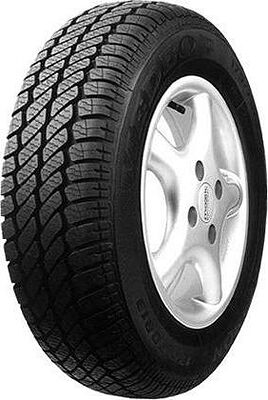
Since the primary "target audience" of this model were the owners of inexpensive passenger cars, it is not surprising that its developers preferred to equip it with a tread featuring an S-shaped pattern. This choice is due to a number of important advantages. First and foremost, these are the increased dimensions of the contact patch, low noise level, and reduced rolling resistance.
To provide the Goodyear Medeo M+S tire with confident behavior not only on asphalt but also on snow, the specialists of the North American brand used a tread with an open design containing a large number of individual elements. Depending on their location in one or another part of the tread, these blocks have different shapes and sizes.
In turn, the blocks of the shoulder zones are distinguished by their transverse arrangement and greater width. The massive sizes make them resistant to deformation, which is why the tire demonstrates not only good traction but also very stable behavior in turns. At the same time, the long transverse edges of the shoulder blocks improve braking performance.
Multiple lamellas
Since this model is a winter tire, it is not surprising that it demonstrates good performance, including on ice. Traction on such types of surfaces is ensured by the numerous lamellas. Most of the edges formed by them are located almost transversely, which has a positive effect on acceleration and braking on icy roads.
Key features of the Goodyear Medeo M+S tire
- the original S-shaped tread improves performance;
- the large number of blocks at a significant distance from each other improves traction on snow;
- low rolling resistance and noise level due to the rounded edges and angled arrangement of blocks in the central part of the tread.
 Enlarge
 Enlarge