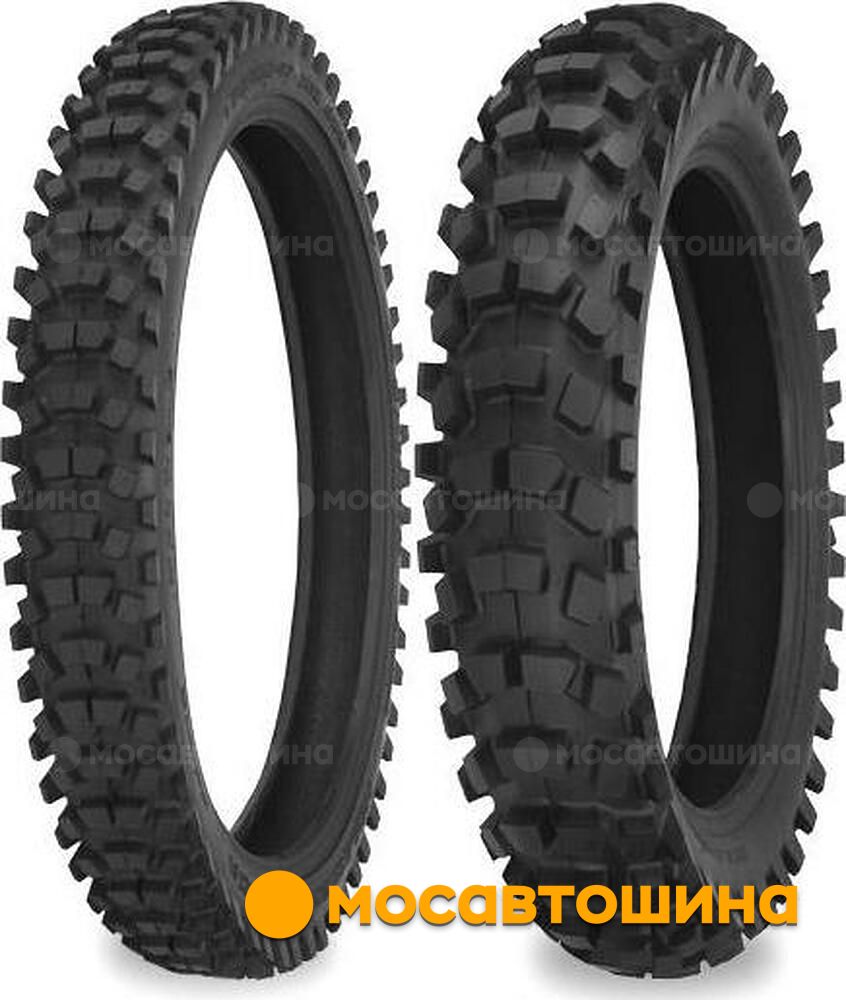
The Shinko 520 motorcycle tire, depending on the version, is designed for enduro category motorcycles. A distinctive feature of this model is the symmetrical directional tread pattern, which has excellent efficiency on various types of surfaces, from sand to wet earth. In combination with excellent applicability, this provides the Shinko 520 with a very wide range of applications.
Directional Tread Pattern
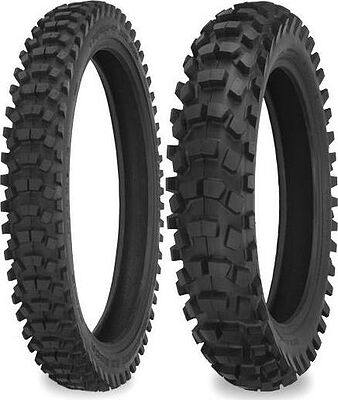
As mentioned earlier, one of the key features of this model is the directional tread pattern, which is not often found on modern off-road motorcycle tires. At the same time, it does not differ too much in versions for the front and rear wheels, differing only in the size of the blocks, which is due to the difference in the dimensions of the tires.
The central part of the Shinko 520 tread pattern contains many blocks of rectangular and trapezoidal shape. During movement, they form very extended contact edges, thanks to which the tire demonstrates excellent traction properties in the longitudinal direction.
The shoulder areas also feature an open design. However, the blocks that make them up are arranged in a checkerboard pattern. This structure provides the tire with excellent grip even at significant tilt angles, as well as improved passability on unstable sandy and earthy soils.
Durable Rubber Compound
Another main feature of this model is the rubber compound. Its composition is characterized by a high content of carbon-containing substances, which provide the tread with high resistance to tearing, which significantly extends the life of the tire even in off-road conditions.
Main Features of the Shinko 520 Motorcycle Tire
- wide range of applications, ensured by excellent applicability and adaptability to off-road operation;
- two versions - for the front and rear wheels;
- symmetrical directional tread pattern has high performance on various types of surfaces;
- excellent self-cleaning properties of the tread, thanks to the large distance between the blocks;
- high resistance to tearing, due to the high content of carbon-containing components in the rubber compound.
 Enlarge