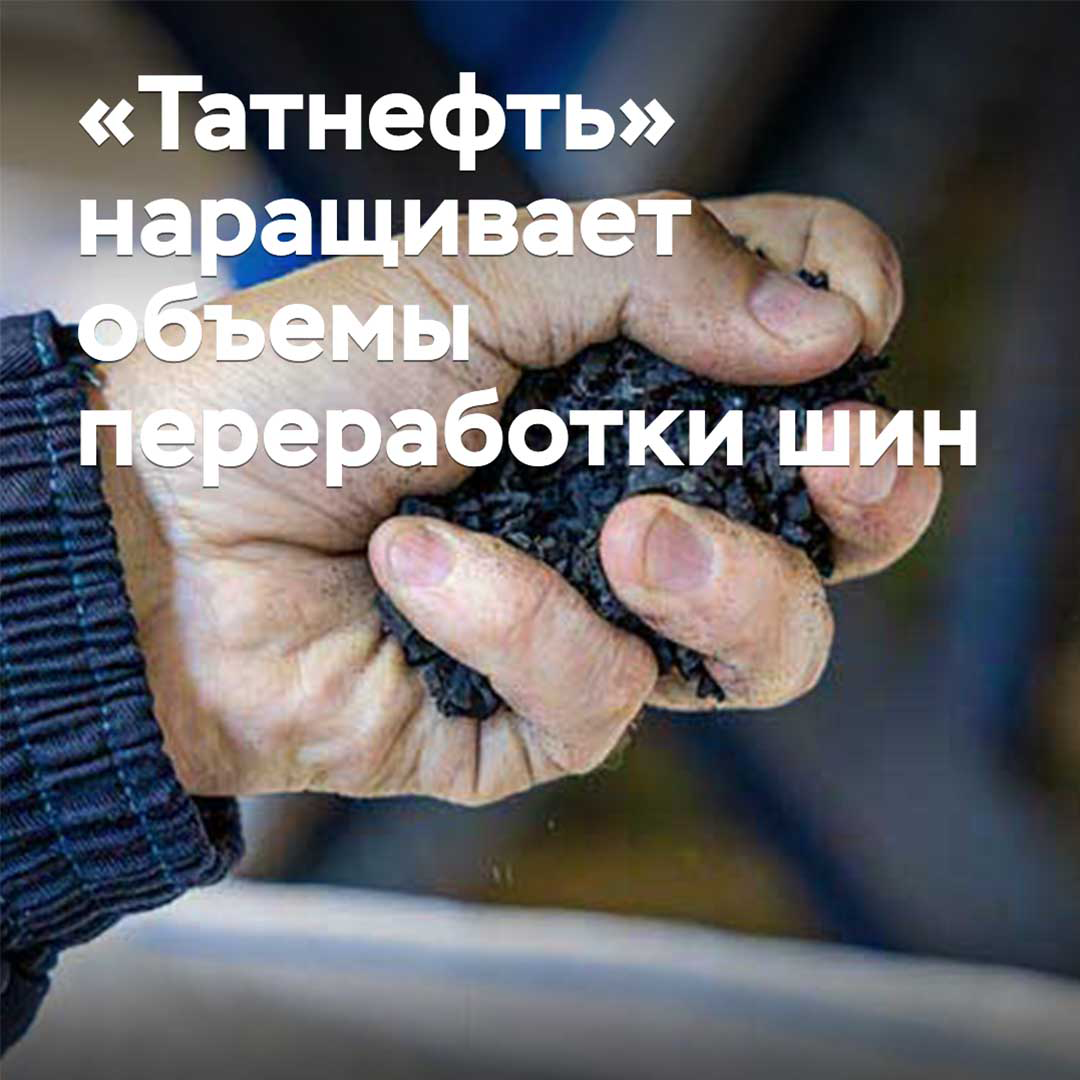
Tatneft increases tire processing volumes
Every year, around 1 million tons of used tires are generated in Russia, but the level of their collection and recycling is no more than 50% compared to 97% in some European countries. The company "Tatneft" offers a systemic solution to this problem, reports the corporate publication "Neftevie vesti".
In 2022, Tatneft created a division called "Secondary Resources Management", which implements the "Green Tire" project. The goal of this project is to "transition to a closed-loop economy, where waste becomes raw materials". By 2030, the company plans to recycle 400,000 tons of old tires annually, and in the future, it plans to increase this volume to 1 million tons per year. Currently, within the framework of the project, 407 new jobs have been created, mainly in small towns, which "reduces tension in local labor markets".
Recycling is carried out using robotics and artificial intelligence, and key stages of the process, such as sorting, cutting, and separation, have been automated. AI optimizes the work schedule, monitors quality, and reduces energy consumption, which improves productivity and the purity of secondary raw materials, as well as reduces the load on the environment.
Currently, the project covers 23 regions of the country, and more than 80 points for accepting used tires have been created at gas stations and urban sites. In particular, at the initiative of the authorities of Tatarstan, 28 reception points were opened in the municipalities of the republic. To date, more than 111,000 tons of tires have been collected, of which over 94,000 tons have been used in secondary processing.
Used tires are not considered waste in the classical sense, but rather hydrocarbon raw materials that, when deeply processed, can return around 90% of their mass to industrial circulation. Using Tatneft's technologies, used tires can be converted into: 34% pyrolysis liquid, 38% carbon residue, 15% metal cord, and 13% pyrolysis gas through the pyrolysis method.
Within the technological process, the metal cord is extracted for further processing, the rubber is crushed into crumbs and sent to the pyrolysis unit, after which pyrogas, pyrocondensate, and solid carbon residue are formed. The key link in the chain is pyrocondensate, which is directed to the TANECO complex to obtain components of motor fuel, as well as isobutane, which is used as raw material in the production of synthetic rubber. This synthetic rubber, in turn, is used to manufacture "green" tires, such as, for example, Viatti Strada 2.
In June 2026, Deputy Prime Minister of the Russian Federation Dmitry Patrushev familiarized himself with the "Green Tire" project, visiting the tire recycling site in Nizhnekamsk. As noted during the visit by Azat Khabibrahmanov, Deputy General Director of Tatneft for Industrial Safety, Labor Protection, and Ecology, currently, around 90% of worn-out tires in the country are recycled into rubber crumb, which is a low-margin product, and the lack of demand makes its production unprofitable, resulting in further accumulation of used tires, i.e., "the current disposal model does not correspond to the priority of reuse".
Photo: Sergey Trusov, Regina Levintan-Kirichenko