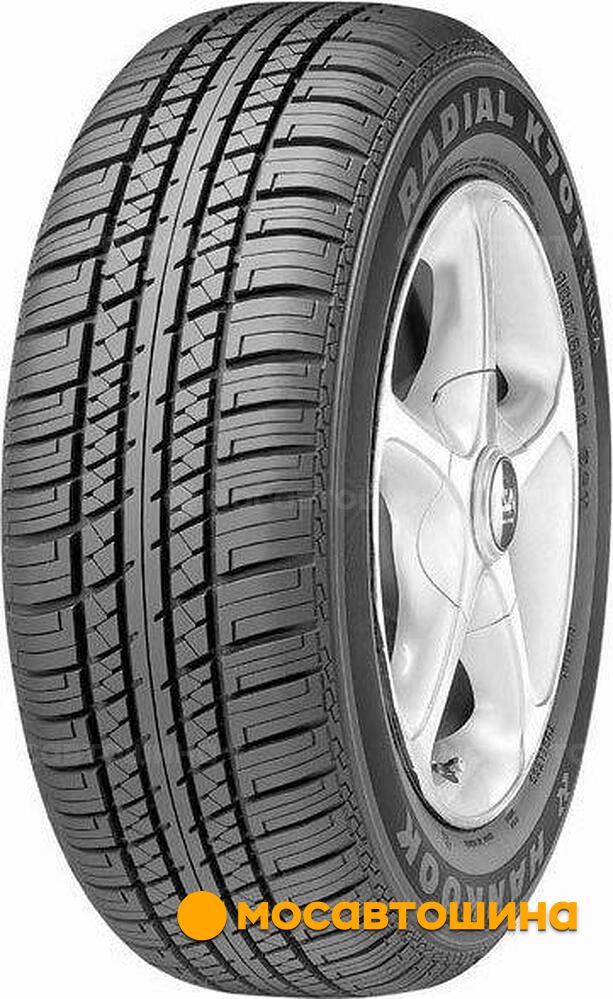
All-season passenger tire Hankook K701 of the world-famous South Korean manufacturer is designed for compact class passenger cars.
One of the distinguishing features of this tire is the asymmetrical design of the tread pattern, which significantly improves the tire's grip on wet surfaces. A characteristic feature of the asymmetrical scheme for arranging tread elements is that water entering from one side of the tread is thrown out from the other side through a system of water drainage channels, which ensures high efficiency of water drainage from the tire's contact patch, thereby preventing the occurrence of aquaplaning.
In the central part of the tread, there are three ribs, one of which is solid, and the other two are rows of separate blocks of complex geometric shape. The solid central rib provides the tire with excellent directional stability and also significantly affects the maneuverability.
The two rows of blocks adjacent to the central rib provide excellent traction and grip characteristics on any surface, as well as contribute to reducing noise and rolling resistance, which affects fuel consumption. All functional blocks of the tire's tread are divided by four longitudinal grooves, through which water is removed from the tire's contact patch.
On both sides of the tire's tread, there are two wide shoulder zones with a rounded profile, divided into separate blocks by transverse grooves. Such a design allows for effective resistance to lateral skidding that occurs when turning, as well as to withstand uneven wear, which significantly reduces the service life of the tire.
Thanks to the use of a steel breaker and a two-layer cord in the tire's design, the tire is characterized by elasticity, resistance to various aggressive influences, and high resistance to wear.
Main features of the Hankook K701 tire
- The original asymmetrical tread pattern design gives the tire confidence when driving on very wet roads;
- Four water drainage grooves in combination with the system of lateral grooves effectively combat aquaplaning;
- Low rolling resistance contributes to reduced fuel consumption;
- Wide shoulder zones significantly improve the tire's grip when cornering;
- Low noise level, softness, and comfort when moving, due to the elasticity of the tire.
 Enlarge