
-
 Enlarge
 Dunlop SP Sport MAXX GT600
Description Dunlop SP Sport MAXX GT600
The Dunlop SP Sport MAXX GT600 summer tire is one of the latest offerings from the oldest British tire manufacturer. Unlike most other tires, this model is designed exclusively for powerful sports sedans and coupes. Such a clear conclusion can be drawn from the size range, which includes only two sizes, 285/35ZRF20 and 255/40ZRF20, as well as the speed index, which in both cases is denoted by the letter Y.
Asymmetrical tread pattern
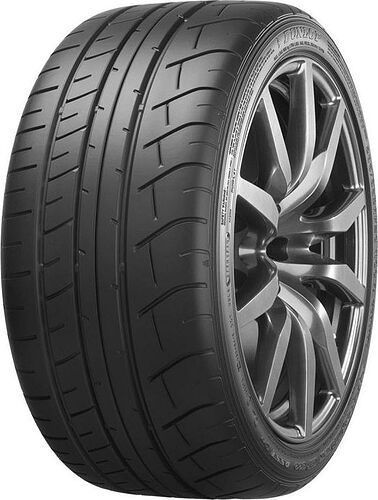
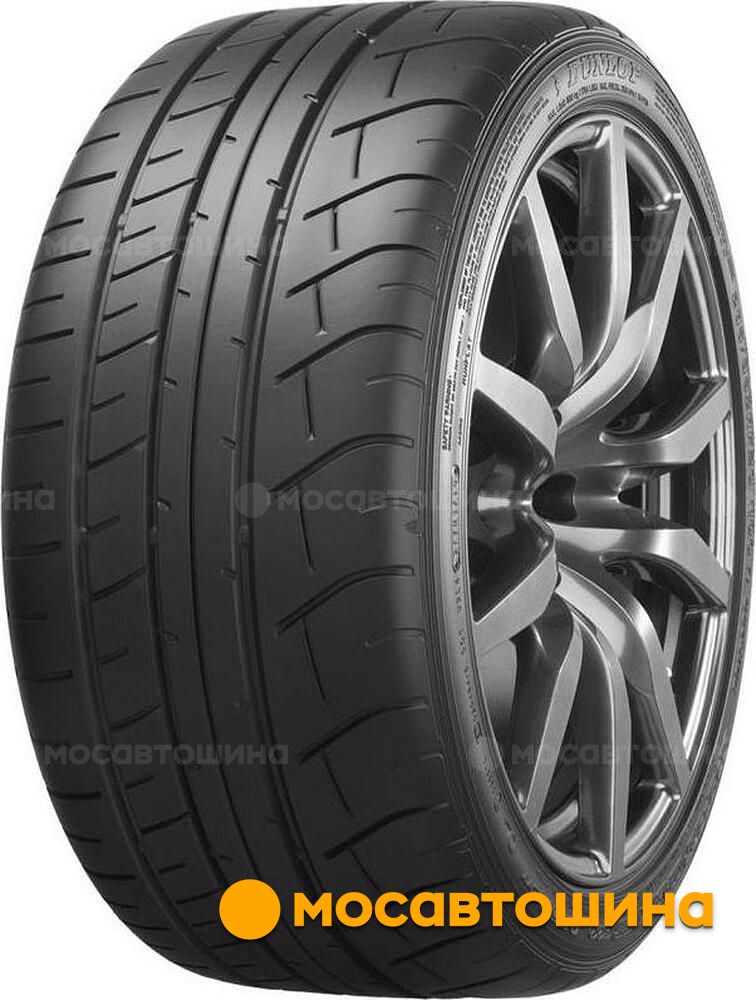
Given the specific operating conditions for which this model was created, the British tire manufacturer preferred to use an asymmetrical directional tread pattern. This choice was driven by the desire to provide maximum traction on both dry and wet surfaces. It is divided into four longitudinal ribs, each of which performs a pre-defined set of tasks, which made it possible to achieve almost ideal balance between the main working characteristics of this model.
Rigid longitudinal rib in the center of the tread pattern
Unlike many other tires in the Ultra High Performance category, the tread pattern of this model features a longitudinal rib that is strictly centered. In addition to its location, this element is distinguished by its massive size and double construction. These design features make the longitudinal rib very rigid and resistant to dynamic deformation, providing the tire with excellent directional stability at any speed, as well as very transparent feedback on the steering wheel. As a result, it becomes much easier to handle the car.
Very high resistance to aquaplaning
When developing the Dunlop SP Sport MAXX GT600 model, special attention was paid to counteracting aquaplaning. To combat this dangerous phenomenon, the British tire manufacturer equipped the tread pattern with drainage channels and grooves of increased volume. Moreover, they optimized their location, directing it against the direction of movement. This significantly increased the speed of water removal from the contact patch. Additionally, the shape of the drainage transverse grooves became curved, which also increased the effectiveness of the drainage system by minimizing the turbulence that occurs in the flow of water being discharged.
Durable and deformation-resistant carcass
When creating the carcass of this tire, the Jointless Band technology was applied. It involves a special method of winding the steel cord, in which only one cord is used, without forming unnecessary seams and layers. As a result, a very durable and lightweight structure is obtained, which is distinguished not only by high resistance to dynamic deformation but also by low heat generation, which has a beneficial effect on the preservation of the rubber mixture of the tread.
Low noise level
Since this tire is intended primarily for civilian purposes, special attention was paid to acoustic comfort during its development, which is at a fairly high level. To achieve this, the company's proprietary development, the Multi-Pitch Tread Design technology, was used. It represents a special scheme for arranging tread elements, which excludes the possibility of resonance noise and vibrations. In other words, they are arranged with a small step relative to each other.
Main features of the Dunlop SP Sport MAXX GT600 tire
- The asymmetrical directional tread pattern provides excellent traction on dry and wet roads;
- The rigid longitudinal rib in the central part of the tread makes the feedback transparent, and the handling - sporty-sharp;
- The numerous wide transverse drainage grooves in the shoulder areas of the tread, due to their location and curved shape, provide excellent resistance to aquaplaning;
- The durable and lightweight carcass is distinguished by excellent resistance to dynamic deformations and low heat generation thanks to the Jointless Band technology;
- The reduced noise level, thanks to the Multi-Pitch Tread Design technology, which involves a multi-step arrangement of tread elements;
- The reinforced sidewall construction allows driving up to 80 km at a speed of 80 km/h in the event of a complete loss of pressure.