The Hankook AL07+ truck tire is designed for installation on the steering axles of trucks, the operation of which is associated with long-distance and long-duration movement at high speed. This model is distinguished by excellent performance in any weather conditions, high reliability, and a very long service life, ensured by the possibility of tread restoration.
Reinforced shoulder areas
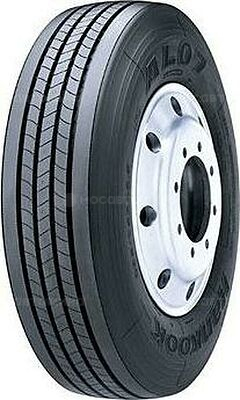
This model is one of the first where Hankook applied the UMS technology. Its main functional purpose is to increase the tire's resistance to dynamic deformation that occurs during movement. To this end, the South Korean tire manufacturers maximally increased the stiffness of the shoulder areas of the tread pattern, which have a flat profile and massive dimensions. Additionally, the tire's carcass was significantly strengthened, receiving a all-steel cord with wires of increased cross-section.
As a result, it was possible to significantly improve most of the technical characteristics of the Hankook AL07+. In particular, the size of the contact patch was increased, while its shape became almost rectangular, which had a very favorable effect on the traction properties, load capacity, resistance to impact loads, and uneven wear. Additionally, the absence of any breaks throughout the shoulder areas reduced rolling resistance and noise level, and also improved handling.
High braking efficiency
In contrast to the shoulder areas, the central part of the tread pattern has a more open design, the characteristic feature of which is the presence of a large number of transverse traction edges. They are formed due to the multitude of straight lamellas cut through the entire depth of the tread on all three longitudinal ribs, which are located in its central part. These elements provide the tire with very high braking efficiency, especially on wet roads.
Main features of the Hankook AL07+ tire
- the tire is designed for the steering axle of trucks;
- UMS technology provides exceptional tire resistance to deformation during movement, which improves handling;
- rigid and massive shoulder areas increase the size of the contact patch, improve traction, reduce rolling resistance, increase load capacity, and resistance to impact loads;
- numerous lamellas on the longitudinal ribs in the central part of the tread reduce the braking distance.
 Enlarge