Grip on ice and snow Handling on ice and snow Impact strength
traction properties on wet asphalt noise
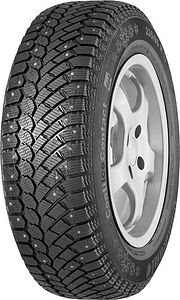
On ice, the ContiIceContact tires are excellent. Acceleration and braking are the best in the test, and the balance of snow and ice handling on the ice track is as if you're driving a four-wheel drive car.
On snow, the tires are also good, only the not always appropriate slight tendency to oversteer of the rear axle did not allow to get the highest score for handling reliability.
On asphalt, the coupling properties are at a medium level. At the first impulse, the tires respond sluggishly, but then they hold the loads well. The sound accompaniment during such maneuvers is very intrusive, the tires are quite noisy even on a straight line, and in turns, the hum intensifies.
These tires hold impact perfectly. And the studs in them hold up to the end.
Surface traction Handling on ice and snow Braking on dry asphalt
Traction properties on wet asphalt noise level high price
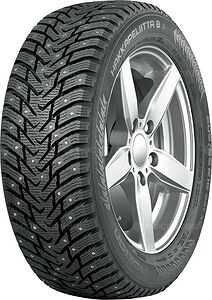
On the handling track - the best time, driving a car is one pleasure. The advantage over ContiIceContact tires is slight, and in terms of acceleration dynamics, Continental tires are even better.
On snow, Nokian tires are traditionally good: precise and timely reactions to the steering wheel and gas. On asphalt, the behavior is unstable. On dry pavement, the tires provide good deceleration, and on wet - the longest braking distance.
The "humming" sound from the studs does not leave the cabin at all speed ranges.
Traction properties and steering on ice traction properties on snow traction properties on asphalt
moderate snow handling ratings
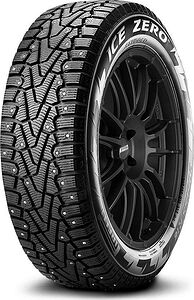
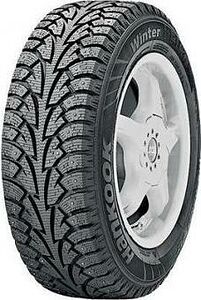
The tread of the tire has only 96 studs with a standard offset, but on ice, these tires are better than many tires that have 130 studs. On the handling track, it's third in time, but the gap to the leader is less than a second. Slides are small and easy to control.
On snow, the behavior is worthy, although on the handling track, abrupt skids interfere. On wet asphalt, the braking distance is minimal! At the same time, the tires are not very loud and softly "swallow" bumps.
In general, well-balanced winter tires that work confidently on country roads and are almost ideal for city use. And the price looks reasonable.
Braking properties on ice Braking properties on wet and dry asphalt
Moderate handling performance on ice and snow noise level
Tires are recommended primarily to those who drive in winter mainly on snow-cleared city streets.
As for longitudinal dynamics on ice, the tires are almost on a par with the test leaders. On the handling track, sharp skidding into sideways skids were noted.
Similar behavior is observed on snow, but here the coupling properties in the longitudinal direction were at an average level.
On asphalt - good deceleration, both on dry and wet surfaces.
Ride smoothness is good, but there is a lot of noise - the hum is audible even when moving on rolled snow.
Insufficient resistance to slash penetration low impact strength
Overall, very comfortable winter tires that are best used on city streets.
Worthy tires, with a pronounced family feature of Michelin tires - high stability on slippery roads and soft, understandable transient processes. However, the skids themselves last a bit longer than desired.
This was also evident on asphalt: prolonged skidding prevented a high-speed overtaking maneuver. There were no problems with braking, the level of comfort is above all praise: these are the softest and quietest tires in the test!
They would still benefit from a stronger sidewall, as the thin rubber tears when hitting an obstacle at a speed of 40 km/h, while most tires hold up to 50 km/h, and some remain intact even at high speeds.
Braking properties on ice and snow Traction properties on wet and dry asphalt.
ice handling snow towing capabilities
Tires are recommended for use on vehicles without electronic stability systems.
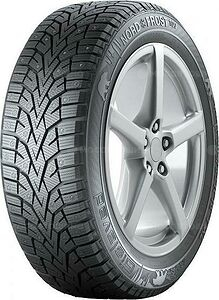
The achievements in the test are not as impressive as in last year's test. The possible reason is the lower quality of the tread. Most of the spikes are excessively recessed into the tread - a protrusion of 0.9 mm versus 1.2-1.3 mm for competitors. The tires lag significantly behind the leaders in both acceleration and braking on ice.
On the handling track, the lag behind the leaders is generally out of decency. UltraGrip Ice Arctic tires used to work better in the longitudinal direction than in the transverse direction, and now the imbalance has worsened - the car holds very poorly on the arc!
On snow, the situation with handling is better, but there are problems with acceleration. On asphalt, it's at the level of mid-range tires. The clattering of the spikes is almost inaudible, but the tread itself howls at all speed ranges.
The tires pleased with their resistance to impacts - third place.
Tires are recommended for those who mostly drive on cleaned asphalt roads.
In the overall rating, they lost to Goodyear by only 0.1 points.
Handling problems on ice: in the transverse direction, the tires hold noticeably worse than in the longitudinal direction. It's difficult to drive a car on a winding track due to sharp, unexpected skidding.
On snow - the minimum braking distance! At the same time, acceleration and handling are just as "sluggish" as on ice.
On dry pavement - the minimum braking distance and the maximum speed of the turn. The car responds clearly and quickly to steering wheel turns. However, there is a side effect - increased stiffness when passing small irregularities.
High impact resistance High cut-resistance Traction and handling over asphalt.
Traction properties on ice and snow
Handling on ice and snow
Comfort
Quite modest coupling properties both on ice and on snow. Handling also leaves much to be desired.
On a snowy-water porridge, the tires float later than others. And on asphalt, they work perfectly: when rearranged, the reactions are fast and accurate.
The puncture-resistant sidewalls pleased. But a more durable sidewall is also more rigid, which has not had the best effect on the smoothness of the ride.
The model will surely find its not-so-wealthy buyer, especially in the outback - where tires are often changed due to punctures received.
Traction properties on ice and snow
low resistance to slashplening
traction properties on wet asphalt
Most of the studs barely protrude above the tread level. On ice, such studs, of course, do not work - the car skids menacingly both when braking and turning. But at the same time, it receives a decent rating for handling reliability: the limit of coupling properties is felt well, the breakdowns are soft, there is a successful balance of understeer and oversteer.
The tires were unable to shine on snow, where the studs do not play a big role. The tread poorly copes with drainage functions - on slush, they float up earlier than others. They also work poorly on wet asphalt, on dry asphalt, everything is more or less in order.
The model is twice as cheap as Nokian - this argument sounds stronger than safety arguments for many.
ice traction properties ice and snow handling low comfort level
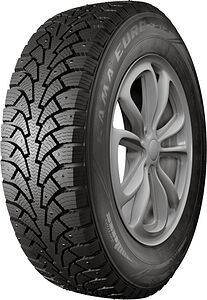
Russian KAMA EURO 519 tires are not yet able to compete on an equal footing with imported counterparts. Longitudinal coupling properties on snow are promising, but on the track, all hopes for handling disappear. It's hard to "fuel" the car in a turn, so you need to slow down more before each one.
Skidding is poorly predictable and poorly controlled. There are also problems with braking on ice.
On asphalt, the tires work at an average level. When performing sharp maneuvers, the reactions to the steering wheel are "smudged". On uneven roads, these tires are one of the stiffest.
In the test, the tires took last place. If the manufacturer establishes control over the quality of tread, it will be possible to claim higher and no less honorable places.