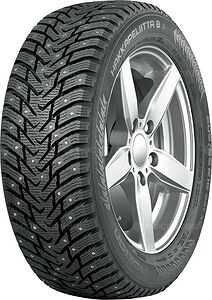
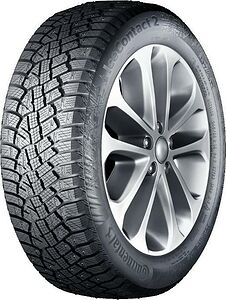
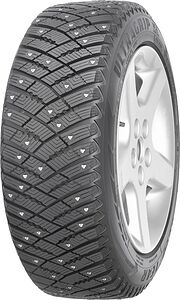
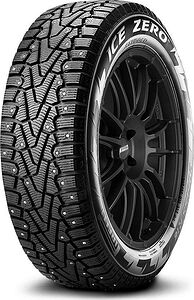
Beautiful tires for winter surfaces, but for large cities where even in winter cars usually drive on asphalt, it's better to choose something else and save money in the process.
The advantage of tires on ice is obvious: with their 190 spikes digging into the ice, they provide a minimal braking distance and the best acceleration dynamics. The directional tread works well on rolled snow, although when moving from a standstill in loose snow, the tires do not grip as well as one might hope. On dry asphalt, the soft tread (the lowest rubber hardness among studded tires) cannot handle high loads, noticeably increasing the braking distance. The impression of driving on asphalt is also spoiled by the loud hum of the spikes. They may be lightweight, but there are so many of them...
Tire traction on ice and snow, steering on ice, smoothness of ride
noise high price
If you're choosing studded tires for urban use, considering that the "glued" studs hold perfectly in place, these tires are a great choice. Unfortunately, they are also quite expensive.
Now, this tire also features 190 studs! However, they are different here: also lightweight (only 0.7 grams), but with rectangular hard alloy inserts. The main technological difference is that they are mounted on glue. By the way, the same technology is used in Kaluga, where IceContact 2 tires are produced with fitment sizes from 14 to 18 inches. On ice, when braking and accelerating, the tires work slightly worse than Hakka 8. But in turns, the difference is barely noticeable. On snow, it's a tie, and on asphalt - both wet and dry - these tires are preferable. And in terms of comfort, they win.
Traction on ice and on snow, traction on wet asphalt
ice and snow handling performance
Good winter tires - both for the city and for the village. They are not as worse as they are cheaper than the first two.
Tires from two years ago had 130 studs per running meter, and now their number has been reduced to 100. It's amazing that now, against the background of competitors, the tires look even better. Perhaps due to higher-quality and reworked stud distribution: previously there were 14 rows, and now there are 20. On ice, the tires slightly lose to the test leaders. Skidding on the handling track is still sharp and poorly predictable. On snow, the aggressive tread pattern works great in the longitudinal direction, providing a minimal braking distance on rolled snow and good traction on "powder". On asphalt - decent grip and acceptable comfort level.
Suitable tires for icy poorly cleaned roads. For city driving, they will also do - if the car has good sound insulation.
The small print "made in Russia" marking is lost among other inscriptions on the sidewall. But the Russian origin of the tires should not scare off buyers. The recently modernized plant in Voronezh produces high-quality tires, and this fully applies to the factory studs: on ice, tires with figured studs are on the heels of the test leaders. However, they give up positions on rolled snow, especially on the handling track, where the lag behind the leader is more than three seconds on a one-and-a-half-kilometer circle. But how great the tires are at plowing through deep snow - the best of all! Deserved grip on asphalt, especially on wet. But here's another problem: a loud, intrusive hum.
Traction properties on ice and snow Tractability Traction on wet pavement
traction properties on dry asphalt insufficient level of comfort
For snow and ice - that's what you need, but for city driving - not the best option.
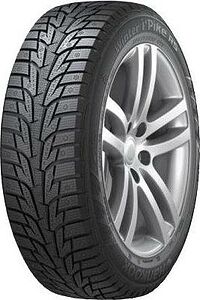
Hankook company has taken a bold approach to quality - and this applies to both summer and winter tires. By luring European specialists away from Korean automakers, the tire makers have achieved minimal lag behind the leaders of our test. The number of "figurative" spikes has been increased to 170, and at the same time, control over the quality of spiking has been strengthened. When braking on ice - the second result! Only Hakkapeliitta 8 is better. The grip properties on snow are also good. It remains to improve handling: on both ice and snow, the reactions lack clarity, especially when entering a turn. On asphalt, the tires are not impressive; there are claims to both noise and ride smoothness, but the main drawback is weak deceleration during emergency braking on dry pavement.
Good tires for out-of-town use, and considering the price, they are a worthy alternative to expensive imported tires.
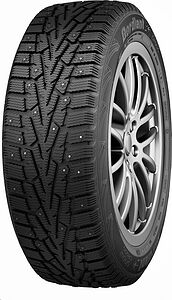
The tread pattern of these tires almost copies the Hakkapeliitta 7 tires. But what's more important to us is that the tires work, and they do! On ice, the traction properties are not bad, and on rolled snow, the dynamics of acceleration are even better. However, on loose surfaces, the tires do not justify their name. And on asphalt, the traction properties leave much to be desired. Perhaps this is also due to the increased protrusion of the studs, which exceeds European standards. There were even concerns that the studs protruding 1.5 mm from the tread would come off after the summer part of the tests. No, they held up. And last winter, during our expedition to the Urals on cars equipped with Snow Cross tires, we lost only one stud per set.
Traction properties on snow traction properties on asphalt.
Traction Handling on ice and snow
A decent option for winter tires for use in major cities.
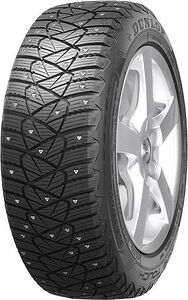
Created using the same technologies as Goodyear tires and produced at the same Polish factory, these tires are a more "sporty" version of winter tires - and are primarily focused on driving on cleared roads. On pure ice, rolled snow - these tires are only slightly worse than Goodyear's when accelerating and braking. However, when cornering, the behavior of the car becomes nervous and poorly predictable. In deep snow, the tires are completely helpless. However, on dry asphalt, Dunlop tires are among the best, and among studded tires, they are the best. And in terms of acoustic comfort, they are preferable to Goodyear.
Traction on asphalt acoustic comfort in studded tire class
traction properties on ice in the class of studded tires passability
Overall, in terms of price and quality, it's a decent choice. It's like a budget version of Nokian.
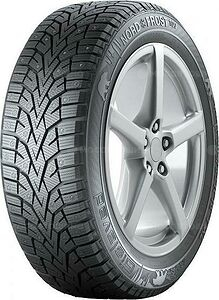
The tires are produced in the same molds as the Hakkapeliitta 5, but with simpler materials, regular, "round" studs - but the prices are lower. The ice and snow traction is worse, although in some disciplines, Nordman is ahead of the latest generation of Nokian tires - for example, it's easier to drive on winding icy roads with Nordman tires. And they work better in deep snow. They performed decently on wet asphalt, although they didn't perform well on dry pavement.
Traction properties on ice in the class of studded tires
traction properties and handling on snow
The key advantage is that they are twice as cheap as the leading tires.
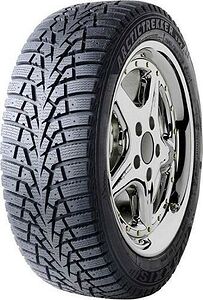
Maxxis are perhaps the most popular Chinese tires on our market, presented in a wide range of models and sizes. But this, alas, is not an indicator of quality. Already during the preparation for the tests, we noted an extremely low quality of stud: the studs are installed crookedly, and the runout varies from 0.4 to 1.4 mm. It's no wonder that on ice, the car accelerates and brakes poorly. And on the ice handling track, it goes slower than on some studded tires. On rolled snow, the coupling properties are also low. But you can get out of the snow virgin land.
Traction properties on ice and snow
Steering on ice and snow
Traction properties on asphalt
Not recommended.
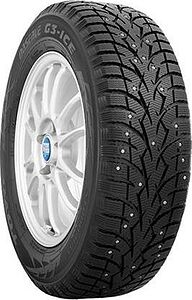
Everything could be attributed to the smaller number of spikes. On the other hand, Goodyear tires with equally "poor" spiking handle their direct duties much better. And Toyo tires slip. Both when accelerating and when braking. And especially when cornering - driving on a winding icy track is frankly scary! On snow, the picture is no better: sluggish acceleration, ineffective braking, and sluggish skidding in corners. But the most annoying thing is that Toyo tires performed mediocrely on asphalt, especially on dry roads. And the final touch to the bleak picture was that the tires easily lose their spikes.