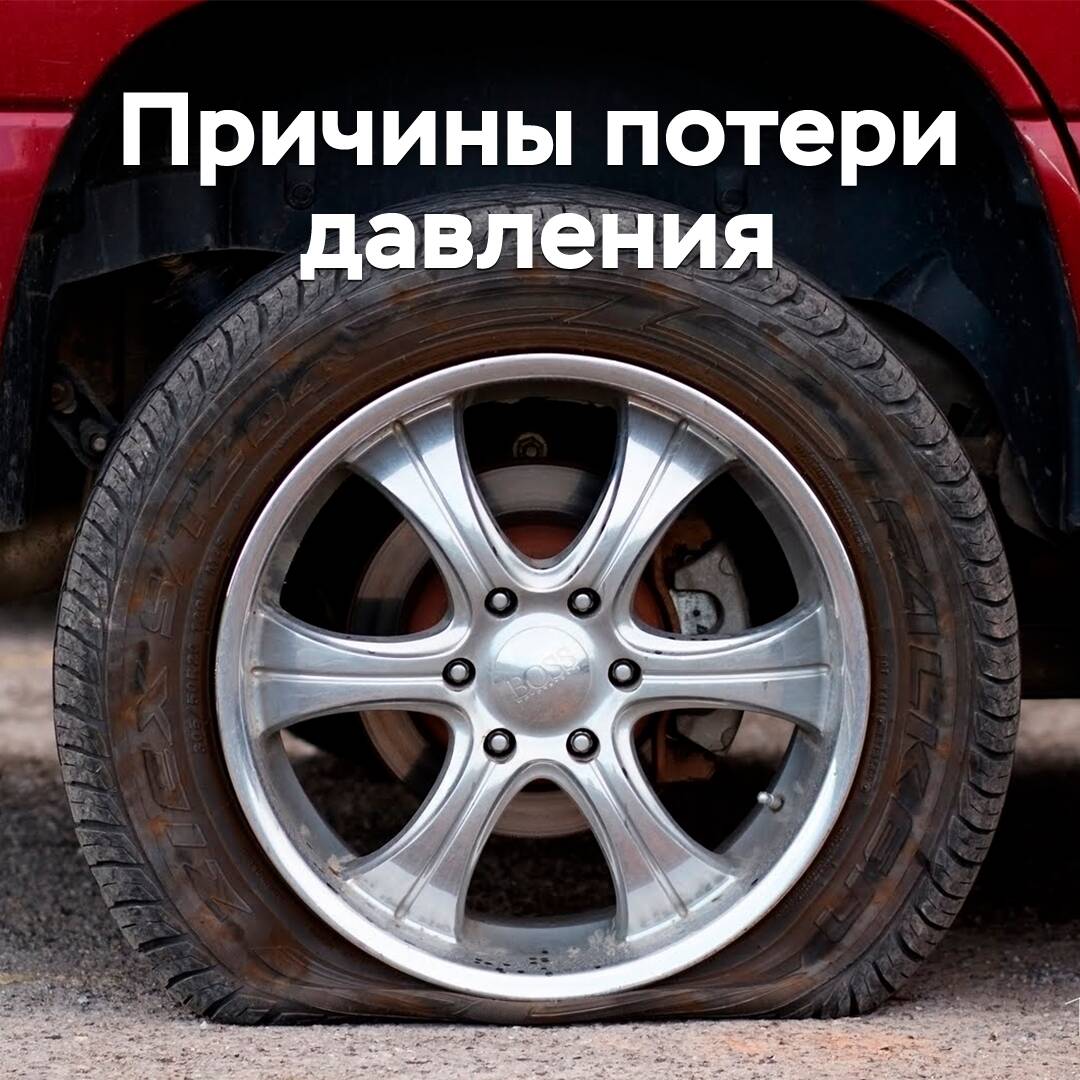
Causes of pressure loss
Sooner or later, all car owners face the problem of pressure loss. That's why you shouldn't start driving without inspecting your vehicle, namely, without visually inspecting the tires for pressure loss. Otherwise, you may encounter a complete tire failure and unforeseen expenses. Today, we'll break down the main reasons for pressure loss.
⠀
A simple puncture.
Many are puzzled by the huge number of screws on the road. It seems like someone is deliberately scattering them. Of course, it's not that simple. Some car elements are attached with simple screws, and their gradual loss is a natural process. If you've driven over a screw, the pressure loss doesn't happen immediately, but gradually. Often, the screw that made the puncture holds firmly to the steel breaker layers of the tire, thereby maintaining the pressure, allowing for a gradual air leak. When you find a screw, don't try to remove it yourself, as the air will escape from the tire in less than 1 minute. Drive to a tire shop and have a quality repair done.
Valve problems.
The valve is the most important element of the wheel assembly, and it's responsible for reliably maintaining the pressure in the tire. Since it's made of rubber, and the composition of this rubber is much simpler than the complex rubber mixture of the tire, it cracks and becomes useless much earlier. Thus, pressure loss through a faulty valve is a perfectly expected process, especially if you have two sets of tires on rims and don't replace the valve with each tire change before the corresponding season.
Damage to the sealing layer.
This component of the tire is also responsible for maintaining air and replaces the camera in tubeless tires. If you've ever driven on a tire with low pressure, it can lead to cracking of the sealant layer and loss of its sealing properties.
Of course, you shouldn't forget about natural air loss.
The tire gradually loses pressure. This can be exacerbated by sharp maneuvers, accelerations, and braking. Pay attention to the pressure and remember that a loss of 0.2-0.3 bar is extremely difficult to determine visually. To do this, it's useful to have a pressure gauge in your vehicle.