
When to change tires?
The snow is melting rapidly, and many have already switched to their spring wardrobe. There is a great desire to change tires, but there is no need to rush. Today, we will discuss the seasonal issue and answer why you shouldn't rush to change your tires to summer ones.
As we have already written, all-season tires are optimal for the spring-autumn period. Yes, as paradoxical as it may seem, but the tires that we often criticize for their inapplicability have an ideal ratio of characteristics, especially in the off-season. At the same time, they significantly lag behind summer and winter tires in the summer and winter periods, respectively. In the graph below, we have visually demonstrated that winter tires perform excellently in the winter period, but at the same time, when passing the approximate temperature threshold of +7°C, they significantly lose traction. Summer tires, on the other hand, have unbalanced characteristics in the winter and summer seasons, but they perform excellently in the transitional period.
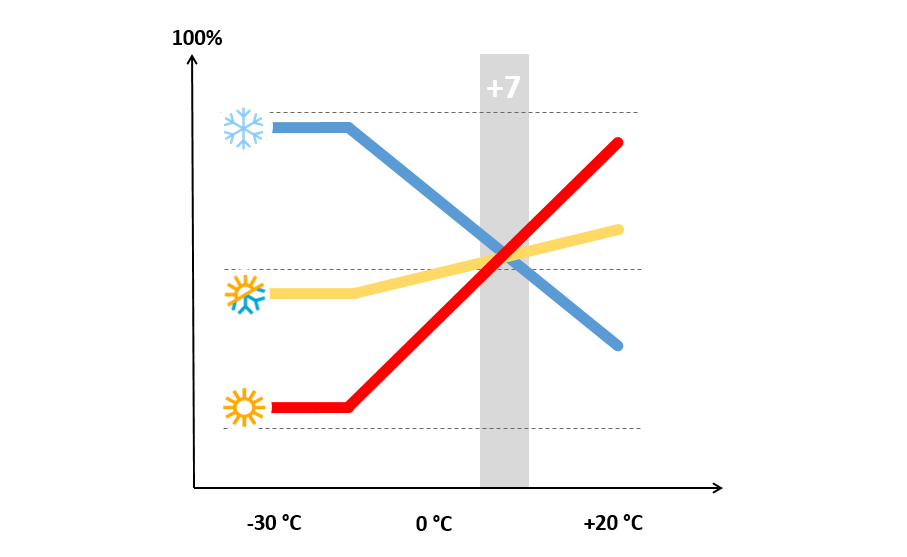
So, it is generally accepted that the optimal temperature threshold is an average daily temperature of +7°C, but it is essential to note that such a recommendation cannot be given for all regions. In regions with a sharply continental climate, it is often possible to encounter situations where after a stable warm weather for 7-10 days and almost complete drying of the roads, up to 20 cm of snow can fall, and if you have already changed your tires to summer ones, the only correct decision may be not to operate the vehicle.
When crossing the temperature threshold of an average daily temperature of +7°C on winter tires, it is not necessary to change them immediately. However, it is crucial to understand that tires become less predictable and noticeably lose their traction and handling properties. The tire change should be carried out when you are fully confident that there will be no precipitation. Nevertheless, the average daily temperature of +7°C should be used as a guideline.