
-
 Enlarge
 Ярославль Я-710
Description Ярославль Я-710
Summer passenger tire Yaroslavl YA-710, produced by one of the oldest Russian manufacturers of automobile tires, is designed for small-class passenger cars.
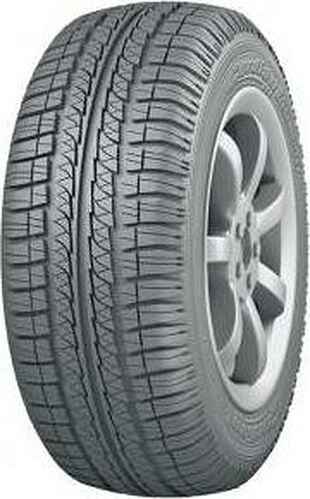
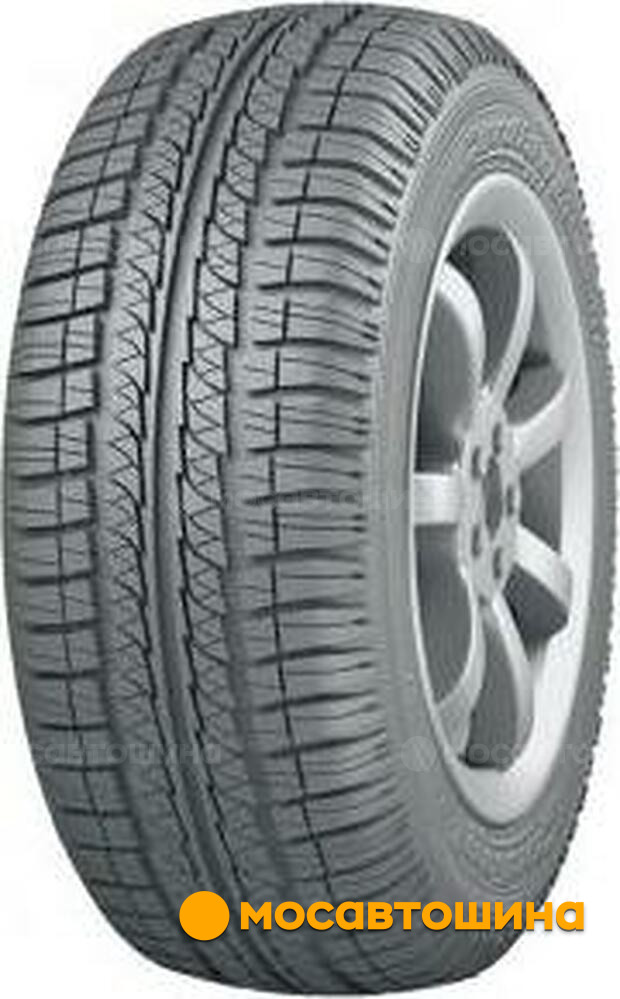
The symmetrical non-directional tread pattern of the tire has an original structure. The tread pattern consists of four ribs located in the center of the tread and two wide shoulder zones. The two central ribs are divided by a very wide water drainage groove. In addition, these two ribs are distinguished by a solid, uninterrupted structure throughout the tread. This solution allowed not only to significantly improve the tire's resistance to aquaplaning but also to significantly improve the directional stability and maneuverability.
The other two ribs, also located in the central part of the tread, have a very original structure. Each rib consists of two rows of separate blocks with a triangular shape. This solution allowed, on the one hand, to provide excellent traction with a dry surface due to the large contact area, and on the other hand, to improve the efficiency of acceleration and braking.
The design of the shoulder zones of the tire YASHZ YA-710 tread can undoubtedly be considered its distinctive feature. The shoulder zones of the tread consist of two rows of separate blocks divided by a longitudinal water drainage groove. This solution has many advantages. Firstly, the large width of the shoulder zones significantly improved traction, both during straight-line movement and when cornering. And secondly, the sharp edges of the large number of blocks that make up the shoulder zones improved the basic operational characteristics when moving on surfaces with different friction coefficients.
Distinctive features of the Yaroslavl YA-710 tire
- Excellent traction in various conditions is provided by the original design of the non-directional symmetrical tread pattern;
- Excellent fuel economy due to low rolling resistance, provided by the high density of the tread pattern elements;
- High resistance to aquaplaning, thanks to three deep and wide water drainage grooves, which ensured stable and safe movement even on very wet roads.