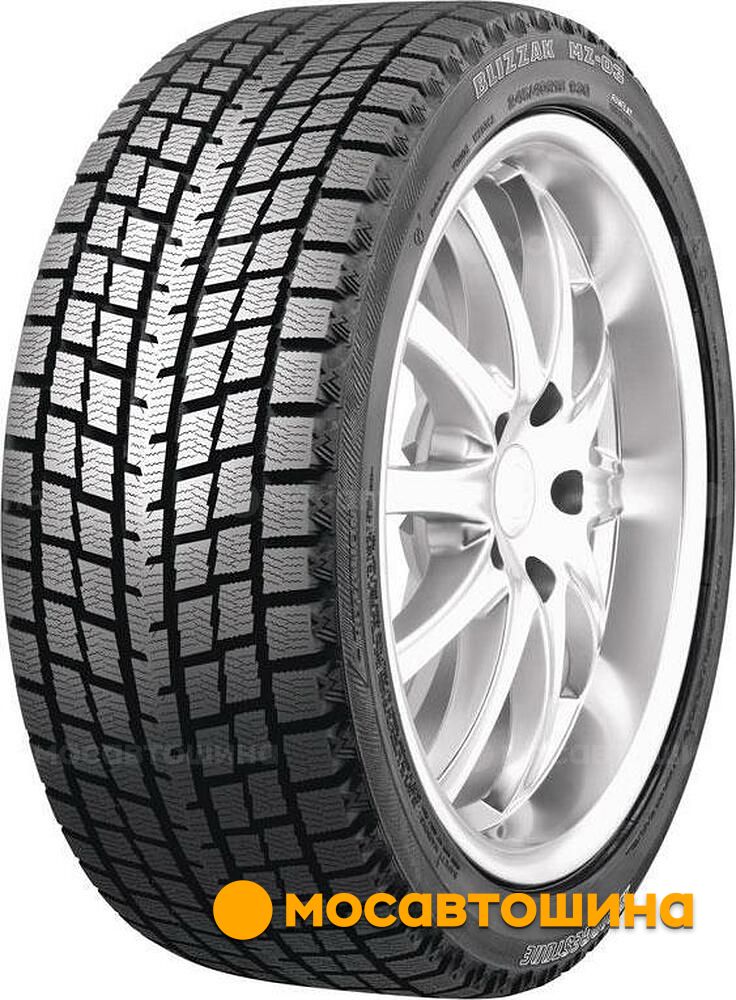
The Bridgestone Blizzak MZ03 winter tire is a so-called "friction" model, designed for use in regions with very cold climates. On snowy and icy surfaces, it demonstrates increased traction and grip properties, along with the ability to slow down intensively in such conditions and provide comfort while driving.
The tread pattern consists of a large number of small blocks. The numerous edges formed by these elements increase the tire's performance on snowy surfaces, allowing for intense acceleration and braking in such conditions. In the central part, the blocks form a continuous longitudinal rib, which increases the stability of grip at high speeds, reducing rolling resistance. It is worth noting the mutual arrangement of elements with a certain step, which further enhances these properties, adding to them a low noise level, an simplified process of controlling the movement trajectory, and a noticeably slowed process of abrasive wear of the tread. Efficiency on more slippery icy surfaces is supported by the use of several thousand lamellas, cut into all, without exception, tread blocks. The sharp edges formed by them easily penetrate the water film, increasing traction and braking properties on icy surfaces. The performance of these elements is significantly improved due to the use of a "winter" rubber compound in the manufacture of the tread. Due to the high content of silicon dioxide in its composition, the tire remains elastic even at extremely low temperatures.
Key features of Bridgestone Blizzak MZ03:
- a large number of small blocks provides excellent traction and stability on snowy surfaces;
- numerous 3D lamellas increase the reliability of control on icy surfaces, forming hundreds of sharp edges in the contact patch;
- an optimized tread profile and block arrangement with a certain step increase the useful area of the tread, improving grip on dry surfaces, reducing fuel consumption and noise;
- a rubber compound resistant to the effects of low temperatures enhances grip properties on slippery winter surfaces
 Enlarge