Tyres and wheels for Maruti Swift, wheel size on Марути Свифт
Подбор шин и дисков по автомобилю Марути Свифт
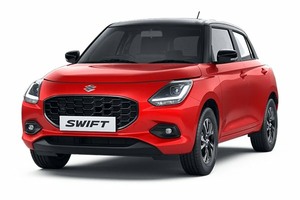
Другие модели Maruti
Maruti 800, Maruti A-Star, Maruti Alto, Maruti Alto 800, Maruti Alto K10, Maruti Baleno, Maruti Brezza, Maruti Celerio, Maruti Celerio X, Maruti Ciaz, Maruti DZire, Maruti e Vitara, Maruti Eeco, Maruti Ertiga, Maruti Esteem, Maruti Estilo, Maruti Fronx, Maruti Grand Vitara, Maruti Gypsy, Maruti Ignis, Maruti Invicto, Maruti Jimny, Maruti Omni, Maruti Ritz, Maruti S-Presso, Maruti Stingray, Maruti Super Carry, Maruti Swift, Maruti Swift DZire, Maruti Versa, Maruti Victoris, Maruti Vitara Brezza, Maruti Wagon R, Maruti XL6, Maruti Zen, Maruti Zen Estilo,Параметры дисков на Марути Свифт
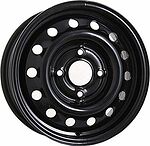
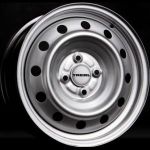
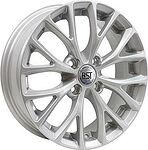
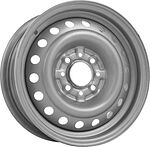
- PCD 4x100 диаметром от 14 до 15, шириной от 5 до 5 и профилем от ET40 до ET45как у Acura Integra

Tires on Maruti Swift
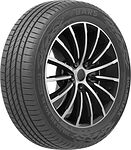
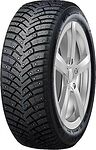
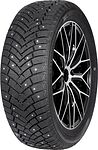
- Tyre size from R14 to R15, width from 165 to 185 and profile from 65 to 80.
- Minimum tyre size: 165/80 R14, maximum: 185/65 R15







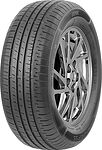
Tires on Maruti Swift (Марути)
The subcompact hatchback "Maruti Swift" has been present in the brand's production lineup since 2005, becoming one of the most popular models in its segment on the Indian market. Despite unification with the Suzuki namesake, it has gradually evolved into an independent product, differing in chassis settings, engine range, and equipment. This was due to the need to adapt the original concept to the specific features of the Indian automotive market, where affordable cost, low operating costs, and high liquidity in the secondary market are highly valued. The hatchback was able to retain, perhaps, the key feature of the original Suzuki model, which was distinguished by its "light" character in handling.Localization of the Japanese concept
The debut version of the model was a localized copy of the "global" Suzuki Swift of the second generation, adapted to the realities of the Indian market through changes in equipment. In contrast to the European version, the emphasis here was on economy and spaciousness, as well as compliance with local legislation, which tied the provision of tax benefits to the length of the car. For the same reason, "atmospheric" gasoline engines of the G series were found under the hood. The base 1.3-liter engine developed 87 hp and 113 Nm of torque, combined with a 5-speed manual transmission. Later, a 1.3 DDiS diesel engine developed jointly with Fiat appeared. The turbo diesel produced 75 hp and 190 Nm, providing extremely low fuel consumption even by the standards of the compact segment.
An important difference was the chassis settings, in which softness and an increased range of damping prevailed. This provided the hatchback with comfort on roads with broken asphalt, largely at the expense of handling.
More space and practicality
In 2011, Maruti introduced the second generation of the model. Despite retaining the recognizable silhouette, the body structure was significantly revised. The wheelbase increased to 2430 mm, thanks to which there was more space for rear passengers. Compared to the Japanese and European Suzuki Swift, the Indian version again differed in the set of equipment. In particular, the multimedia and climate installations were simpler, and the list of electronic assistants was noticeably more modest. This allowed the cost of the car to be kept at a level where it remained an attractive alternative to the Hyundai Grand i10 and Ford Figo.
The second factor in popularity was the salon. The front console had a protrusion facing the driver. The trim used higher-quality plastic than before. In the top versions, a multimedia system with a 7-inch touch screen, a engine start button, and climate control appeared.
Under the hood was a new 1.2-liter gasoline engine of the K12 series, producing 86 hp and 114 Nm. The diesel engine, after a cycle of modernization, retained its previous power and torque indicators but became much quieter, generating less vibration. In addition to the 5-speed "mechanics," a robotized version of it appeared in the list of transmissions. In terms of the chassis, the hatchback still stood out for its large profile of standard tires, changed stabilizers of the transverse section, and other damping elements, which ultimately allowed increasing the energy intensity of the suspension and ground clearance.
Transition to the Heartect platform
The next generation debuted in 2018 and became one of the most important updates in the model's history. The Heartect platform, already familiar from modern compact Suzuki models, was used as the basis. Due to the widespread use of high-strength steels, it was possible to reduce the body weight and increase the rigidity of the structure. The car again received individual features relative to the global model. The Indian version had a simplified safety structure in the basic configurations, and the equipment was adapted to the competition in the domestic market. Some systems available in Europe, including advanced electronic assistants, were absent for a long time.
The body design became noticeably more aggressive. The front part received a large radiator grille and elongated optics, and the rear door handles moved to the body pillars. Despite the compact size, it became more spacious inside thanks to the redesigned salon architecture. In the engine range, a modernized 1.2-liter gasoline engine of the K12 family appeared, producing 90 hp and 113 Nm, working in pair with a 5-speed mechanics or its robotized version. Later, a hybrid SHVS system with a starter-generator appeared, allowing to reduce fuel consumption in the urban cycle. On the road, the third-generation model differed in much greater cohesion due to the increased rigidity of the body and the reduction of its mass. This was combined with the "signature" settings of the suspension with an emphasis on smoothness for the Indian version.
"Digitalization" and new electronics
The current generation was presented in 2024. It became an evolution of its predecessor, being created on the same platform but in a modified version, allowing the use of new engines and electronic systems. Under the hood, an in-line "trio" with a volume of 1.2 liters of the Z12 family appeared, producing 82 hp and 112 Nm of torque. Depending on the configuration, a 5-speed manual transmission or a robotized transmission is used. Its appearance was largely due to the need to comply with new environmental requirements, implying a reduction in fuel consumption and the amount of harmful emissions.
Together with the updated platform, more electronic systems appeared in the car. First of all, this is multimedia with a 9-inch screen, a "digital" instrument panel, and cameras with a circular view. However, in terms of equipment, the hatchback still conceded to the "global" Swift, including in terms of active safety systems. But this allowed preserving one of the key advantages of the model — low operating costs. In particular, it is for this reason that the "factory" configuration included disks with a diameter of 14 to 16 inches with tires in the size of 165/80, 185/65, and 195/55. For a compact hatchback with a relatively light body, it is especially important to correctly select tires by the level of rolling resistance and comfort, so the assortment of the "Mosavtoshina" online store allows you to choose the optimal kit for any operating conditions.
Advantages of selecting tires for Maruti Swift on our website:
- The assortment constantly includes tires for subcompact models, allowing to enhance certain driving qualities;
- A wide selection of disks provides an opportunity to choose the optimal combination, both with the technical features of this car and with its aesthetic properties;
- Discounts and special offers allow you to profitably purchase wheel products, both for new and regular customers;
- Specialists will help with the search for wheel sets for this hatchback, offering optimal options.