Choosing Tires for SUVs
Tires for SUVs or as they are commonly referred to as "SUVs" have their own characteristics and when choosing, this should be taken into account. Today, we will discuss some nuances of choosing tires for crossovers and SUVs.
Markings
It's not worth choosing tires based on signs like the "SUV" or "4x4" prefix. This is already an outdated marketing ploy and nothing more. Some manufacturers have long since moved away from markings that denote SUVs. The reason for this is the blurring of this segment to enormous sizes. It's already impossible to say exactly what a crossover is. Many consider the Hyundai Creta to be a full-fledged crossover. There are reasons for this, but at the same time, this car cannot be put in the same row as the Chevrolet Tahoe or Toyota Land Cruiser. That's why, by putting a marking of belonging to the SUV segment on a tire, the manufacturer greatly limits itself. That's why many have stopped doing this. All you should pay attention to is the size, speed index, and load index. If these markings are in order and are recommended for your car, then you can install them.
Directional Stability
Crossovers and SUVs have one fundamental difference from passenger cars, which is a high center of gravity. This is the main challenge for tire manufacturers. Ensuring safe directional stability for a heavy vehicle body with a high center of gravity is extremely difficult. That's why you should pay attention to the number of carcasses in the tire. As a rule, all tires have a DOT marking if this marking is present, then the composition of the sidewall is indicated on the sidewall, namely the number of layers. Sometimes, even for crossovers, a single but thicker carcass can be used to provide a load index. As a rule, double carcasses provide the best directional stability. Pay attention to this.
Inertia when Braking
Experts from the Polish automotive magazine "Motor" conducted an interesting test. They tested tires in the size 215/60 R17. What's interesting is that they tested the braking distance on both dry and wet surfaces at the same speed of 100 km/h. Pay attention to how the braking distance increases on new tires depending on the type of surface. 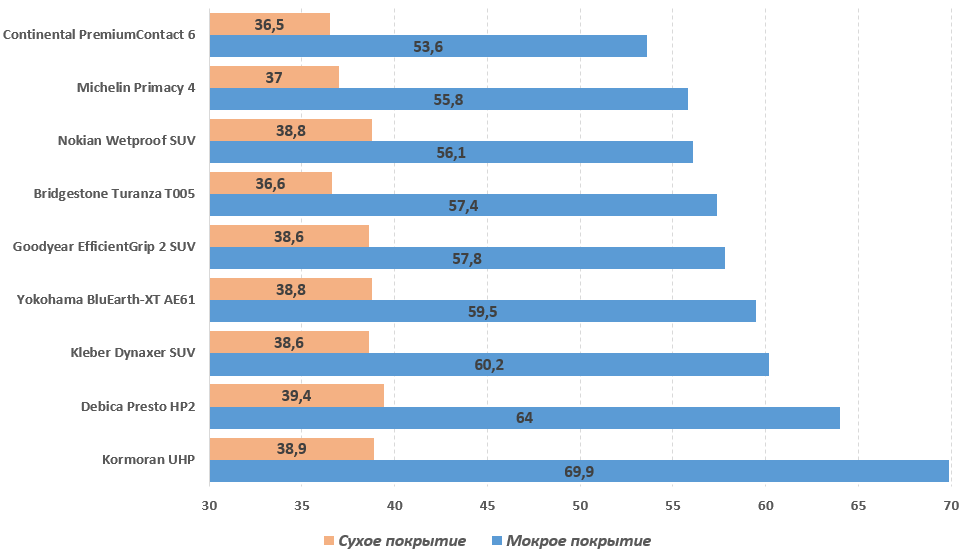
This perfectly shows the importance of adjusting your driving style depending on the weather. Additionally, you can't ignore the high weight of the vehicle and the inertia when braking. The combination of high weight, a higher center of gravity, and the type of surface can turn into a very dangerous cocktail. Also, you should consider tire wear. If the braking distance of a new tire is 70 meters, how can it increase with significant wear?