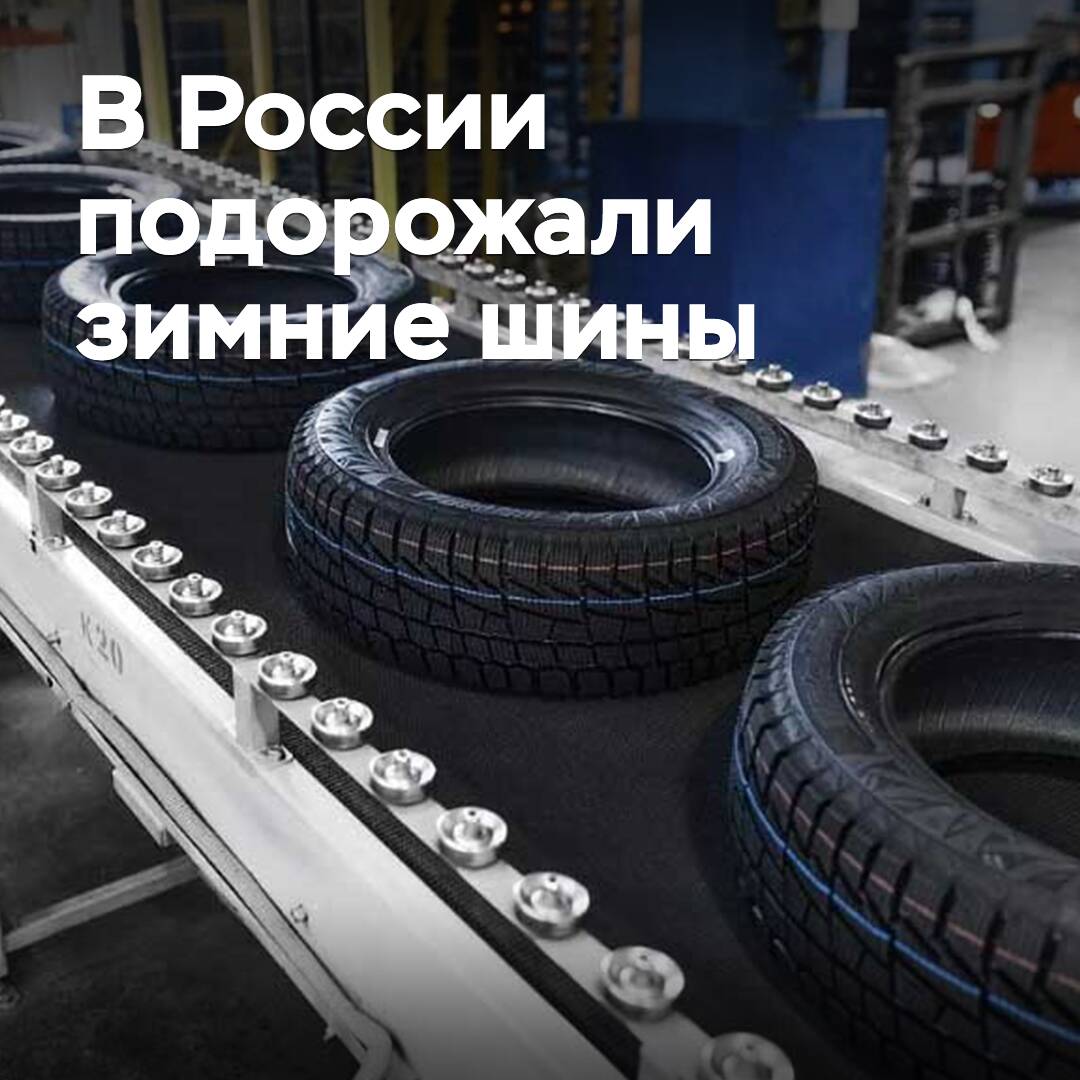
In Russia, winter tires have become more expensive
In October 2024, a decline in sales of winter tires was recorded on the Russian market: demand for friction tires decreased by 2%, and for studded tires by 7% compared to the same period in 2023, reports RBC with reference to the data of the CPRF (operator of the "Honest Sign" brand). At the same time, sales of summer tires increased by 18%, and all-season tires by 15%.
According to experts, the decrease in demand for winter tires is due, among other things, to the increase in their cost. "The main impact on the sales of winter tires is the increased cost of tires," said Egor Telegin, the operational director for service at Rolf (a car dealer who plans to launch its own tire production), while Roman Timashov, the director of after-sales service at Avtodom Altufyevo, added that "the decline in sales of winter tires may be due to the savings of some car owners who drive on worn-out tires".
The average cost of studded tires in October 2024 was 7,674 rubles, which is 16% higher than last year's figure. The price of non-studded winter tires increased by 13%, to 7,472 rubles, and summer tires by 12%, to 6,225 rubles. At the same time, all-season tires became 5% cheaper, to 6,639 rubles.
In October, winter tires accounted for 90% of sales, and studded tires remained the most popular (63%). In September, the share of winter tires was 67%, and non-studded tires became more expensive by 14%, to 6,776 rubles. The average cost of studded tires increased by 12%, to 7,688 rubles, summer tires by 10%, to 5,915 rubles, and all-season tires by 2%, to 7,137 rubles. In physical terms, sales of summer tires increased by 8% in September and by 18% in October.
Experts say that car owners are trying to save money when buying tires, and "such a purchase is often made not in the hot season, but in the quiet one". "Winter tires are looked for in the summer, and summer tires in the winter. This is due to the most favorable pricing for consumers during these periods. But the factor of increased prices affects the sales of winter tires, undoubtedly," Telegin noted.
Nikita Kulagin, the head of the macroeconomic analysis department at Sovcombank, adds that the growth in demand for summer tires in the fall is due to sales of remaining stocks and warm weather in October. As a result, according to the expert, "demand for winter tires may be realized to a greater extent in November".
In January-October 2024, the average cost of studded tires on the Russian market increased by 12%, to 7,544 rubles, and non-studded winter tires by 10%, to 6,587 rubles. At the same time, sales of tires of these two categories increased by 4% and 3%, respectively. In October, sales of studded and non-studded winter tires in monetary terms increased by 16% and 13%, respectively.
In Ikon Tyres, it is noted that in the current season, tires have become more expensive on average by 9-11% depending on the size, model, and segment, and the increase in prices is due to "the growth in raw material costs, the complication of logistics, and the general level of inflation, the exchange rate, as well as transaction costs associated with the import of raw materials and finished products".
In "Cordiant", they say that Russian car owners still prefer winter tires. "Three out of four sets of winter tires sold are studded; we do not think that this situation will change dramatically this winter," the company said, adding that "over the years, there has been a steady trend towards an increase in the share of non-studded winter tires in the country, associated with the improvement of road infrastructure and the development of technologies. However, studded tires continue to be a priority for Russians".
"Given the unpredictable and harsh nature of winters, car enthusiasts more often choose studded tires," Cordiant notes.
In Pirelli, they say that the weather factor affects the preferences of Russians: "If the winter is mild, demand for non-studded tires grows, if the winter is expected to be harsh, sales of studded tires increase". In addition, in the south, car owners more often choose friction tires, and in the north, studded tires, the company adds.
In October 2024, Russian factories produced almost 4 million tires (3.5 million in October 2023), and the volume of imports over the year almost did not change and amounted to 2.3 million tires (+0.2%). At the same time, in September, imports decreased by 5%, to 2.6 million tires, and production volumes increased by 5% and also amounted to almost 4 million tires.
As noted by Georgy Bozhydomov, the director of communications and sustainable development at the Russian division of Pirelli, the existing capacity in the country "allows to fully meet the needs of the domestic market, taking into account the volume of imports: a deficit is possible only for some rare and specific categories". Producers have already adapted to the new conditions, and a new import structure has formed. At the same time, since many Chinese car manufacturers have entered the market, Russian factories "are forced to reorient themselves to the production of new tire sizes that were not previously used or were rarely used on models of European, Japanese, Korean, and American production".
In the Pirelli press service, they add that the change in the situation on the car market "may be due to the limited offer in the segment of large-sized tires (20 and above)", and besides, currently, there is "a general shortage of studded winter tires for new Chinese cars".
In "Cordiant", they confirm that "the range of Chinese cars is developing very dynamically, and it is not easy to close all the needs of the market for new tire sizes": "The development of new tire sizes takes some time". "Some owners of Chinese cars will be limited in their choice," the company said, emphasizing that they "react as quickly as possible to changes in demand".
In a conversation with RBC, a representative of one of the unnamed Chinese car brands (the start of car sales in the Russian Federation is scheduled for the first quarter of 2025) noted that the company "is forced to prepare stocks of tires for its customers in advance, already now, since we are talking about rare tire sizes with a diameter of 20-21: customers should not face a shortage of tires in any development of events".
Russian tire companies say that there will be no problems with buying tires, since production in the country is growing faster than import volumes, and there are opportunities for expanding production. Currently, factories in the Russian Federation can produce up to 54 million tires per year, and in 2023, the capacity of the Russian market was 76 million tires.
"Many foreign factories that produced tires in Russia continue to do so, but under Russian brands. Therefore, the quality remains almost the same as that of imported tires, but prices are not subject to increase due to logistics from abroad. The population has the opportunity to switch to domestic production, which restrains price growth," Kulagin noted.
Auto expert Vsevolod Kushchinsky adds that "tire production has not grown, but has remained at the same level, but the market has become much smaller in terms of imported tires of familiar brands, and new manufacturers that have entered the market, Chinese and those produced in Russia, car owners mostly do not fully trust yet and prefer to buy used imported sets".