Best Summer Tires for Aquaplaning
How does aquaplaning occur?
During rain or due to poor drainage, water on the road surface can't be quickly drained from the contact patch by the vehicle's tires. This often happens when the vehicle's speed is too high for the tires to drain the water in time. As water accumulates in front of the tires, a water cushion is created, and the tires lose contact with the road, leading to aquaplaning. You essentially lose complete control of the vehicle.
Speed plays a crucial role: the higher the speed, the greater the likelihood of aquaplaning.
The consequences of aquaplaning can be catastrophic. Loss of control over the vehicle can lead to collisions with other vehicles, leaving the road, or overturning.
How to prevent aquaplaning?
While it's impossible to completely eliminate the possibility of aquaplaning, there are several ways to reduce the risk:
- Monitor the tread depth of your tires. The less tread depth, the lower the speed threshold for aquaplaning to occur.
- Reduce your speed. Decrease your speed on wet or flooded road sections, especially during or after rain.
- Maintain a safe distance: keep a safe distance between your vehicle and those in front of you. This will give you more time to react in case of aquaplaning by another vehicle.
- Follow the recommended tire pressure. The internal pressure in the tires counteracts the pressure of the water wedge that forms in front of the tire.
- Avoid deep puddles: try to avoid driving through deep puddles, especially if you're unsure of their depth.
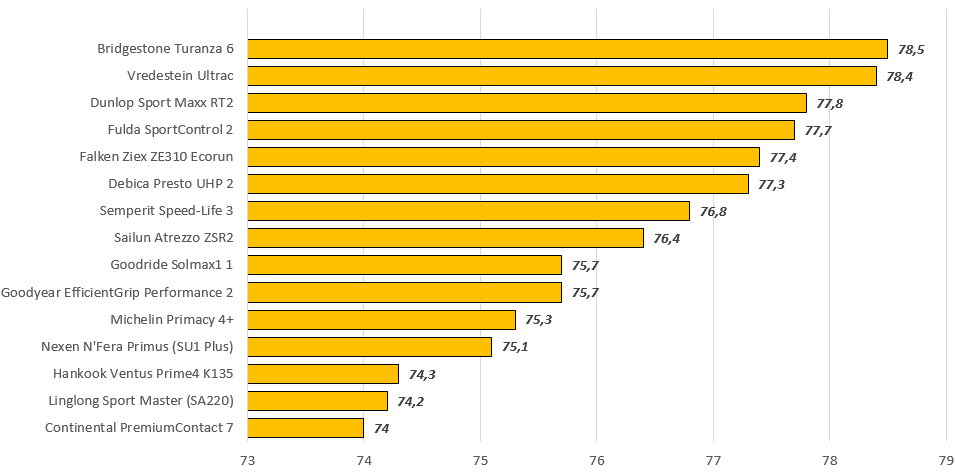
Top tires and the speed at which they lose traction on a flooded surface according to ADAC magazine
The results of the tested tires are shown below. It's essential to note that the speed at which the vehicle completely loses traction with the surface is indicated, i.e., becomes completely uncontrollable. It's logical to assume that if the best result is 78.5 km/h on a new tire, then on a tire with 50% wear, it may be twice as low. This once again proves the importance of reducing speed when driving on a flooded road.
Aquaplaning is a serious hazard on the road that can lead to accidents and injuries. However, with the right precautions and awareness of the risks, the likelihood of its occurrence can be reduced. Maintain the pressure in your tires, follow safe speeds and distances, and be careful on wet roads. Ultimately, road safety depends on you and your willingness to adapt to changing conditions.