
Winter Tyre Test from Tyre Reviews - 2024
The Tyre Reviews portal tested European-type winter tires in the 235/35 R19 size of six models, comparing their characteristics on snow, ice, wet and dry asphalt, as well as evaluating their noise and impact on fuel consumption.
The following were tested: Continental WinterContact TS 870 P, Goodride ZuperSnow Z-507, Goodyear UltraGrip Performance 3, Hankook Winter i*cept evo3, Michelin Pilot Alpin 5 and Pirelli P Zero Winter 2. In addition, in each test, the result of all-season tires was taken into account, which previously became the best in the test of tires of their class.
Characteristics on snow are of key importance for European-type winter tires, and in snow surface tests, Pirelli unexpectedly took first place, and the surprise, according to TR creator Jonathan Benson, is that Michelin usually dominates this part of the tests. Italian brand tires were the best in terms of traction and braking properties, as well as handling, Michelin also showed excellent results, and Hankook allowed the car to stop quickly and provided good controllability, but the traction effort was the lowest among the tested tires. Summer tires, naturally, work poorly in such conditions, and the unusually high results of all-season tires are due to the fact that these are the indicators of the Michelin CrossClimate 2, which works well enough on snow.


On ice, Michelin, Pirelli, and Hankook became the leaders, while Goodyear and Continental were at the bottom of the table. The fact that the "all-season" tires are in the first rows is due to the fact that this is the result of budget Grenlander Greenwing A/S, about which Benson said that "they almost certainly have a soft 'winter' compound that is not suitable for all conditions".
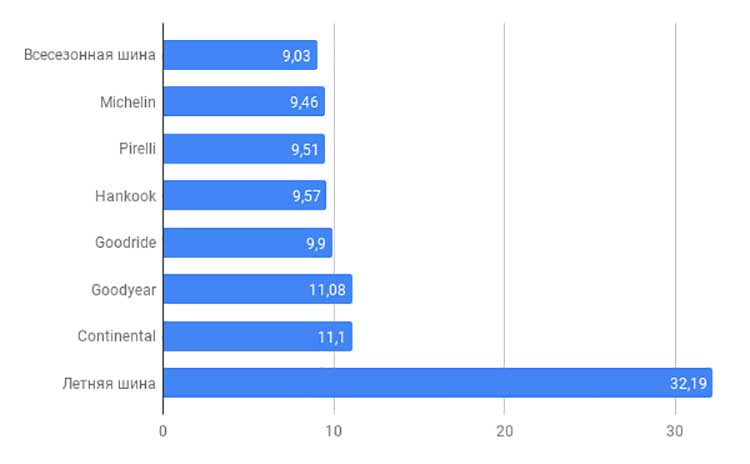

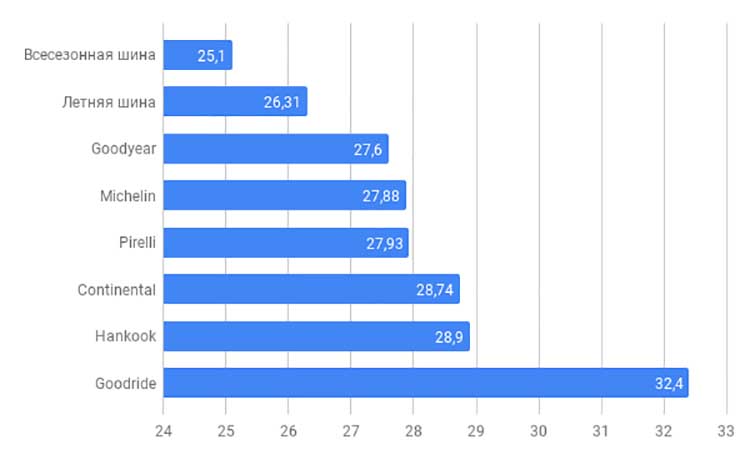
Braking distances on wet asphalt were measured in warm and cool weather, and here Goodyear showed excellent results, while Michelin and Pirelli were also very effective, and Hankook and Continental were slightly behind their competitors. In turn, Goodride from the Chinese ZC Rubber demonstrated very weak results.

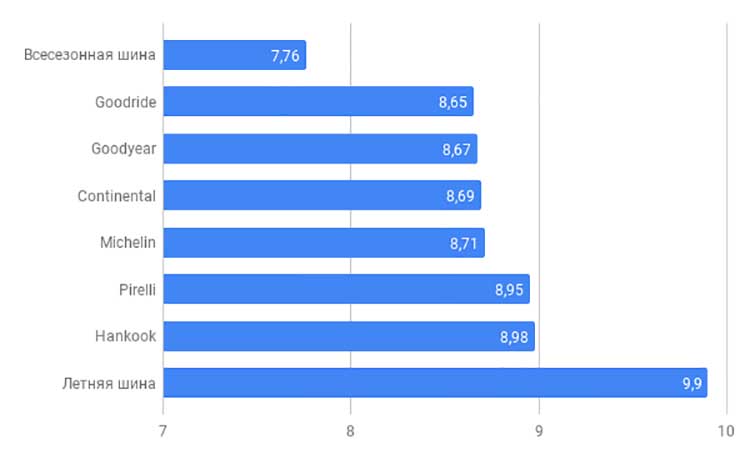
In the wet handling test, Pirelli rose to the first line, but Michelin and Goodyear conceded to them very little, and in general, all three tires have a good level of grip and behave predictably in rainy weather.

Pirelli also very effectively resist lateral aquaplaning, while the best resistance to longitudinal aquaplaning is possessed by Hankook.


On dry asphalt, all tires have good braking properties, and Hankook took the first line. In the handling test, the premium Pirelli, Michelin, and Goodyear were recognized as the best.


In terms of ride comfort and noise, the differences between the tires were also small, and Pirelli was the quietest, followed by Michelin and Continental.

Goodride tires were able to distinguish themselves with the lowest rolling resistance, but this is unlikely to be enough to compensate for the weak indicators in other disciplines.
Michelin and Pirelli shared the first place in the end, and while the former tires have a very good balance of characteristics in general and excellent handling on dry surfaces and smoothness of the ride in particular, the latter have higher grip on snow and equally balanced parameters. Goodyear took the third line, which stood out against the background of competitors with very good indicators on wet asphalt, but they have relatively weak grip on ice (it should be taken into account that these are European-type tires, and they are usually not tested on icy surfaces in independent tests).
Hankook, as the tests showed, work effectively on dry surfaces and resist longitudinal aquaplaning, but they have weak grip on snow, while Continental, which shared the fourth place with the Korean brand's tires, showed even results (if you don't count the ice) and provide good ride smoothness.
Finally, Goodride turned out to be the most economical among the tested tires, but they have long braking distances on wet roads, as well as low resistance to aquaplaning, and in general, according to Benson, they "left less pleasant impressions".

Source (including photos): Tyre Reviews.