Motor's 2024 Winter Tire Test
Compiling a list of participants in the new winter tire test, the experts at the Polish magazine Motor decided to include products from all segments to once again remind of the differences between tires of different categories. As representatives of the budget class, Debica were chosen, as well as one of the cheapest tires on the local market: Imperial and Zeetex (private brands of Belgian Deldo and Zafco from the UAE, respectively), produced in China.
In the mid-range segment, according to experts, there has been dynamic development in recent years, along with a significant improvement in product quality, and many manufacturers in this sector are striving to compete with premium brands. This year, the medium segment was represented by Falken, Nokian, and Yokohama tires. Finally, from the premium tires, Continental and Goodyear were taken. The tires were tested in size 225/45 R17.
List of participants:
Continental WinterContact TS 870
Goodyear UltraGrip Performance 3
According to Motor, organizing tire tests, especially winter ones, is a very difficult task, and this time the tires were bought a year ago in an online store, after which they were delivered to a test site in Germany, where the running-in process was carried out, and during driving on a wet track, the lubricant that got on the tires from the molds during production was removed. In the winter, the tires were transported to a specialized testing complex in Sweden near the Arctic Circle, where snow tests were conducted. From there, the tires were transported back to Germany, where in the spring they were tested on wet and dry asphalt.
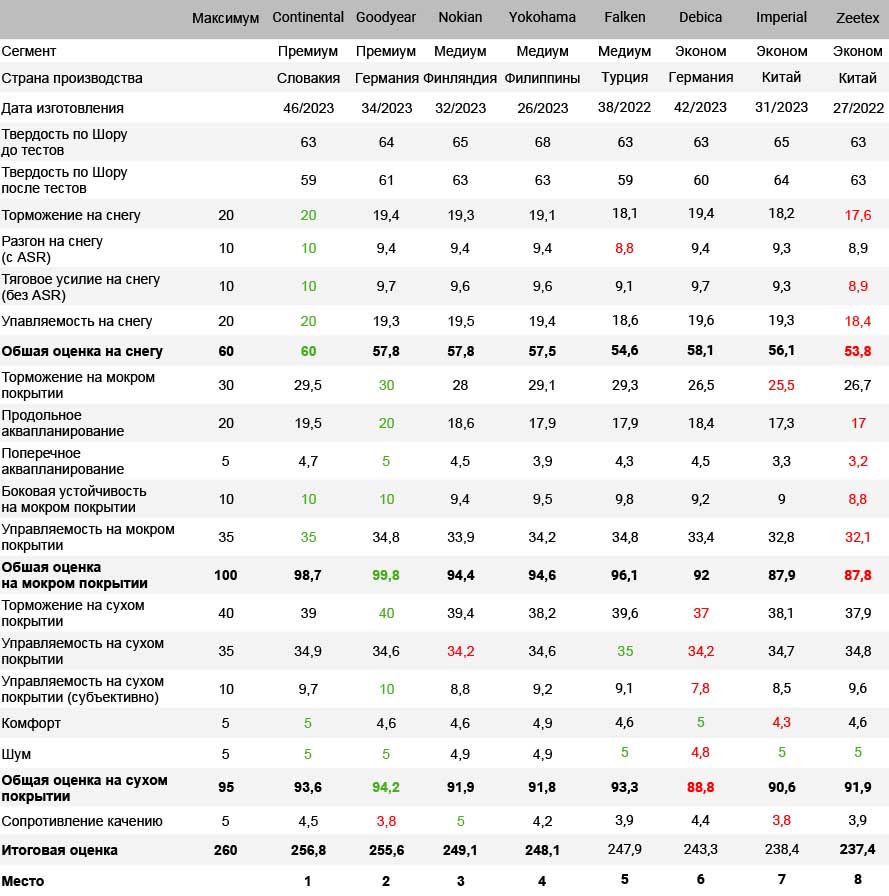
On snow, the premium Continental tires were the clear leaders, stopping the car faster than all others (Zeetex came in last, but their result was still within acceptable limits), and also demonstrated the best handling (difficulties arose not only with Zeetex but also with Falken).
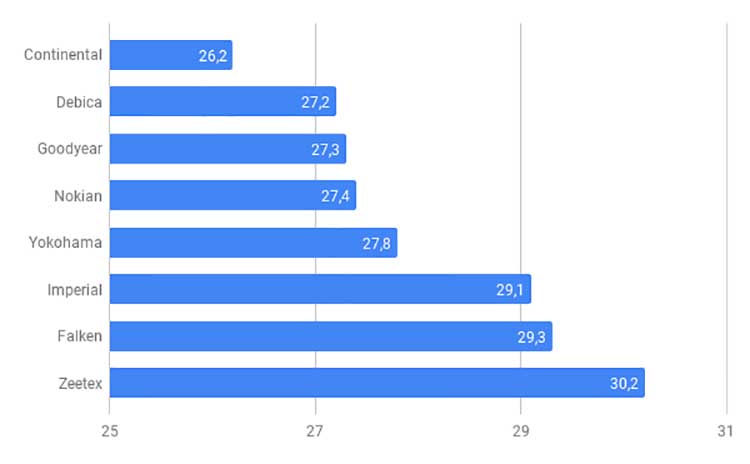
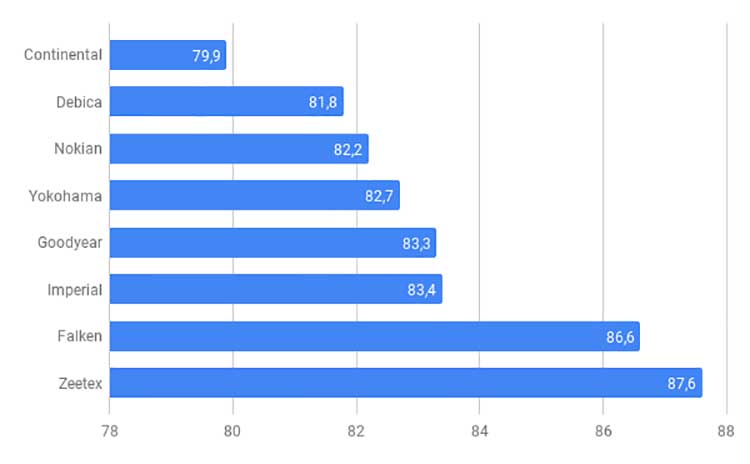
Usually, the efficiency of acceleration on snow is evaluated in one discipline, but in Motor, they decided to divide it into two. In the first case, the distance required to accelerate from a standstill to 20 km/h was recorded (here, the characteristics of the rubber compound are key), and in the second, the driver accelerated the car with the ASR turned off, maintaining wheel slip at 10-60%, and the average force in decanewtons was measured (here, it is important how the tire tread "bites" into the snow).
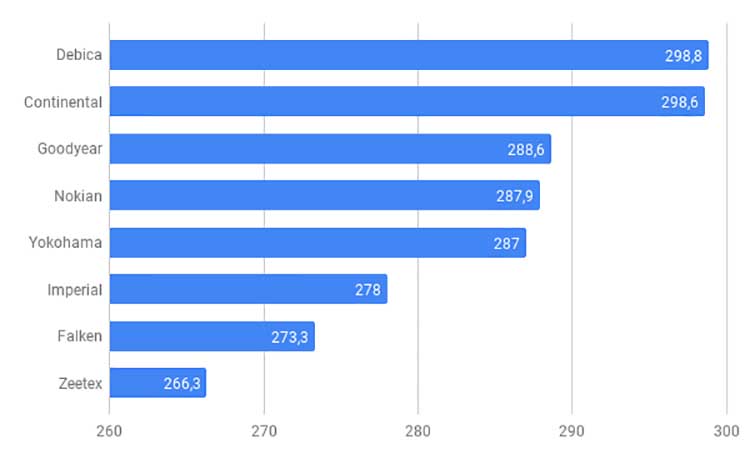
In the first test, Continental won with a clear margin, while Zeetex and Falken, although again lagging behind the others, still showed acceptable results. In the second test, Continental and Debica were the leaders, Imperial and Falken had mediocre ratings, while Zeetex lagged far behind.
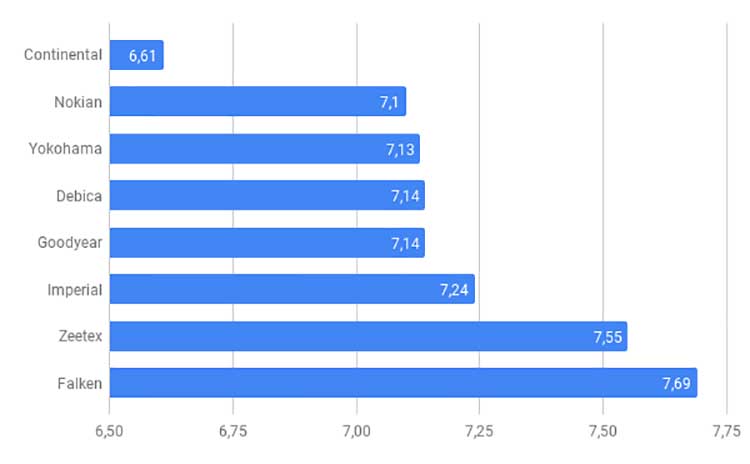
Continental also performed best in the test of handling on wet pavement, while Debica's performance was "weak but acceptable", which cannot be said about the results of Imperial and Zeetex. The latter tires, according to experts, have very low grip and pose a safety hazard.
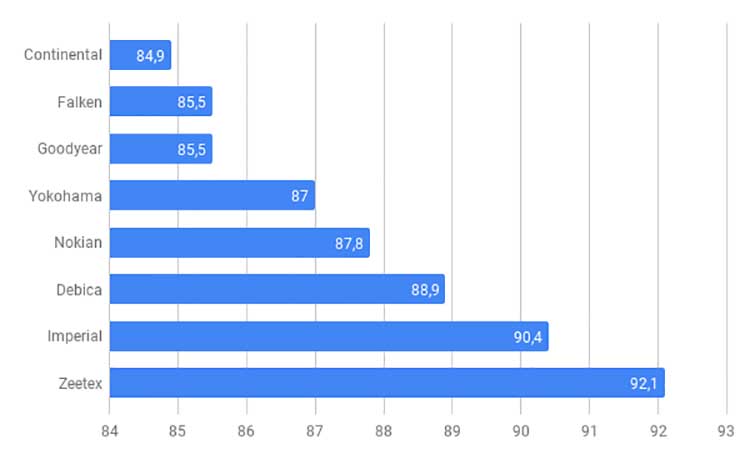
In the tests for braking efficiency on wet asphalt, Goodyear, Continental, Falken, and Yokohama performed very well, while Imperial came in last, with a result that was too weak even considering they are budget tires.
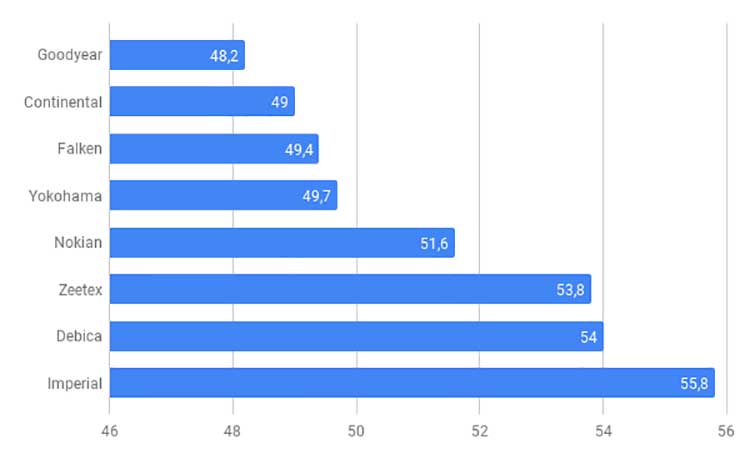
On the irrigated circular track, the resistance of the tires to lateral drift was evaluated, and Goodyear performed best, followed by Continental, while Debica, Imperial, and Zeetex had average ratings.
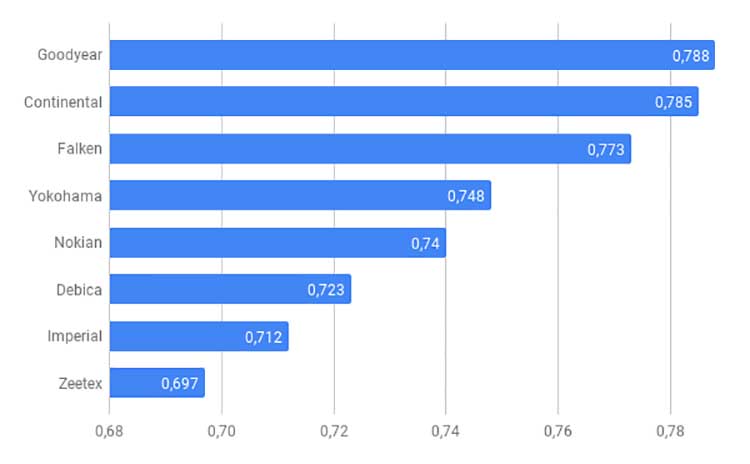
In the tests for resistance to longitudinal aquaplaning, only Goodyear tires were able to withstand speeds of over 80 km/h without losing traction. The other tires also performed well, including Imperial and Zeetex, whose results were deemed acceptable.
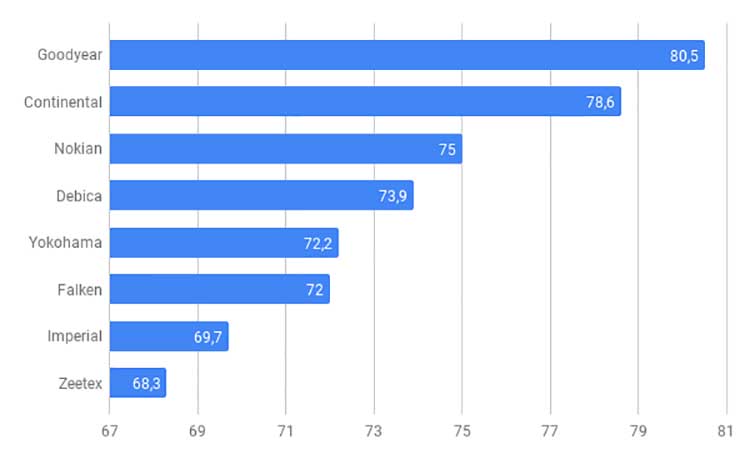
Goodyear tires also effectively resisted aquaplaning when entering a puddle while turning, while Imperial and Zeetex failed to cope with the task, and one needs to drive with increased caution on wet roads with these tires.
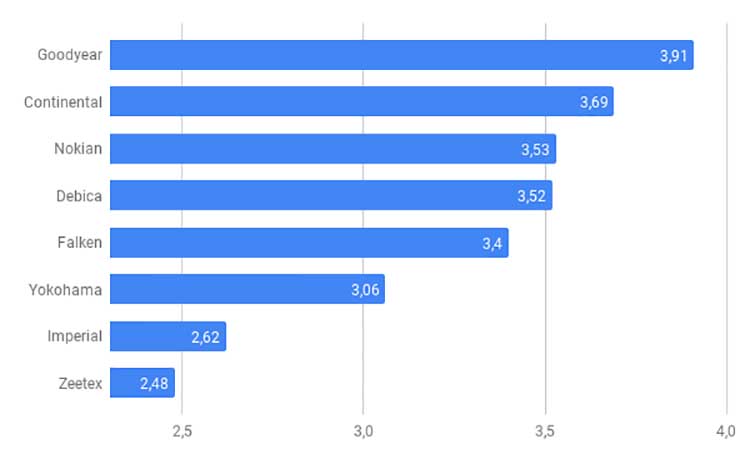
Goodyear tires work well not only on wet but also on dry asphalt, and here they had the shortest braking distance. Debica came in last in this discipline, but they still provide the necessary level of safety.
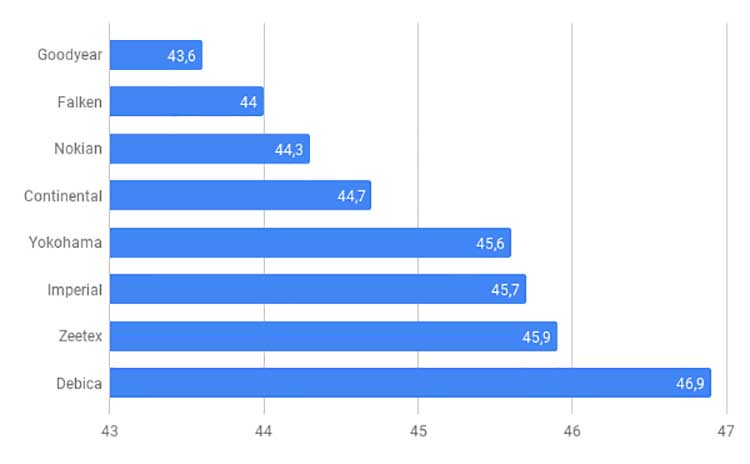
In the tests for handling on dry pavement, the time to complete the circle was measured, and the driver also gave subjective evaluations to the tires. Falken and Continental performed best in the first discipline, while Nokian and Debica came in last, although, as the experts noted, although they do not have such a sporty character as the test leaders, the lag was not so significant.
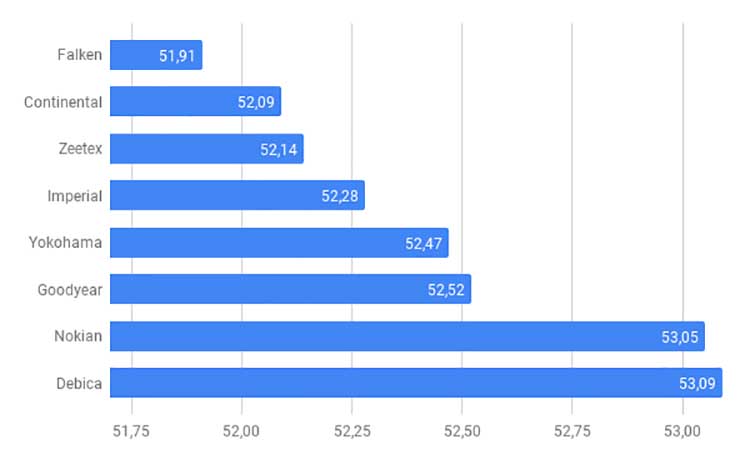
In the subjective rating, the first places were taken by Goodyear, Continental, and Zeetex, while Nokian had not such precise reactions to steering wheel turns, but they behave stably, and Imperial clearly has problems with ensuring the necessary grip. Debica received even fewer points, lacking stability when sharply avoiding obstacles, but they coped well with high-speed turns.
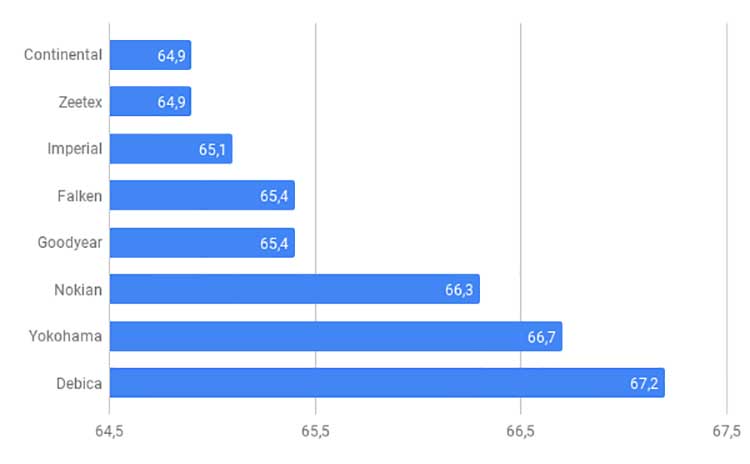
Noise was measured outside the car, and Continental and Zeetex were the quietest, while Debica was the loudest.
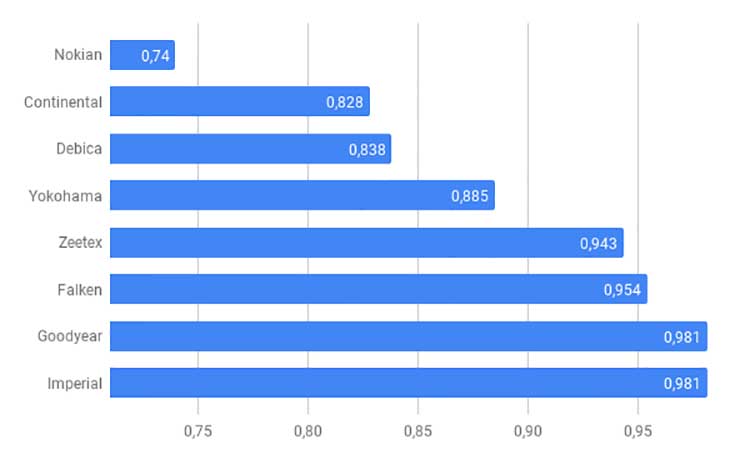
In the tests on the drum stand, Nokian showed the lowest rolling resistance, while Goodyear and Imperial were the least economical with the same result.
Thanks to the excellent balance of characteristics, in the 2024 test, Continental tires won, which were the best on snow and received very high ratings on wet and dry asphalt, as well as having low noise levels and rolling resistance. Goodyear followed, outperforming the leader on dry and wet tracks, but conceding to them on snow and in the test for fuel efficiency. Nokian closed the top three, showing even results in all disciplines and standing out with the lowest rolling resistance.
The fourth place was taken by Yokohama tires, which performed at the level of Nokian, but had lower resistance to aquaplaning and lost points in the test for fuel efficiency. At the same time, Yokohama has an attractive price. Falken took fifth place with good ratings but unbalanced characteristics, and if on dry and wet surfaces there were no complaints about the tires, then on snow, they did not meet expectations.
Among budget tires, Debica became the best, significantly outpacing their "classmates". The tires of the Polish brand, owned by Goodyear, work very effectively on snow and not bad on wet asphalt, but the performance on dry surfaces leaves much to be desired. Imperial, on the contrary, showed good results only on dry surfaces, while on snow the grip is weak, and on wet asphalt, the tires can pose a safety hazard. In addition, Imperial has high rolling resistance, and their only advantage is a low price. As for Zeetex, they also work well only on dry surfaces, and their characteristics in other conditions are often below the acceptable level.
Source: magazynauto.pl.