
Winter tire test from Auto Bild Sportscars — 2024
Auto Bild Sportscars conducted a test of European-type winter tires in the 235/35 R19 size, testing models from well-known brands such as Continental, Goodyear, and Michelin, as well as budget tires from Asia: Autogreen and Radar.
Asian-made tires regularly surprise in independent tests, and this time, the Autogreen Snow Chaser 2 AW08 (a private brand of the Chinese company Best Choice International) was able to impress, outperforming all participants in three out of four disciplines, and only losing to Michelin in traction tests. However, tires of this type are also required to work efficiently on asphalt, and on wet pavement, the braking distance of the Autogreen from 100 km/h was 30 meters longer than that of Bridgestone, for which they received the lowest possible rating, a rarity in AB tests.
In addition to Autogreen, the list of participants included Bridgestone Blizzak LM005, Ceat WinterDrive Sport (produced by the Indian company Ceat), Continental WinterContact TS 870 P, Dunlop Winter Sport 5, Goodyear UltraGrip Performance 3, Hankook Winter i*cept evo3, Michelin Pilot Alpin 5, Radar Dimax Alpine (a private brand of the Singaporean company Omni United), and Vredestein Wintrac Pro, which were tested on snow, wet, and dry asphalt.
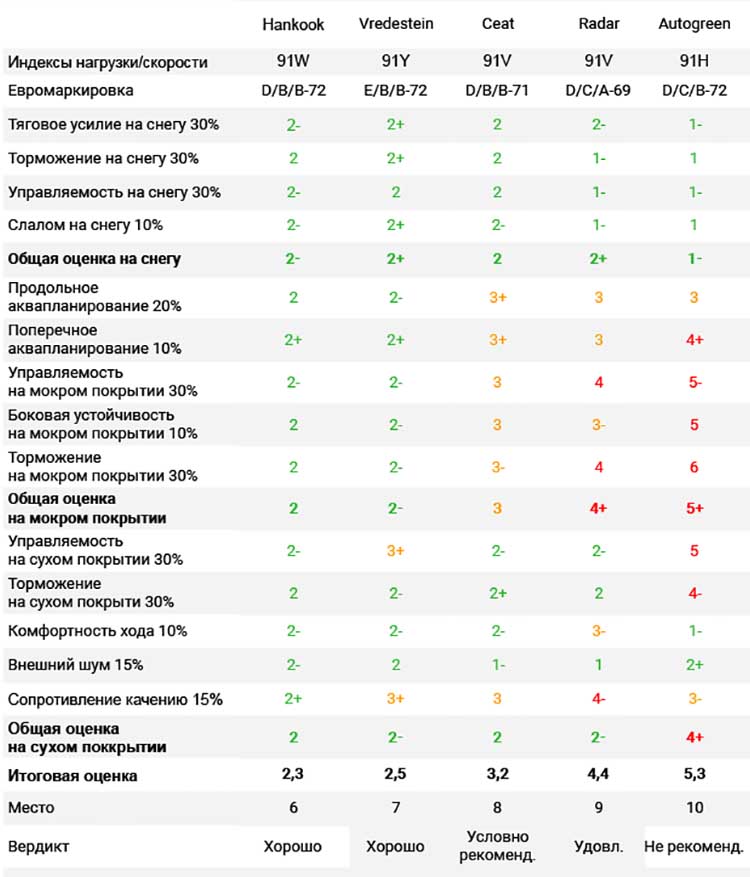
On a snowy surface, as mentioned earlier, the undisputed leader was the inexpensive Autogreen, but at the same time, all tires showed good results, and no one received a "Satisfactory" rating. The weakest results were shown by Hankook, which had relatively unreliable traction on the front axle in turns, as well as the weakest traction among the tested tires.
On wet pavement, the differences between the tires became much more significant, and the best ratings for safe behavior and precise reactions to the driver's actions were awarded to Bridgestone, Dunlop, and Goodyear, which were able to outperform even summer tires. In the test of braking distance, summer tires were not the best again, and the first places were taken by Bridgestone and Dunlop. At the same time, the braking distances of Radar and Autogreen were so long that they posed a safety risk. On the circular track, where lateral stability was evaluated, summer tires still took first place, while Bridgestone, Michelin, and Continental also showed excellent results, and Autogreen again failed to cope with the tasks. Finally, in terms of resistance to aquaplaning, both longitudinal and transverse, Dunlop was recognized as the best, while budget tires, according to experts, made cornering a "cruel ordeal".
In tests on dry pavement, winter tires with their numerous lamellas were unable to match the handling of summer tires, but Michelin and Continental "can provide driving pleasure", and in the test of braking efficiency, Goodyear took the first place, whose braking distance when decelerating sharply from 100 km/h was seven meters shorter than that of Autogreen.
The most economical tires were Continental, whose rolling resistance was approximately 20% lower compared to Radar, which is equivalent to a 4% reduction in fuel consumption. As for noise, all tires provided good acoustic comfort, and the first places were taken by budget Radar, Ceat, and Autogreen.
Four tires out of 10 received an "Exemplary" rating in the overall test, namely Michelin, Goodyear, Continental, and Dunlop. All tires have a very good balance of characteristics, but there are also small drawbacks, and Michelin has slightly reduced resistance to transverse aquaplaning, Goodyear has a relatively long braking distance on snow, Dunlop has increased rolling resistance, and Continental is simply very expensive.
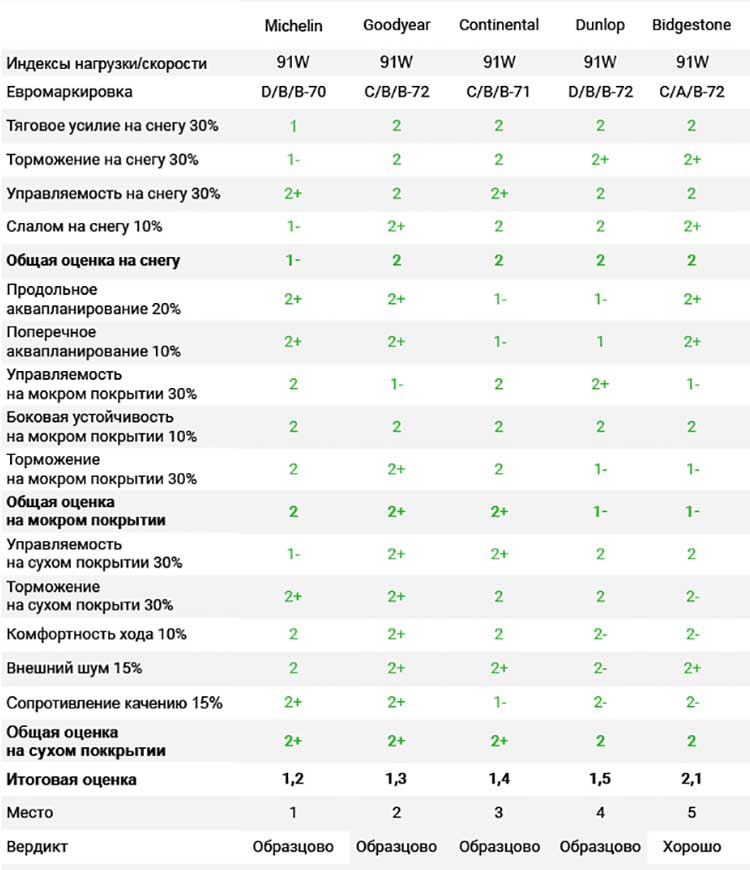
Three more tires - Bridgestone, Hankook, and Vredestein - earned a "Good" rating. The first two tires also did not allow themselves to have obvious weaknesses in any discipline, and in the case of Vredestein, there were claims of handling on dry pavement and fuel efficiency. Next are the Ceat tires, which became "conditionally recommended", as they performed poorly in tests on wet pavement.
Radar tires, like all test participants, work well on snow, and on dry asphalt, everything is also fine, but on wet pavement, they significantly worsen handling and increase the length of braking distances, and were worse in these parameters only than Autogreen, which is not recommended to buy.
In conclusion, AB noted that "almost all modern tires work well on snow, but most drivers also drive on wet and dry asphalt in the winter, and the best choice will be universal tires with separate qualities typical of summer models. The Chinese have not yet been able to offer anything like this, but Michelin, Continental, and Goodyear can do it".
Source: Auto Bild.