
All-season tire test by Auto Bild (2024)
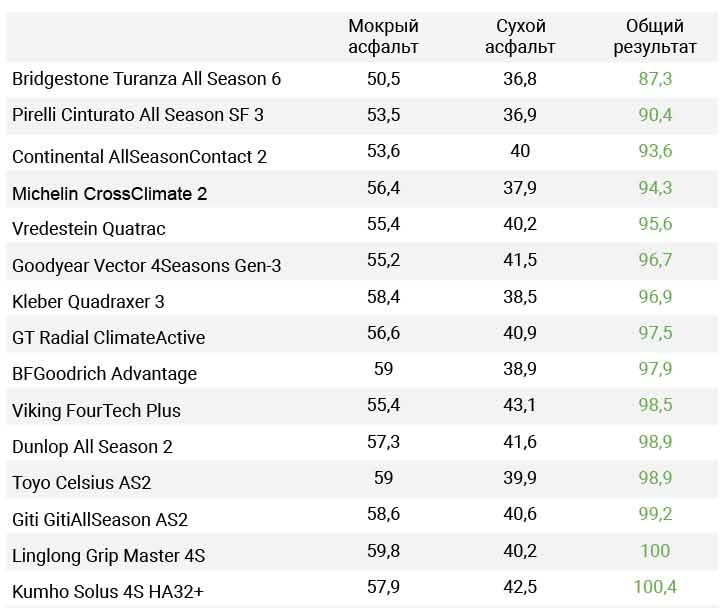
The selection of all-season tires on the European market has become truly wide in recent years, and to help consumers choose the best option, Auto Bild tested 37 models for year-round use in the 225/50 R17 size. Following the qualifying stage, where the braking distance from 100 km/h on wet and dry asphalt was measured, 15 top participants were selected to proceed to the main part of the test.
In the snow, the candidates for victory were compared to each other and to winter tires, which, surprisingly, conceded, albeit slightly, to the all-season Continental and Michelin in the handling test. In the slalom, five "all-season" tires (Michelin, Kleber, Continental, BFGoodrich, and Pirelli) were more efficient, but overall, winter tires still work better on snow, which is particularly noticeable in braking distances. In this discipline, all all-season tires conceded to winter tires, and the braking distance of Bridgestone was 3.6 meters longer when stopping from 50 km/h.
In summer conditions, specialized tires for warm weather outperformed all-season models in almost all tests on wet surfaces, and only in the test for longitudinal aquaplaning could Pirelli take first place. In the key discipline - braking on a wet surface (from 100 km/h) - the braking distance of the summer tire was 2.9 meters shorter than that of the best "all-season" tire (Bridgestone), and 12.2 meters shorter than that of the Linglong tires, which took last place. On dry asphalt, the situation was similar, and here all-season tires with their soft rubber compounds and additional lamellas also increase the braking distance, and the result of the tires on the last line (Viking from the Continental concern) was worse than that of summer tires by 8.2 meters (when decelerating from 100 km/h). In the handling test, all-season tires also lag behind, although their soft compounds reduce the noise level - in this indicator, summer tires took last place, and the best were GT Radial and Vredestein.
In AB, tires are also rated for purchase profitability, and for this, in particular, the potential resource of the tires is determined, and the cost of 1000 km of travel is estimated based on the price of the tires. The first line in this parameter was taken by the cheap Linglong, followed by Toyo and Dunlop, and the worst were Pirelli. At the same time, Linglong had the highest rolling resistance among the tested tires, and the best in this discipline were Toyo, Michelin, and Continental. If we talk about the resource, then Dunlop can overcome more than 67,000 km, while Kumho end their service life at a mileage of just under 40,000 km. At the same time, tires that wear out quickly not only require replacement earlier but also increase the load on the environment, and Kumho lost twice as much rubber (including harmful micro-particles) after 13,000 km than Michelin, Dunlop, Toyo, and Kleber, which have high wear resistance. From an environmental and economic point of view, the mass of the tires, which affects fuel consumption, is also important, and the lightest in the test were Dunlop, whose set weighs 6.9 kg less than in the case of GT Radial.
The first place in the overall standings was taken by the Vredestein Quatrac tires, which showed good results in all disciplines, and the rating "Exemplary" was also received by three more participants: Continental AllSeasonContact 2, Michelin CrossClimate 2, and Goodyear Vector 4Seasons Gen-3. All of them have balanced characteristics and only minor drawbacks: Continental has reduced resistance to aquaplaning (and a high price), Michelin has a relatively long braking distance on a wet road, and Goodyear has an average resource.

The "Good" rating was able to earn five tires: Pirelli Cinturato All Season SF 3, Dunlop All Season 2, Kleber Quadraxer 3, Giti GitiAllSeason AS2, and GT Radial ClimateActive. All of them, in general, showed decent results but allowed themselves weaknesses in individual disciplines, namely those related to safety. First of all, problems arose in the test for the effectiveness of braking on a wet surface, where Dunlop, Kleber, Giti, and GT Radial performed relatively weakly, while Dunlop (along with Pirelli) also worsened their overall rating in snow tests. At the same time, Dunlop was able to receive the Eco-Meister award, as they had the highest resource and a very good ratio of potential mileage to price.

The rating "Satisfactory" was received by BFGoodrich Advantage All Season, Viking FourTech Plus, and Bridgestone Turanza All Season 6. The Bridgestone tire unexpectedly took only 12th place, and the reason for this was the relatively weak grip on snow, while BFGoodrich does not work very well on wet asphalt, and Viking had low ratings on snowy and dry surfaces.

The tires Kumho Solus 4S HA32+, Toyo Celsius AS2, and Linglong Grip Master 4S were placed on the last lines, which all showed weakness in tests on wet asphalt, and Toyo and Linglong also in snow tests. It remains to add that, although Linglong took last place, they still managed to get into the main part of the test, which can already be considered a success for the Chinese manufacturer.
Source: Auto Bild.