ADAC All-Season Tyre Test 2025
More and more European drivers are opting for all-season tires, which allow them to avoid changing tires twice a year in regions with mild winters, and in a new test by ADAC, 16 "all-season" tires in the 225/45 R17 size participated, showing, according to experts, both disappointing and encouraging results.
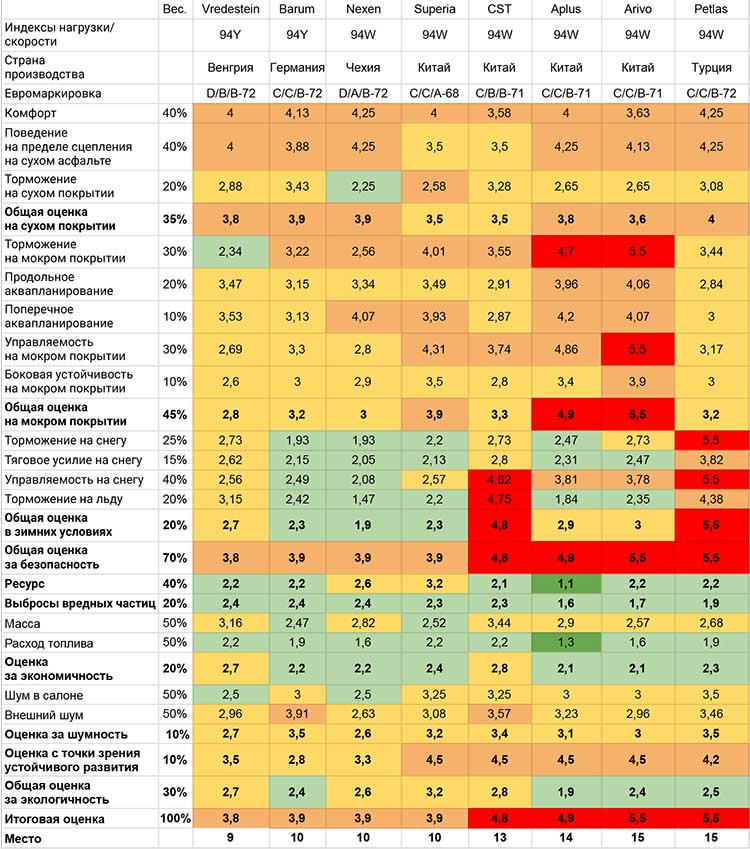
The differences between the tires were very significant, and four models received a "Poor" rating, and another four - "Fair", meaning that every second tested tire is not worthy of recommendation. At the same time, if a year ago, an all-season tire for the first time earned a "Good" rating in the ADAC test, then this time this rating was awarded to four participants, which means that this segment continues to evolve, and it is already possible to find really universal products (although they are still not suitable for northern winter).
Tires of all price categories, from premium to budget, were tested, and the list of participants looks like this:
BFGoodrich Advantage All-Season
Bridgestone Turanza All Season 6
Continental AllSeasonContact 2
Goodyear Vector 4Seasons Gen-3
Pirelli Cinturato All Season SF 3
Winter tests
All-season tires should work well on snow, and all participants passed the braking efficiency tests in such conditions quite well, with the exception of the Petlas tire from the Turkish manufacturer.
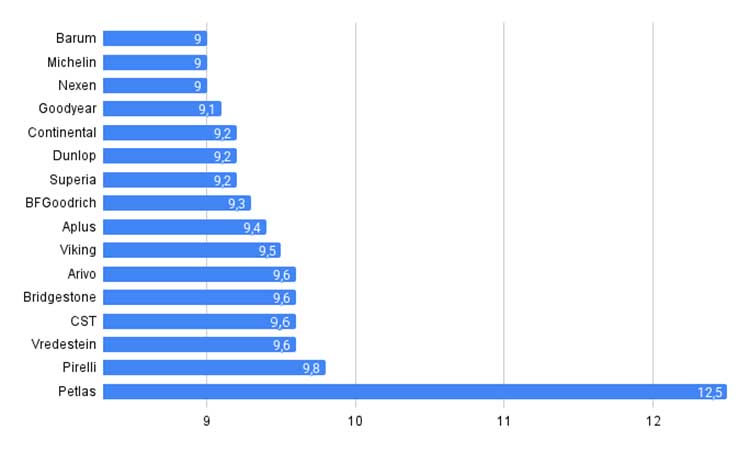
The best traction on snow was shown by Michelin tires, which are generally designed with an emphasis on improving "winter" characteristics, and Petlas is clearly not suitable for regions with snowy winters.
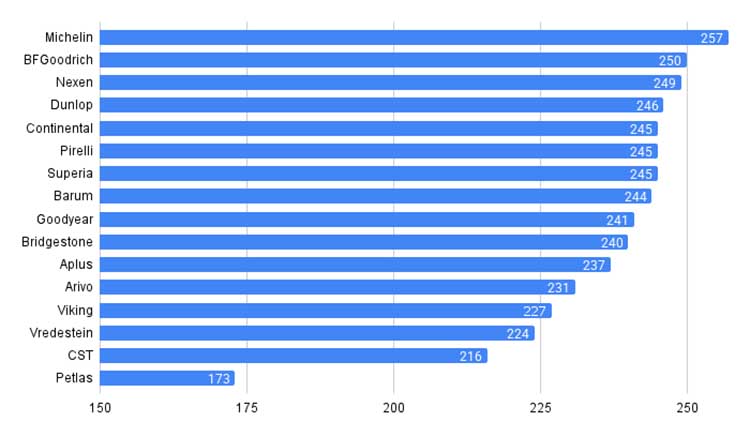
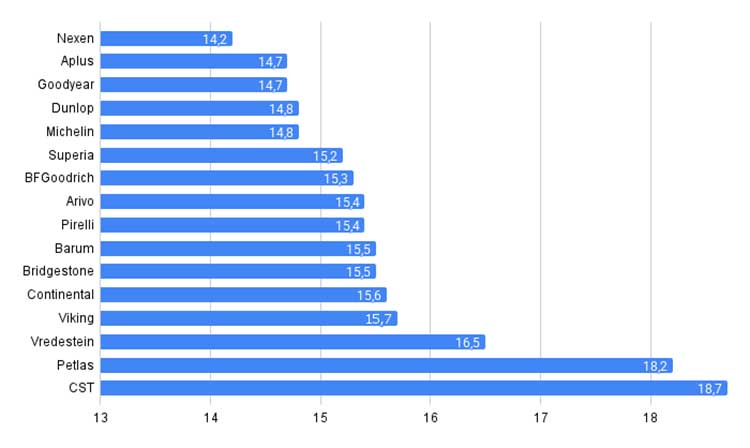
In the ice test, Nexen showed the shortest braking distance, and the second place, together with Goodyear, was unexpectedly taken by the budget Aplus tires, which are produced by the Chinese company Shandong Haohua Tire.
Wet pavement tests
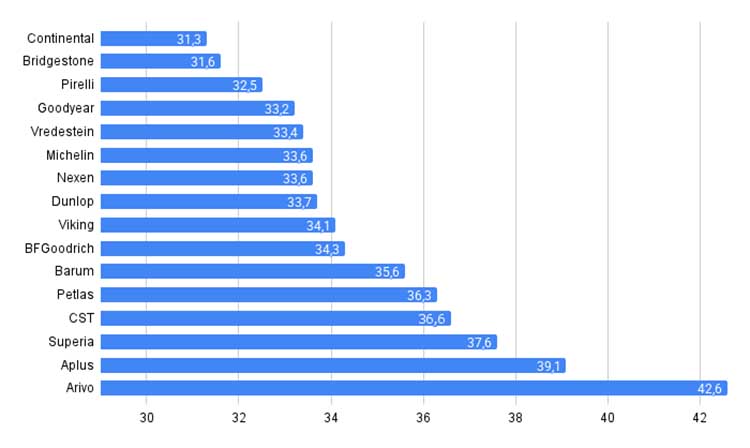
The fact that not all manufacturers manage to create all-season tires with balanced characteristics is also confirmed by the fact that some models had frighteningly long braking distances on wet asphalt. The difference in the results of Continental and Arivo when stopping from 100 km/h was 11.3 meters, which means that the residual speed would be around 41 km/h.
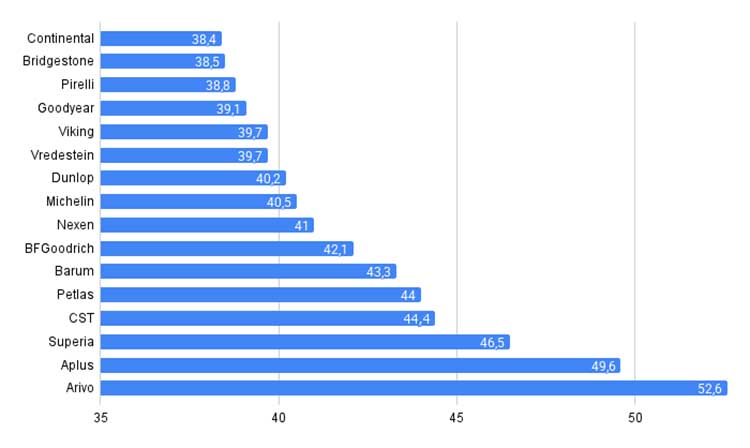
ADAC also measured the braking distances of tires on wet concrete, and here the alignment of forces was almost the same as on asphalt.
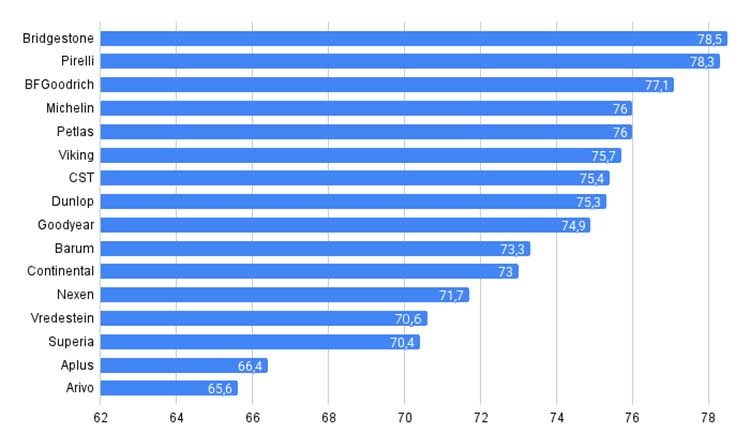
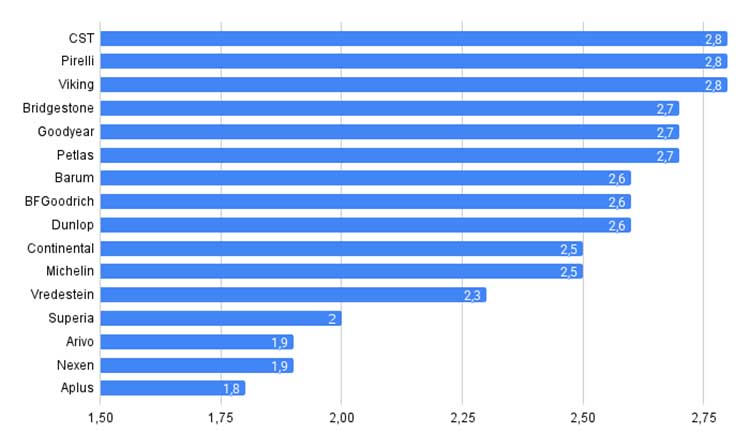
In the tests for longitudinal and transverse aquaplaning resistance, the best were the premium Bridgestone and Pirelli, and the budget Arivo and Aplus were the first to "surface".
Dry pavement tests
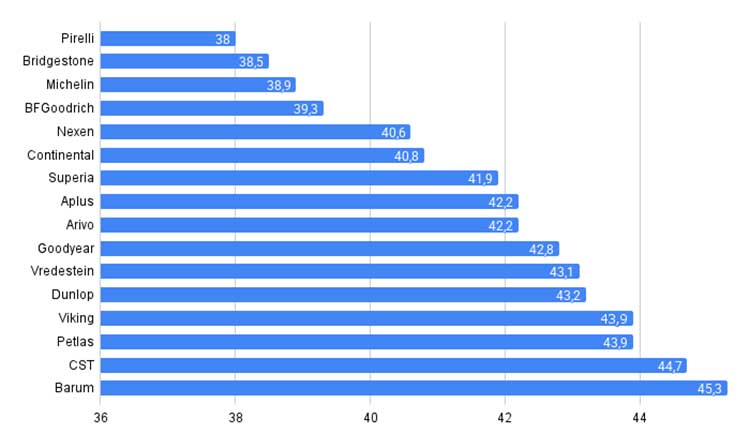
Pirelli and Bridgestone were also the most effective in terms of braking qualities on dry asphalt, and Barum took the last place in this discipline, although they are produced by the German concern Continental.
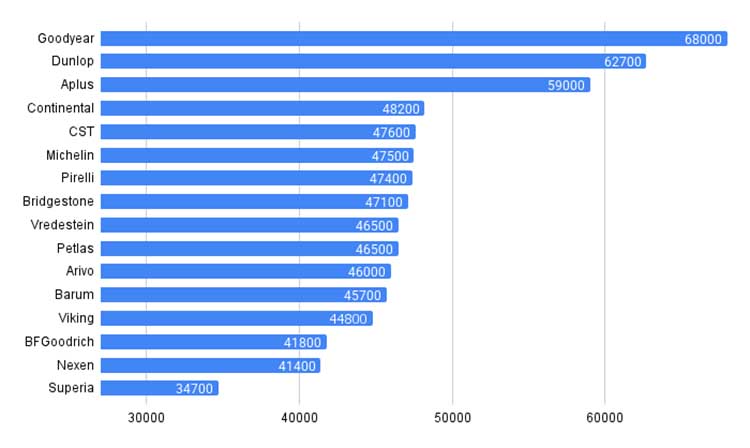
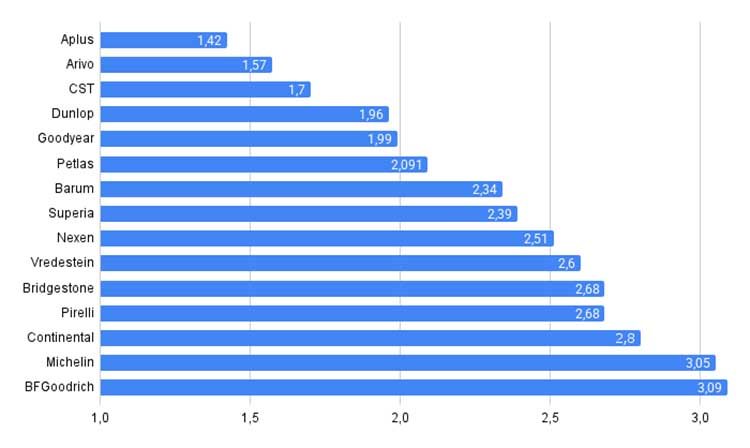
There were significant differences between the tires in terms of mileage, and Goodyear may potentially cover a distance of around 68,000 km, while to cover this distance on Superia, you would need two sets of tires. If we talk about the cost of a kilometer of road, the best in this regard will be the cheap Aplus and Arivo, and the worst - Michelin and BFGoodrich.
ADAC also takes into account the volume of micro-particle emissions that occur during tire wear, and the most environmentally friendly in this regard were Goodyear, followed by Aplus and Dunlop.
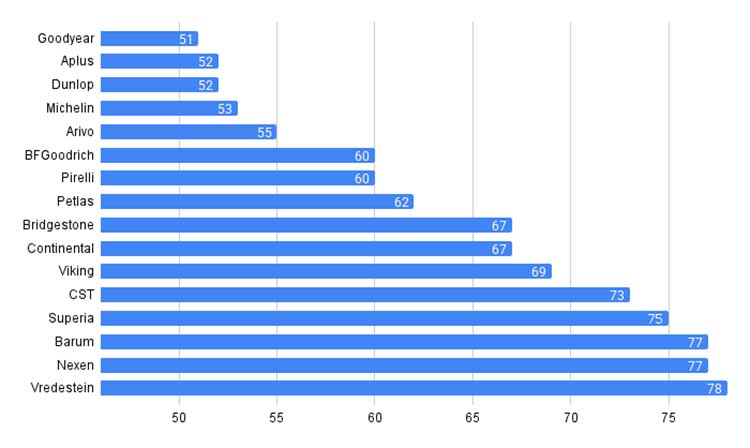
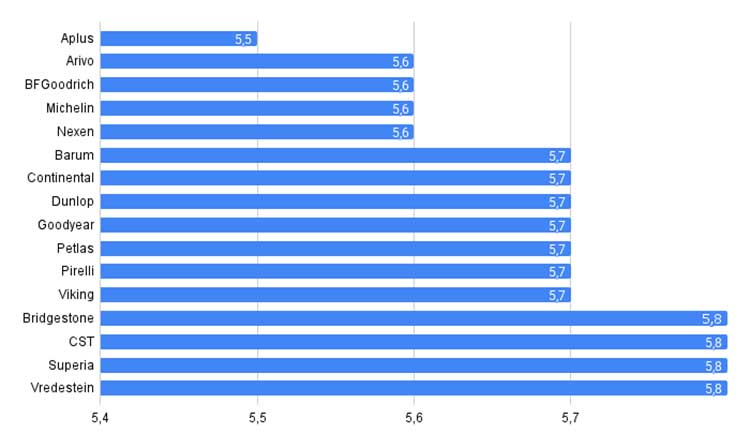
Fuel consumption was measured at 100 km/h, and the best fuel economy is provided by Aplus, while Arivo, Michelin, BFGoodrich, and Nexen also had good results.
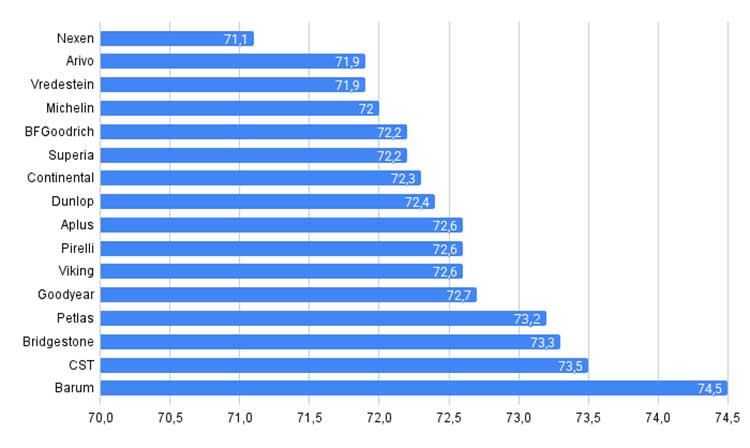
In the tests for external noise level, Nexen was recognized as the leader, and Barum was the noisiest.
Results
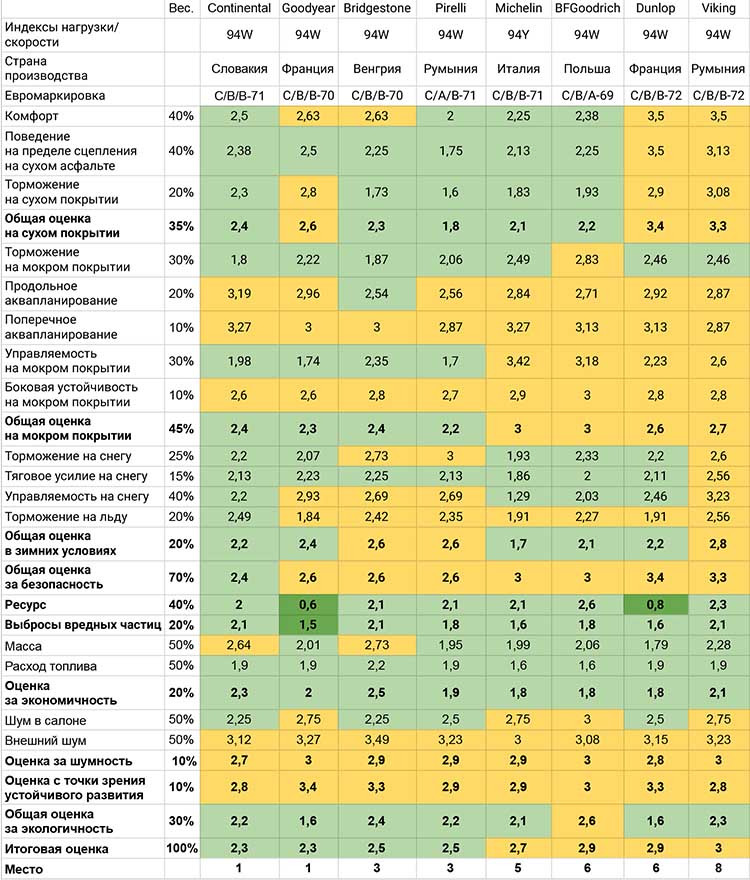
Gold in the new ADAC test was shared by Continental AllSeasonContact 2 and Goodyear Vector 4Seasons Gen-3, while Bridgestone Turanza All Season 6 and Pirelli Cinturato All Season SF 3 also received a "Good" rating, and the testers noted that all four tires are capable of providing good traction both in summer heat and on snow and ice at low temperatures. At the same time, only Continental managed to earn a "Good" rating for both safety and environmental friendliness (weighting of estimates: 70%/30%) and did not allow themselves weaknesses in any discipline, while Goodyear had less precise reactions to the driver's actions on dry asphalt, but very good results on wet roads. In turn, Bridgestone and Pirelli were not among the leaders on snow and ice.
Next, with a "Satisfactory" rating, are four tires - Michelin Crossclimate 2, BFGoodrich Advantage All-Season, Dunlop All Season 2, and Viking FourTech Plus - which all have their strengths and weaknesses. Thus, Michelin, BFGoodrich, and Dunlop are very effective in winter conditions, and the last tire also differs in environmental friendliness, while Viking showed even results in all tests.
With a "Fair" rating, the test was completed by Barum Quartaris 5, and this is despite the fact that they are produced by the German concern Continental. As noted in ADAC, it seems that Continental does not invest such significant funds in the development of inexpensive tires as in the creation of products under its main brand, otherwise it is difficult to explain why Barum has such unimpressive characteristics, especially on dry asphalt.
The results of Vredestein Quatrac Pro+ and Nexen N'Blue 4Season 2 were also called a disappointment, since both brands are well-known on the market and are not "no-names" from China, but received the same rating as the cheap Superia Ecoblue2 4S, which are offered by the Belgian trading company Deldo.
The "Unsatisfactory" rating in the 2025 test was received by the CST Medallion All Season ACP1, Aplus AS909, Arivo Carlorful A/S, and Petlas Multi Action PT565 tires, which are all not recommended for purchase, primarily due to low braking efficiency, which creates a safety hazard. In addition, since CST and Petlas have an obvious lack of traction on snow, and Arivo and Aplus work poorly on wet roads, none of these tires can be considered all-season.