
2024 ACE All-Season Tire Test
The Automobile Club of Europe (ACE) conducted another tire test, this time testing nine sets of increasingly popular all-season tires in the European market in the size 215/50 R18. The partners of ACE, as usual, were the Austrian Association of Drivers of Cars, Motorcycles and Bicycles (ARBÖ) and the German Society for Technical Supervision (GTÜ), and the aggregate carriers were Volkswagen T-Roc.
Economy-class tires were not tested, and models of the upper and middle price segments were chosen: Bridgestone Turanza All Season 6, Continental AllSeasonContact 2, Falken Eurall Season AS210, Goodyear Vector 4Seasons Gen-3, Maxxis Premitra All Season AP3 SUV, Michelin CrossClimate 2, Pirelli Cinturato All Season SF 2, Toyo Celsius AS2 and Vredestein Quatrac Pro+.
The snow tests were conducted at the Arctic Falls test site in Luleå (Sweden), about 100 km south of the Arctic Circle. When the testers arrived at the site in mid-January, there was plenty of snow, but the temperature dropped to -40 degrees, and since all-season tires are not designed for such conditions, they had to wait for warming.
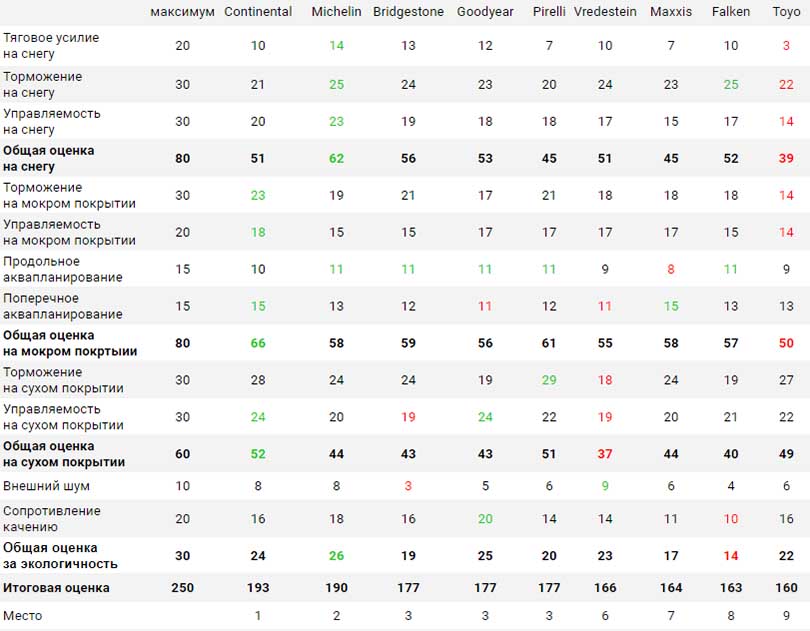
First, the braking and traction properties of the tires were evaluated, and in the first discipline, all participants showed approximately the same results, and the best were the Falken tires, followed by Michelin and Vredestein. In the second test, the alignment of forces changed somewhat, and Michelin became the leader, while Falken slightly lagged behind, and Toyo had a very weak result - it took them 27.5 meters to accelerate to 30 km/h, while Michelin only needed 23.5 meters. For comparison, summer tires were also taken, which were expectedly completely ineffective, and while the braking distance of the worst all-season tires when slowing down from 40 km/h was 20.9 meters, the summer tires had a distance of 51.8 meters, which is more than twice as long. In the traction test, the result of the summer tires was three times worse than that of Toyo, which once again confirms that it is not worth driving on tires of this type in winter.
In the snow handling test, test driver Henning Renner was particularly impressed by the Michelin and Continental tires, which behaved most safely in turns. According to him, there was only a slight oversteer (when the rear tires skid), but it was not difficult to control the car due to good lateral stability. "The main thing is that you can easily predict the transition to skidding, so despite the slight oversteer that occurs from time to time, control is not lost," he said.
The worst were the Toyo tires, on which skidding begins suddenly, and the car is difficult to control. "I wouldn't say that the tires create a real safety hazard, but the other test participants are clearly doing much better," Renner added.
The "summer" part of the tests was carried out at the ATP test site in Papenburg (Germany), and here the tires were required to confirm their effectiveness on wet pavement. The best in terms of braking properties were Continental, which stopped the car from 80 km/h in just 29 meters. Pirelli needed almost a whole meter more, and Toyo again had the worst result - 35.5 meters, which means their braking distance was longer than that of Continental by almost the length of a car. As for summer tires, they expectedly outperformed all "all-season" tires with a result of 25.2 meters.
In terms of handling on a wet surface, Renner highlighted three tires: Goodyear, Pirelli, and Continental, which all work reliably, with only a slight tendency to understeer on the front axle. At the same time, Michelin, Bridgestone, Falken, and Toyo did not cause positive emotions in the pilot, as they do not respond accurately to steering wheel turns, do not resist lateral skidding well enough, and constantly demonstrate insufficient steerability. "You constantly lose time because you have to slow down in a turn, and overall it was uncomfortable due to too strong understeer of the front axle," he noted.
The stability to longitudinal aquaplaning was also evaluated, and this time all tires showed themselves from the best side, and Continental became the leader with a small margin, followed by Michelin and Falken. In general, the best in terms of performance on a wet surface were Continental, Pirelli, and Bridgestone, and the last place, as in the snow tests, was taken by Toyo.
Although Toyo had not been doing very well before, they still managed to show decent results on a dry track, where they became third in the braking efficiency test from 100 km/h, while Vredestein and Falken, who had previously demonstrated good braking qualities on snow, now fell to the bottom of the rating. The difference between the best and worst results - 35.6 and 42.4 meters (Pirelli and Vredestein respectively) - was 6.8 meters, which is equivalent to the length of a minivan. In the handling tests, all tires were quite effective, and the best, according to Renner, were Goodyear and Continental, while Michelin unexpectedly found themselves among the outsiders.
In conclusion, ACE noted that the most balanced were Continental, and the second place is taken by Michelin, and both tires receive the rating "Extremely recommended". The rating "Recommended" was earned by Bridgestone, Goodyear, and Pirelli, and the rest of the tires were recognized as "conditionally recommended". The last lines were taken by Falken, which work well in winter but are less effective in summer, and Toyo, which had high results on dry asphalt but frankly weak results both on snow and on wet pavement. In conclusion, we add that there are still no all-season tires for the northern latitudes, and all the tested models can be used throughout the year only in regions with a mild climate.
Source (including photo): ACE.