Studded tire test by Vi Bilägare (2024)
The Swedish car magazine Vi Bilägare conducted a test of seven sets of studded winter tires in the size 225/45 R17, taking one friction model for comparison, as the question "what is better - 'studs' or 'friction'?" is still relevant for all northern countries.
The test included premium-class tires Bridgestone Blizzak Spike 3, Continental IceContact 3, Goodyear UltraGrip Arctic 2, Michelin X-Ice North 4 and Nokian Hakkapeliitta 10, while the mid-range segment was represented by Nordman North 9 tires, which Nokian released after leaving Russia. In addition, budget Mazzini Ice Leopard (Mazzini is one of the private brands of the Chinese company Best Choice International Trade) were tested, and the non-studded tire in the test was Nokian Hakkapeliitta R5.
Not only Nokian left Russia, but also a number of other manufacturers, who, in particular, had to relocate the production of studded tires to other countries, which affected the quality. So, the studding of Michelin tires, which usually produces high-quality products, was done more "carelessly" this time, and the stud protrusion on the Italian-made tires was uneven, which, as the experts noted, had not been noticed before. The situation was even worse with Bridgestone Blizzak Spike 3 tires, whose "birth" was generally associated with numerous problems. First, their release on the market was delayed due to the pandemic, then it was decided to leave Russia, where the company also had its own plant, and when production was established in Hungary, the production volumes were extremely limited. As a result, the Swedes only now had the opportunity to evaluate the Blizzak Spike 3, and in VB they stated that "we were horrified when we looked at the tires - not only is the stud protrusion uneven, but their tips are tilted in different directions, and sometimes so much that the stud body is exposed". Such studding could not but affect the tests, and the studs in the Spike 3 shifted more strongly than in all other tires, and after the snow and ice tests, 18 studs fell out of the left front tire, and 8 more from the right front one. "Let's hope that this is a temporary problem that a manufacturer of this level will quickly solve," the testers added.
The handling tests on snow and ice were conducted at the Elvsbyn polygon (Sweden) in February, and the acceleration and braking efficiency was evaluated in the covered Arctic Falls complex in Piteå (there), after which, already in April, asphalt tests were carried out, for which the experts went to Tampere (Finland).
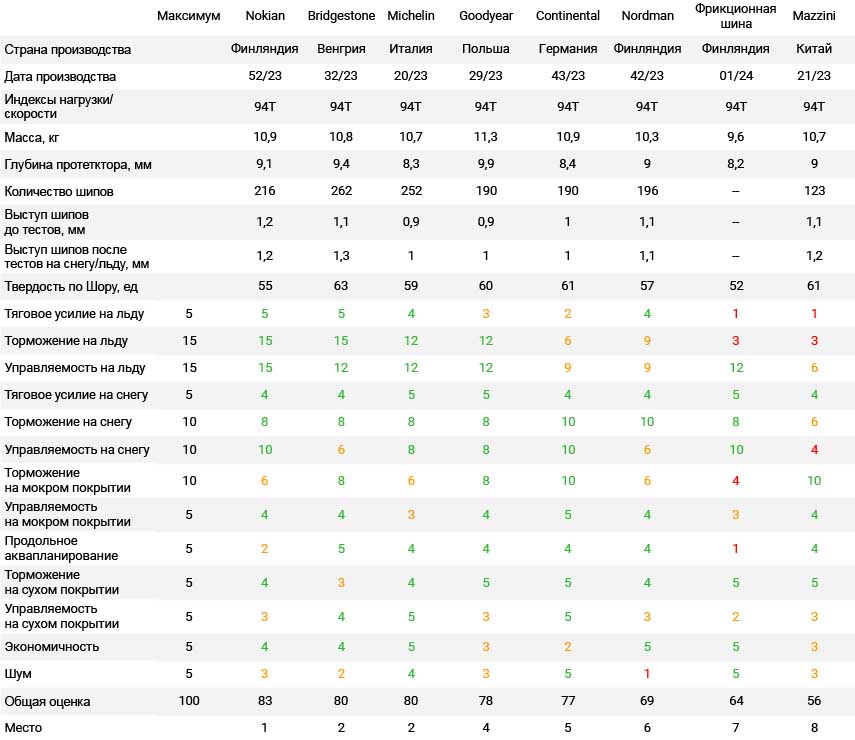
On smooth ice in the covered pavilion, Bridgestone scored the most points, with the highest longitudinal grip, while on the icy track with a more uneven surface, Nokian took the first place, working better than others in turns. Bridgestone loses grip more sharply than Goodyear and Michelin, and the worst were Mazzini, which go into a wide skid without any warning.
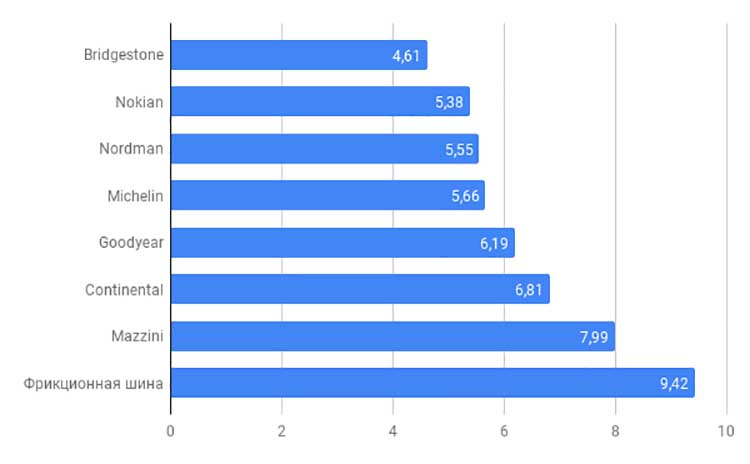
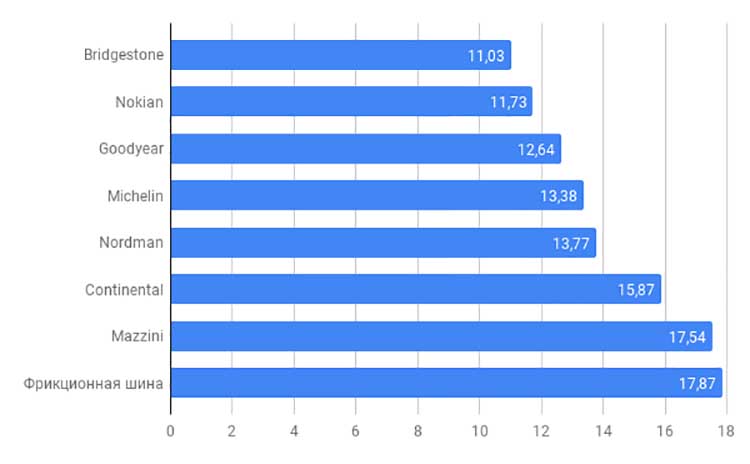
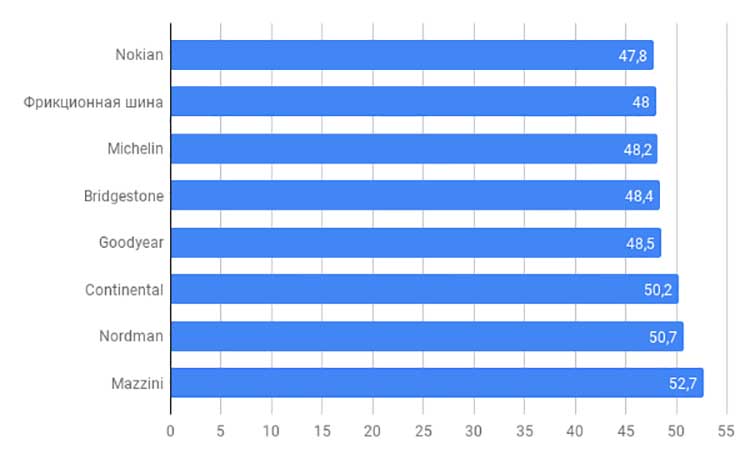
The differences between the tires on snow were significantly smaller, and Continental rose to the first place in the handling test, confidently maintaining efficiency under load. Michelin has a clear tendency to skid on the rear axle, and Bridgestone and Nordman had balanced behavior at the limit of grip.
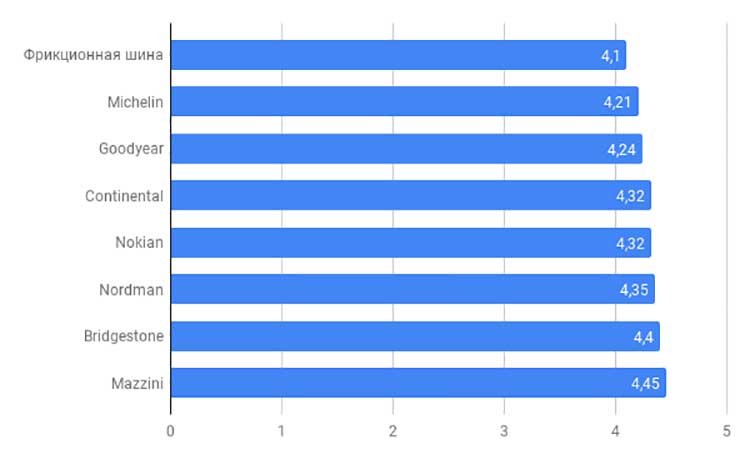
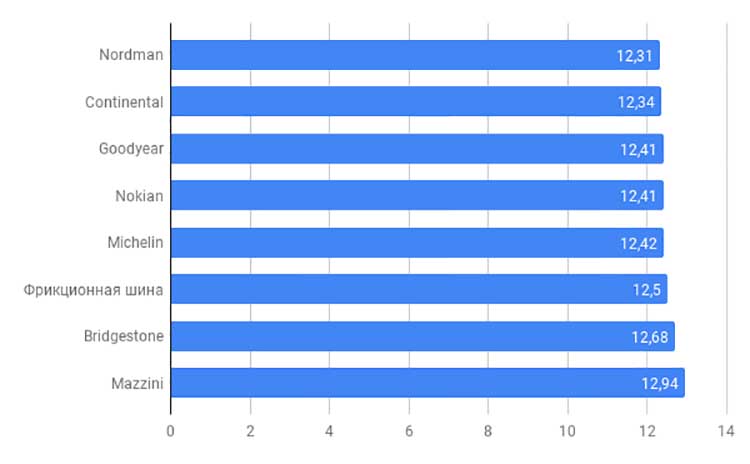
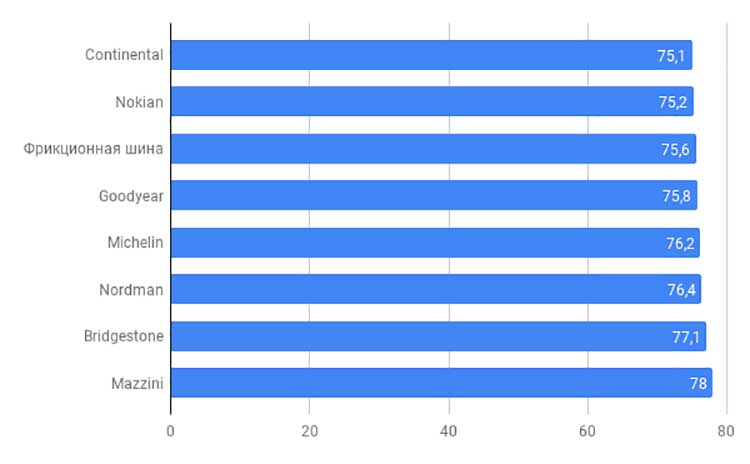
In the tests for resistance to longitudinal aquaplaning, Bridgestone took the first place, while Nokian "surfaced" earlier than competitors, and the friction tires performed the worst, hindered by their dense tread. In terms of braking properties and handling on wet asphalt, Continental and Mazzini were the best, which earlier performed very weakly on ice (this confirms that with increased grip on icy surfaces, the performance on wet pavement and vice versa often worsens). In addition, the non-studded tires had a very long braking distance, and in the handling test, Michelin took the last place, forcing to reduce speed in turns.
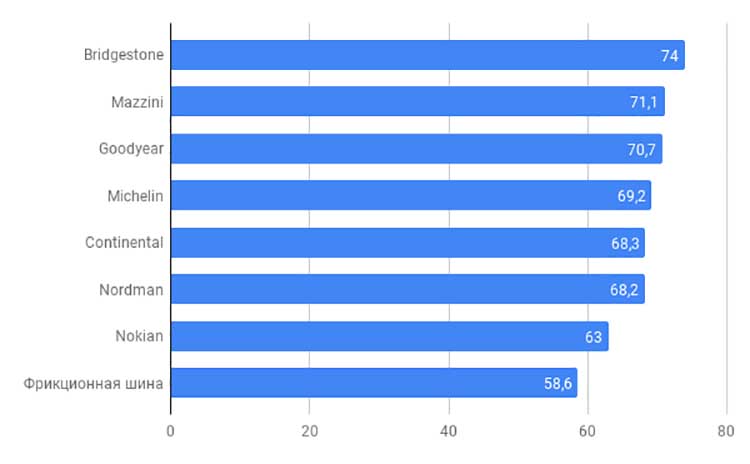
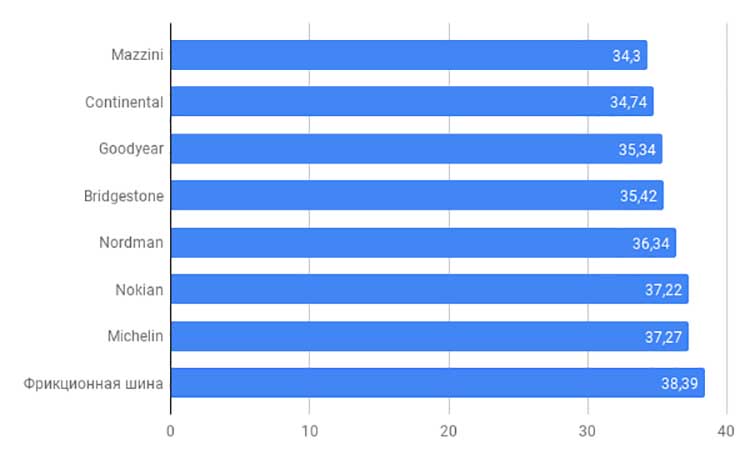
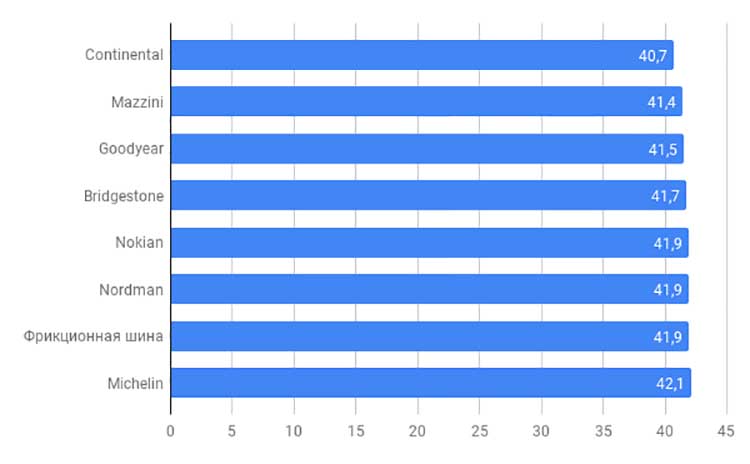
The soft rubber compound helped the non-studded tires to quickly stop the car on dry asphalt, but it also prevented them from maintaining stability during maneuvering in similar conditions. Continental became the best in this part of the tests, while Bridgestone with their increased compound hardness had a relatively long braking distance.
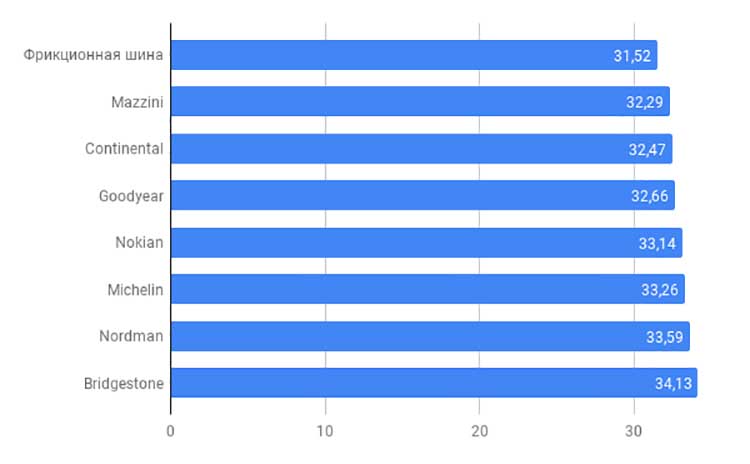
In the fuel efficiency test, fuel consumption was measured at 60 km/h on an oval track, and here the friction tires took the first place, followed by Nordman and Michelin.
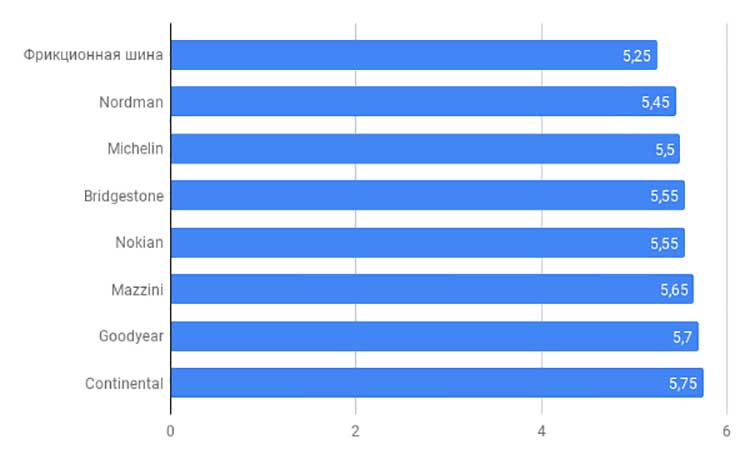
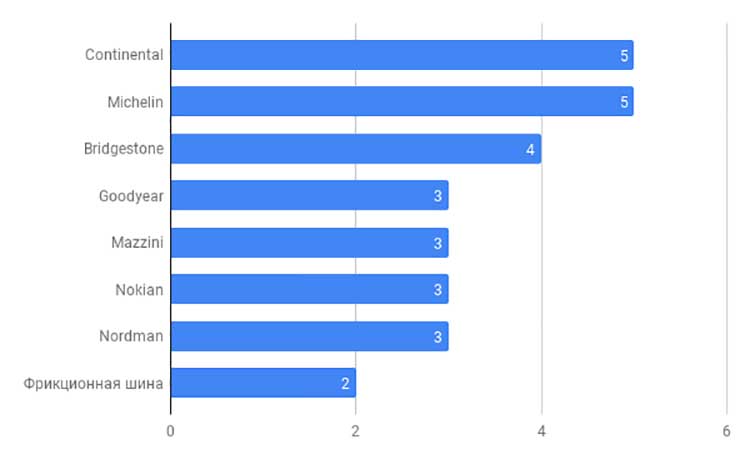
Noise was measured in the cabin at two speed modes, but the subjective assessment was more important, and the friction tires were the quietest, and among the studded tires, Continental received the highest rating. Nordman tires produced the most annoying noise.

Nokian Hakkapeliitta 10 won gold in the test, which can handle very high speeds in turns and on ice, and on snow. At the same time, the emphasis on winter performance characteristics led to the fact that on dry pavement, the sensitivity of steering and directional stability suffered, and on wet pavement, Nokian had a relatively long braking distance and reduced resistance to aquaplaning.
The second place was shared by Bridgestone Blizzak Spike 3 and Michelin X-Ice North 4. The tires from the Japanese brand were able to win in a number of disciplines thanks to good resistance to aquaplaning and excellent longitudinal grip on ice. At the same time, as already mentioned, the studs are installed poorly, so there may be problems with their loss. Bridgestone also has a relatively hard rubber compound, which improves stability on asphalt, however, the tires tend to skid on snow and ice, and the car is not so easy to control when reaching the limit of grip as on more efficient tires in this regard (although this does not create serious problems).
In turn, Michelin, although released six years ago, still create competition for more recent models, and what impresses most is the balance of characteristics - no other tire can boast of successfully combining reliable grip on ice with relatively low noise and good fuel efficiency. At the same time, there is a certain lack of grip on asphalt, which affects stability in turns.
Goodyear UltraGrip Arctic 2 tires also have balanced characteristics and, for example, can quickly stop the car in both winter conditions and on asphalt. The manufacturer has slightly reduced the stud protrusion, which affected the grip on ice, but the results are still good. At the same time, Goodyear had the deepest tread in the test, which negatively affected the sensitivity of steering, primarily on asphalt. In general, these are good tires, but for really demanding drivers, there are more interesting options on the market.
Continental IceContact 3 took the fifth place, scoring a significant number of points, but at the same time performing the worst on ice, which is at least strange for a studded tire. At the same time, Continental has excellent performance on asphalt, where they were among the best in terms of braking properties. IceContact 3 behaves reliably and predictably in any situation, and this was also observed in the snow tests, so the low performance on the ice surface was an unexpected disappointment.
Behind Continental is Nordman North 9 with a pattern borrowed from the Nokian Hakkapeliitta 9 tire (whose analog in Russia is now Ikon Autograph Ice 9), but differing in a harder rubber compound. On asphalt, Nordman showed itself at the level of Nokian Hakkapeliitta 10, but the grip on snow and ice is much worse - the tire cannot handle the same high speeds in turns, and the behavior at the limit of grip is not so predictable.
The last place was expectedly taken by the cheap Mazzini Ice Leopard, which have a very weak grip and a tendency to sharp skidding on ice (although on smooth ice, even Mazzini were able to overtake the non-studded tires). The tire works best on asphalt, but although the braking distance is short, the directional stability and steering sensitivity are average, and when quickly bypassing an obstacle, skidding easily occurs, which, fortunately, is easy to control.
As for non-studded tires, they had a very weak grip on smooth ice, but this is their main disadvantage compared to studded tires. On compacted snow and "coarse-grained" ice, the tires hold grip well in turns, while the "harder rubber compound of studded tires increases the risk of skidding". At the same time, soft friction tires are worse at resisting aquaplaning, increasing the braking distance on wet pavement and worsening handling on dry pavement, and in fact, contrary to popular belief, the differences between tires of two types are more pronounced on asphalt, rather than in winter conditions.
Source (including photos): Vi Bilägare.