2025 Summer UHP Tyre Test from Tyre Reviews
One of the main novelties of the summer season 2025 was the Pirelli P Zero tire of the fifth generation, and although the PZ5 was officially presented quite recently, it has already managed to participate in its first test, and Jonathan Benson, the creator of the Tyre Reviews portal, compared the novelty with direct competitors: premium Bridgestone Potenza Sport, Continental SportContact 7, Goodyear Eagle F1 Asymmetric 6 and Michelin Pilot Sport 4 S. Additionally, the test included Falken Azenis FK520 from the mid-price segment, and as a budget tire, Sunny NA305 from the Chinese company Wanli was taken.
As always, the tests were conducted on wet and dry asphalt, and factors such as noise, comfort, and economy were taken into account. The tires were tested in the 225/40 R18 size.
Wet Asphalt
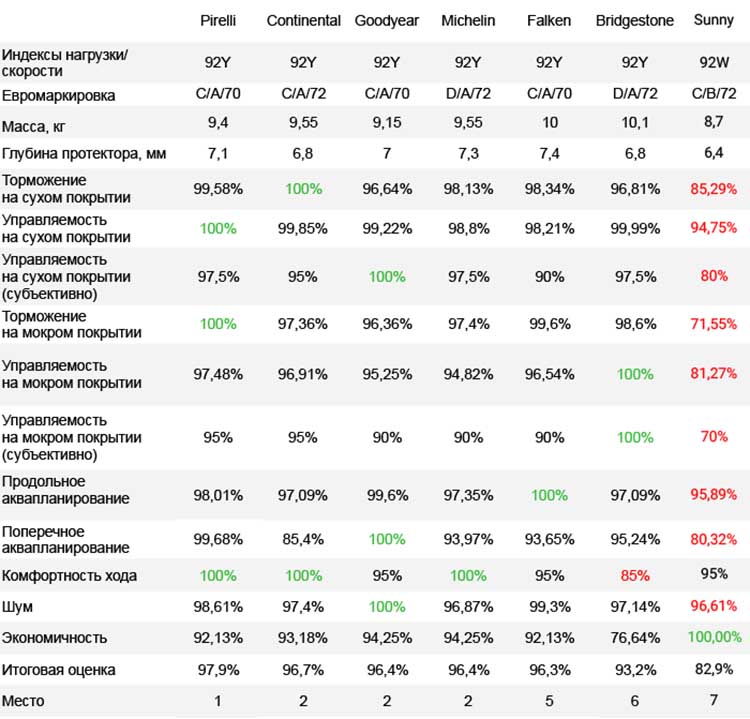
On wet pavement, all tires provide good handling, and the only exception was the Sunny, which, according to Benson, behaves as if the manufacturer did not prepare them for such conditions, and a dangerous tendency to skid is combined with slow reactions to the driver's actions. The other tires did not have any difficulties, but they differed in their characteristics, and the fifth and sixth places were taken by Goodyear and Michelin, respectively, whose lap time differed by only half a second. Michelin had a certain tendency to understeer in long turns, but otherwise, the behavior of the tires was reliable and stable. It is worth noting that the Pilot Sport 4 S was the oldest model in the test, and it has already been replaced by the Pilot Sport S 5 tire, which the manufacturer says has significantly improved characteristics.
Goodyear traditionally showed themselves from the best side, but also slightly lagged behind the best tires in this discipline in terms of overall grip level, so although this is still a good option, there are already fresher and more effective models on the market.
The Falken tires were somewhat surprising, as they did not perform very well on wet pavement in other tests, but this time they demonstrated a very high level of grip and stability, thanks to which it is easy to drive at high speeds, and in general, the FK520 is clearly better than the tires of the previous generation, Azenis FK510.
Continental, as usual, copes well with all tasks, although there was a slight tendency to understeer, and about the new Pirelli, Benson said that it is a "fantastic tire" with a clearly higher grip compared to tires with less good results.
Pirelli could have taken first place if it weren't for the Bridgestone tires, which allowed the car to be driven as if there was no water on the track at all, and it seemed as if the company had taken a "rain" rubber compound from motorsports and made a road tire out of it.
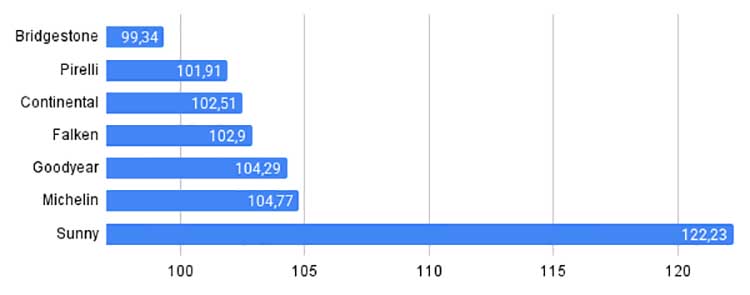
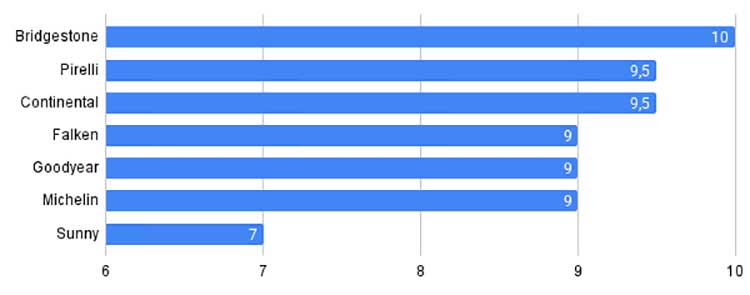
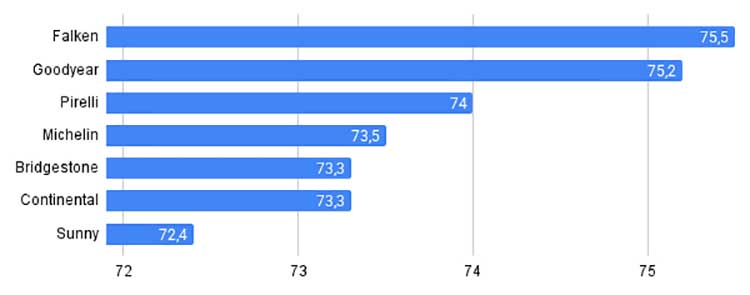
The shortest braking distance on wet pavement was recorded by Pirelli, and all tires, except for Sunny, showed very good results with a maximum difference of only 3.8%.
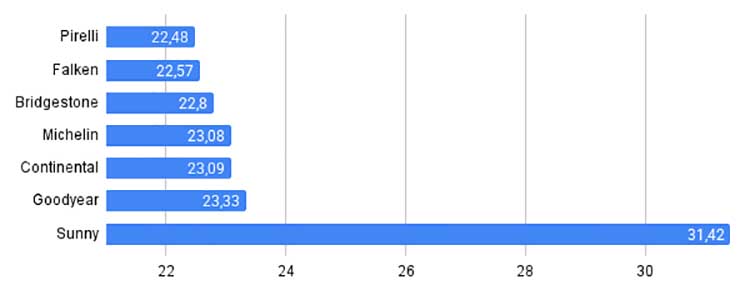
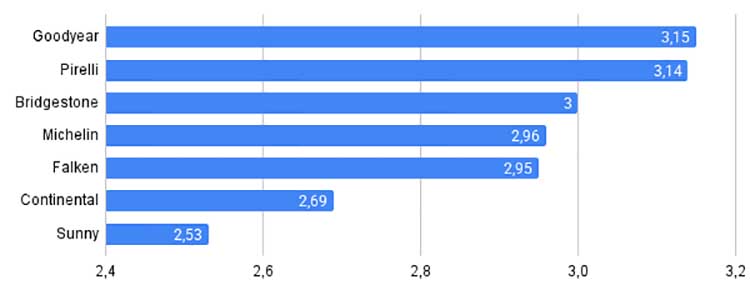
In the tests for resistance to aquaplaning, Pirelli again had excellent results, but here the first place was taken by Goodyear. The Sunny tires again lagged behind all participants.
Dry Asphalt
On dry pavement, the Sunny tires also failed to provide good handling, as they have a tendency to understeer and also significantly worsen the stability of the rear axle. At the same time, the Falken tires on the next line confidently hold the grip, including when changing lanes, which improves the level of safety. Michelin and Goodyear received good ratings, and the first tires are very predictable (only the grip on the front axle could be slightly improved), and the second ones are reliable at the limit of grip.
The top three included Continental, Bridgestone, and Pirelli, which all guarantee excellent handling in dry weather. There were only minor differences between the tires, and Continental deserved praise for their "monumental" grip and precise reactions in a calm mode, but they lacked stability in really high-speed turns, while Bridgestone also had "incredible" grip and a fast response to steering actions, but the disadvantage was not the best informativity in the middle and at the exit of the turn. As for Pirelli, they have very high grip in turns and also behave extremely predictably.
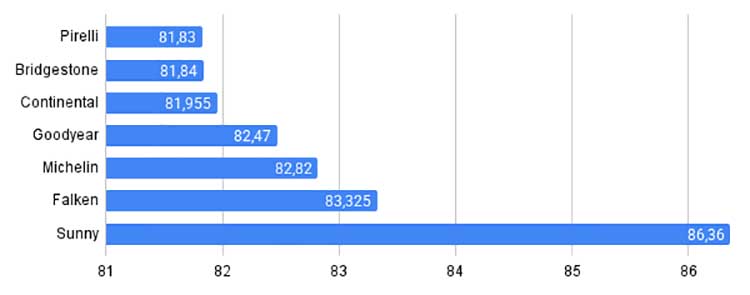
In the braking efficiency test on asphalt, Continental outperformed Pirelli by only 0.4%, and the difference between the tires in first and sixth place was less than 4%.
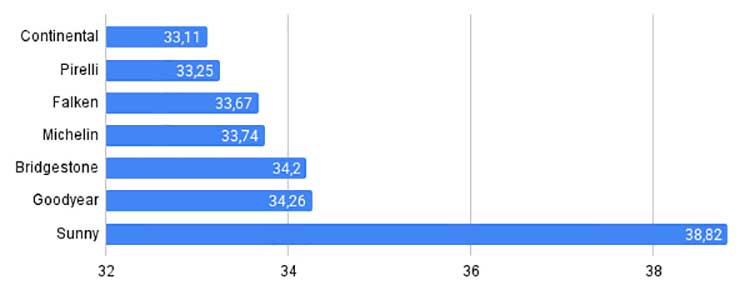
The quietest tires among those tested were Goodyear, from which Falken slightly lagged behind. However, although the noise level of the Sunny tires was 2.5 dB higher, the measurements were taken outside the car, and the difference was not noticeable in the cabin.
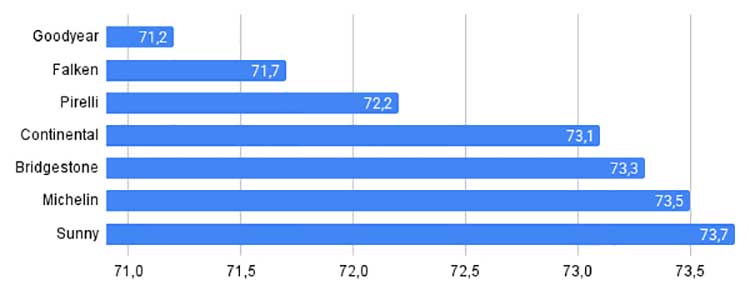
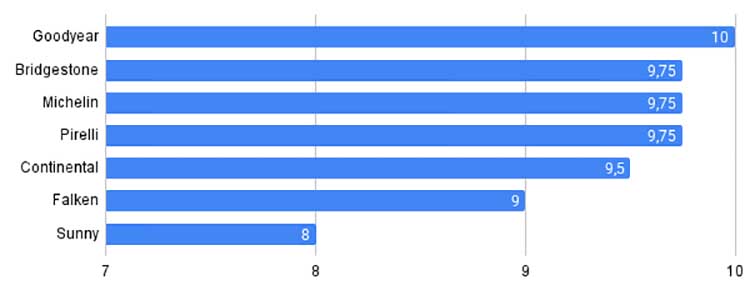
The best tires in terms of mechanical comfort were Continental, Michelin, and Pirelli, and the Bridgestone had a slightly harder ride, which is generally characteristic of this model.
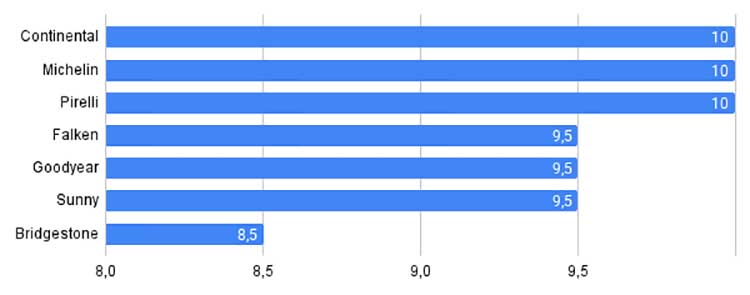
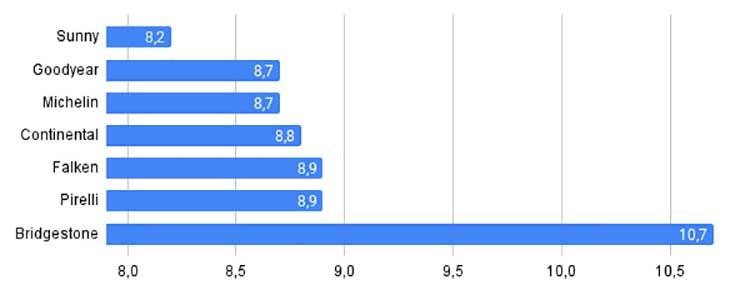
A unique advantage for the Sunny tires was the lowest rolling resistance among all the tires tested. The indicators of the other tires differed insignificantly, and only Bridgestone had a result that was 30% worse than Sunny, which is surprisingly much.
Test Results
The new Pirelli P Zero tires took first place in their debut, which outperformed all competitors on dry pavement and were one of the best on wet pavement, and also provided a good level of comfort, and only the rolling resistance was relatively high.
Silver was shared between Continental, Goodyear, and Michelin (the SportContact 7 rating was slightly better, but Benson placed all three tires on the second step). All tires are examples of very effective modern UHP-class tires, and Continental works well on dry asphalt and provides good ride smoothness, as well as quickly responding to steering actions, so taking a high step was not hindered by even average resistance to aquaplaning.
Goodyear slightly lag behind some competitors in terms of braking efficiency, but received very high ratings for handling, ride comfort, noise, and economy, and of the four leaders of the test, they are usually also the cheapest on the European market. Michelin also has an excellent balance of characteristics and very good handling. At very high speeds, Michelin was "not the most sporting", but if you don't often go to the racing track, these tires will also be highly recommended.
The strong points of the Falken Azenis FK520 were high grip on dry and wet pavement, low noise, as well as the best resistance to aquaplaning on a straight line among the test participants. With lateral aquaplaning, the Falken tires cope worse, and the ride was a bit stiff, but overall, this is a very good tire with an attractive price that will perfectly suit everyday life.
The Bridgestone Potenza Sport tire took only the penultimate place, and the reason was that the rolling resistance was so high that, according to the new rules of the euro mark, they should be withdrawn from production, which makes the test results a little less relevant. In addition, high wear of the outer shoulder was noted after the handling tests, but if this problem is solved and economy is improved, Bridgestone will be one of the best tires in its class.
The Sunny NA305 tire did not bring any surprises and took the last places in all disciplines, except for the noise and energy efficiency tests. At the same time, the grip was not relatively, but really weak, and it's worth noting the 40% lag behind Pirelli in the braking efficiency tests on wet pavement. According to Benson, when driving on a high-speed highway, where the car on Pirelli has already stopped, the car on Sunny will continue to move at a speed of 70 km/h, and this is a really bad result.
Source (including photos): Tyre Reviews