Summer Tyre Test 2026 from Tyre Reviews
As part of his first of three summer tire tests for 2026, Jonathan Benson, the creator of the Tyre Reviews portal, compared the characteristics of 12 models in the size of 225/45 R17, using the Volkswagen Golf GTI as the vehicle.
All tires were purchased anonymously in free sale, and were selected as premium and mid-range products, as well as budget products, such as Goodride from the Chinese company ZC Rubber and Davanti, also manufactured in China and included in the lineup of the brand owned by the British trading company Oak Tyres.
List of participants:
On a wet surface, the economy-class tires immediately began to lag behind the competitors, and the worst time in the handling test was recorded by Davanti, which performed significantly worse than Goodride from the same price category. According to Benson, it was difficult to control the car because the tires poorly "gripped" the road, and "it was almost impossible to enter and exit a turn", so Davanti immediately receives a "Not recommended" rating.
Bridgestone and Goodride had almost the same lap time, but the Japanese brand's tires were subjectively much better, as they behaved predictably and reliably held the grip on the front axle, while Solmax 1 was not as stable, which is why only on them the pilot almost flew off the track. At the same time, Benson noted that the last time he tested Goodride, the tires were "horrible", and although the handling in this year's test was far from ideal, the manufacturer is definitely improving their characteristics.
Kleber and Vredestein both provided a pleasant ease of handling, and Kleber felt "almost sporty", which was a surprise for the expert, since usually tires from the Michelin sub-brand behave safely but boringly, and this time they really delighted with high traction when maneuvering.
The Debica tires surprised by the fact that on the first lap they felt like a cheap product, wanted to lose grip on the rear axle and struggled to hold the trajectory when entering a turn, but as soon as they warmed up, the lap time improved by almost a second, which is unusual. At the same time, on the roads, especially in cool weather, the tire characteristics will not be so good.
About Primacy 5, Benson noted that they behave in the "classic Michelin style" with a tendency to insufficient steering, very safely and with good ease of handling. Usually, when developing tires from the Primacy line, the company seeks to maximize their service life, which can harm the performance on a wet road, so they never lead during tests in similar conditions, and this time Primacy 5 again were only in the middle of the rating, which, however, does not mean that they cannot provide acceptable safety.
The Maxxis took a line above, which had previously already shown excellent results on a wet surface, and their only drawback was that they can lose grip too sharply in a turn, and its restoration takes a relatively long time, but otherwise, there were no complaints about the tires.
The Kumho also performed excellently, becoming the fourth in lap time, and Benson stated that "they don't create any reasons for concern". "I just drove a lap and thought: 'Excellent, no unpleasant surprises', and that's one of the most significant compliments you can give a tire", he noted.
Even better than Kumho, the Hankook tires performed, which entered the top three and "proved that they can definitely compete with the market leaders", and the car always clearly followed the trajectory. The time of Pirelli was half a second better, and Cinturato has more acute reactions to steering wheel turns, but they are also less predictable at the limit of adhesion, which worsened the subjective assessment. Continental, on the other hand, responded less quickly than Pirelli, but also lost grip less sharply, i.e. they were more balanced, which helped them take first place. "All three of these tires are incredible," Benson said. "Kumho also performed well, but all the tires from the top four could use a little more grip to really show themselves well on a wet surface".
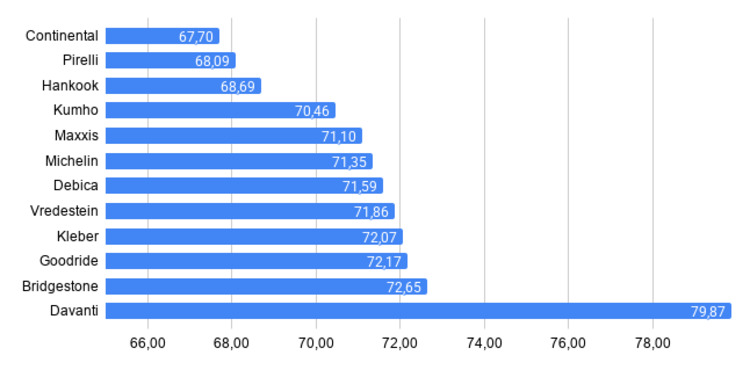
The four leaders from the previous discipline were also the best in the braking efficiency test on a wet surface, but in a slightly different order, which happens when the difference between the tires is so small. There were also tests on a circular track, where cross-adhesion is assessed, and the top four again confirmed their superiority.
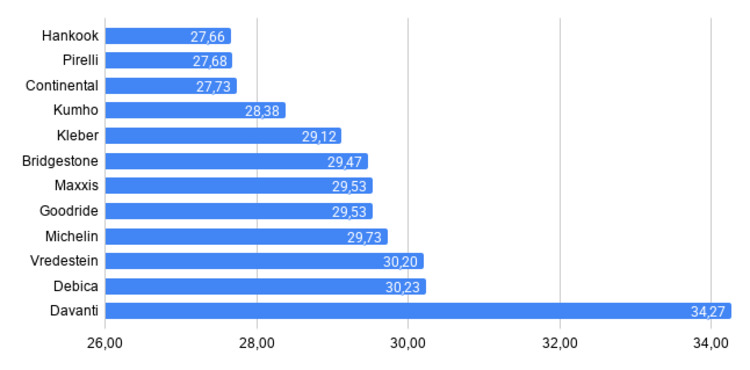
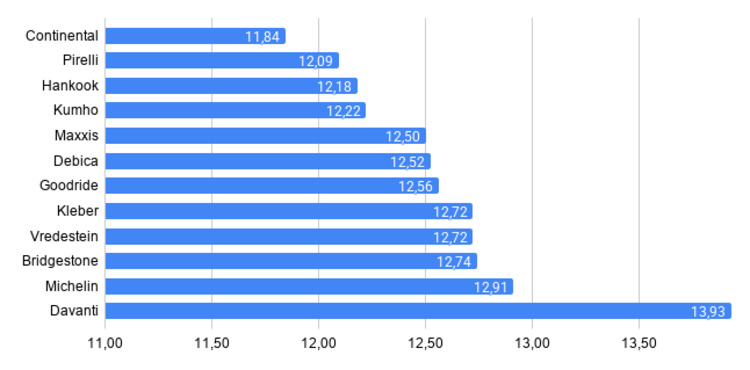
In the aquaplaning resistance tests, Hankook, Michelin, and Continental were recognized as the best, while the last lines were occupied by Davanti and Kumho. It is especially worth noting the Debica tires, which better than any of their competitors resist aquaplaning in a turn.
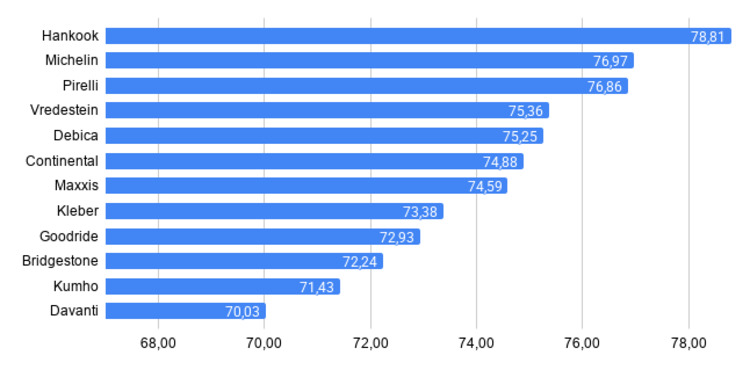
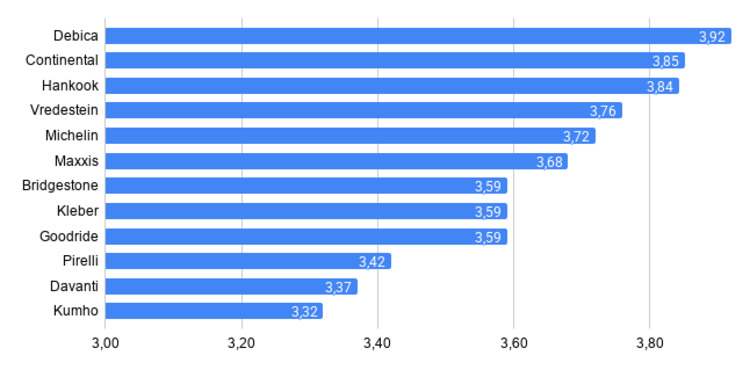
On a dry surface, the budget Davanti and Goodride were the worst in handling, and regarding the latter tires, Benson noted that their indicator could have been better, but on one lap he made a mistake, and usually the results of such laps are ignored, but it was decided to take them into account, since the tires themselves greatly complicated the management.
Bridgestone and Debica were able to provide good grip, but they are not suitable for a racing track, and this is quite expected, since for tires of this class, braking properties and comfort are more important than handling on a dry surface. At the same time, Debica delighted with excellent ease of handling, which combines with a low price (in Russia, however, their manufacturer - Goodyear - is currently not working).
The Maxxis tires were a real surprise, which, judging by the relatively long braking distance on a dry surface, do not have particularly strong grip in such conditions, but at the same time, thanks to better handling, they took first place in lap time. "If you want to find inexpensive 17-inch road tires that can deliver pleasure on the track, maybe this is what you need," Benson noted.
Pirelli, Kumho, Continental, and Hankook also showed themselves from the best side, and in the subjective rating, the victory was won by Kumho and Hankook, which in terms of dynamic characteristics slightly outstrip Pirelli, in turn, superior to Continental.
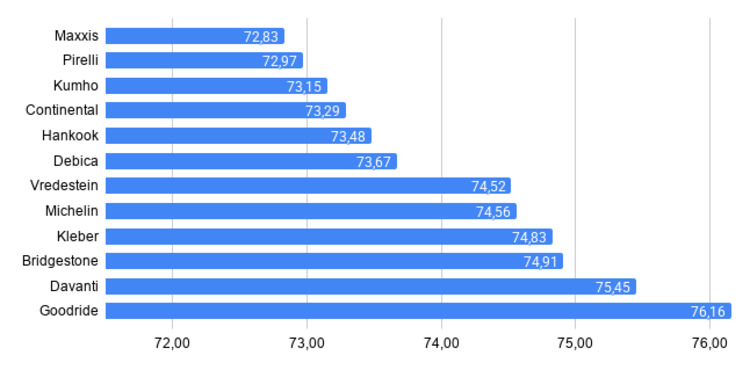
In terms of braking performance on a dry surface, Maxxis, as already mentioned, do not enter the top list, and the best in this discipline were Pirelli, followed by Continental and Kumho.
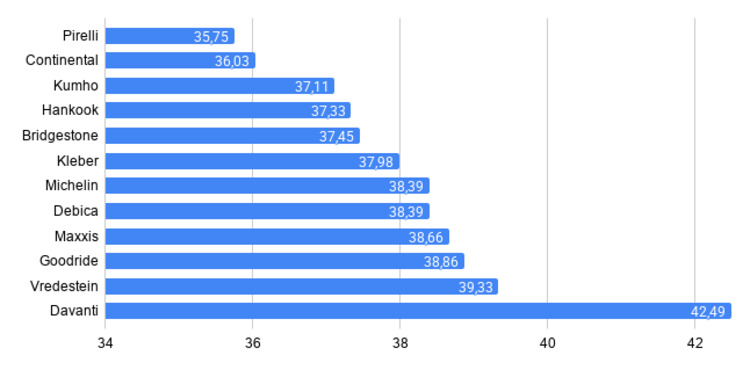
The most comfortable were the Michelin and Debica tires, while the Continental were a little more noisy, but in general, all participants showed themselves approximately equally, and the only exception was the budget Davanti and Goodride. Both tires provide not the best smoothness of the ride, but at the same time, it is interesting that they also had the lowest level of external noise.
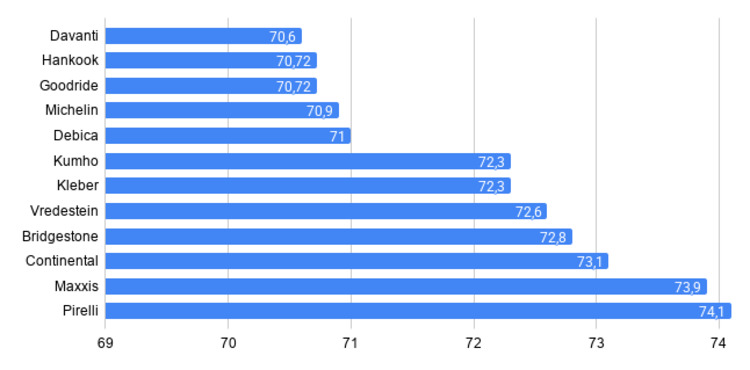
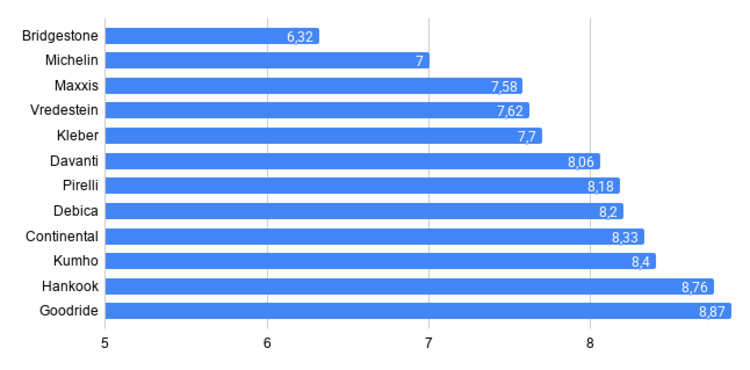
In the rolling resistance test, Bridgestone took first place, and their result was 10% better than that of the nearest competitor, and perhaps this explains their relatively weak performance on a wet surface, since improving fuel efficiency and increasing grip in the rain are conflicting goals.
The first line in the final rating was shared by Pirelli and Continental, and the first tires provide excellent grip in any conditions, including during fast acceleration, and their main drawbacks should be considered a high level of noise and average resistance to aquaplaning, while PremiumContact 7 is very efficient on a wet surface, where, for example, they quickly stop the car and showed an excellent lap time, while the noise is also elevated, and the economy is not at the level of the best tires, and on the track, Continental was not as reliable as more sports models.
Next come the Hankook Ventus evo, which confirmed that Korean manufacturers are starting to produce tires that can compete on an equal footing with products from leading world brands. Hankook deserved high marks for a short braking distance on a wet surface, good resistance to aquaplaning, a sporty character, and confident behavior at the limit of adhesion, and the drawbacks were reduced economy and not the best braking efficiency on a dry surface.
Immediately after Hankook, the Kumho Ecsta Sport followed, so the test was very successful for the brands from South Korea. Kumho earned the same number of points as Bridgestone Turanza 6, and their key advantage is a very good balance between grip on dry and wet surfaces, which combines with predictable and confident behavior. At the same time, the resistance to aquaplaning was one of the lowest among the participants, and the comfort could also be improved. In turn, Bridgestone stood out with very low rolling resistance, but at the same time, they lagged behind the leaders on a wet surface.
Michelin Primacy 5 was recognized as quiet, comfortable, and economical tires, capable of providing high safety on both dry and wet surfaces, and the fact that they took sixth place is due to the fact that the grip was not the highest, and this affected the length of the braking distances and handling.
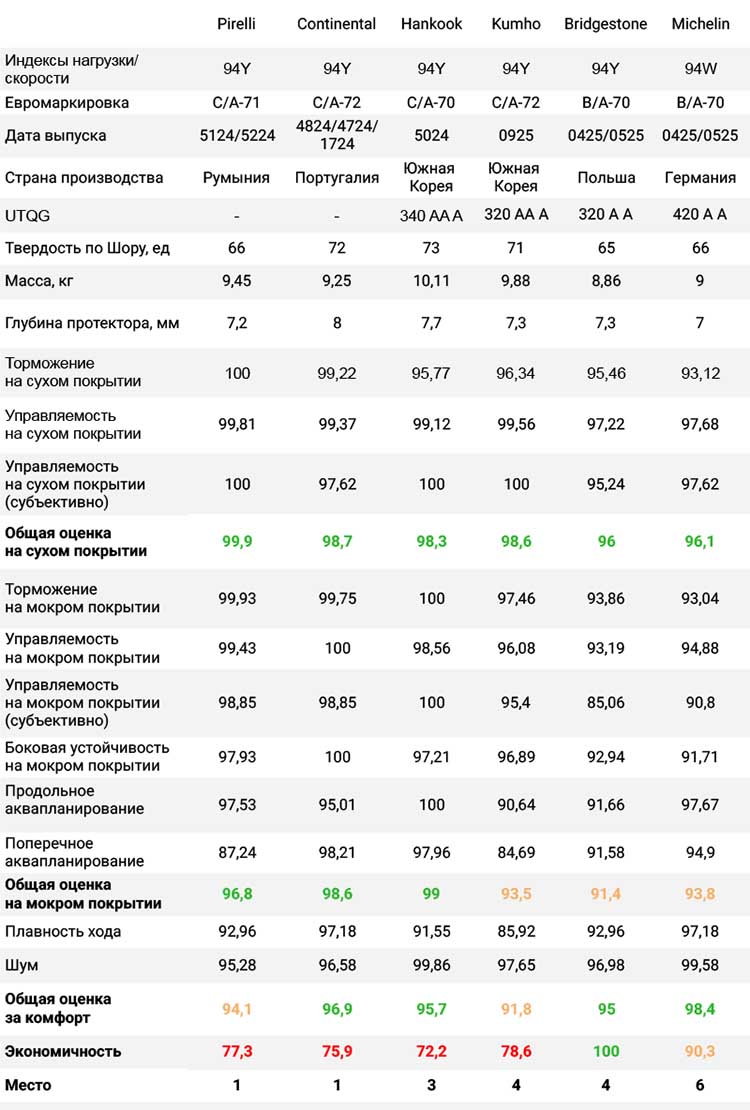
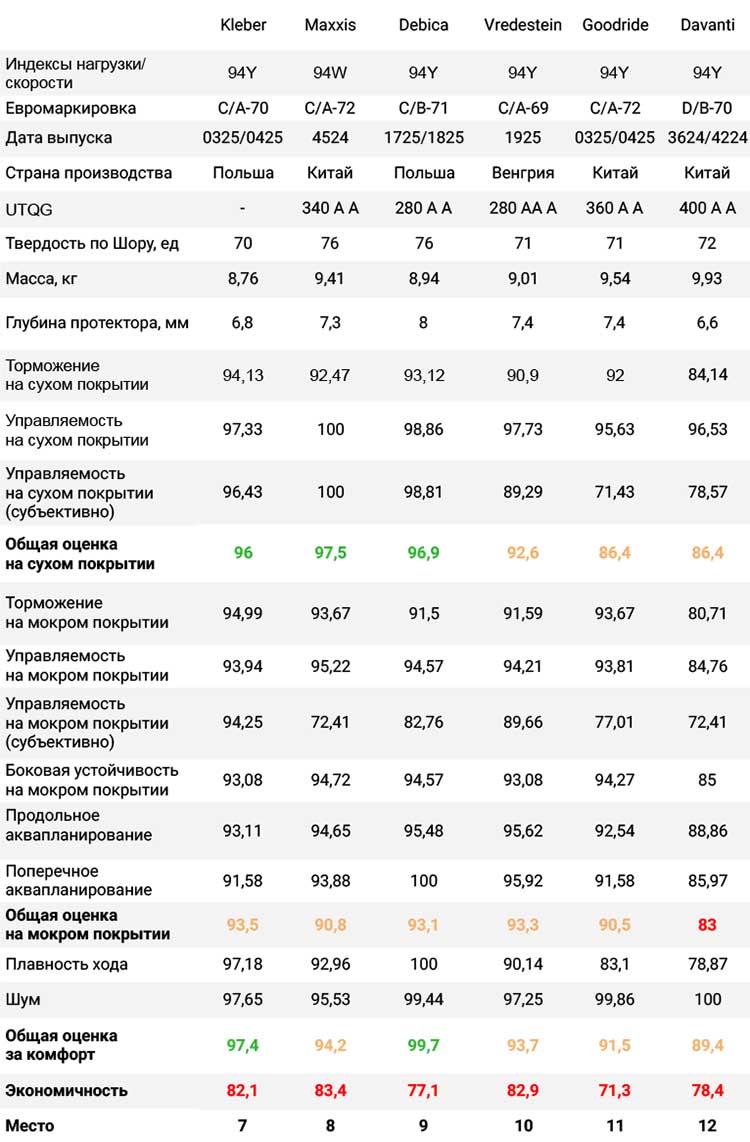
One line below is another Michelin tire - Kleber Dynaxer HP5 - which demonstrated good versatility and did not show significant drawbacks in key disciplines, but conceded to the test leaders in terms of grip on both wet and dry surfaces.
The Maxxis Premitra HP6 tires surprised this time with the best lap time on a dry track, due to excellent handling sensitivity, however, on a wet track, the tires behaved somewhat unstable at the limit of adhesion, which worsened the subjective assessment.
The ninth place is occupied by Debica Presto UHP2, which have a very good level of comfort and excellent resistance to transverse aquaplaning, and, as Benson noted, "surprisingly sporty handling on a dry surface for tires of this price category". However, Debica has only average performance on a wet surface, and in addition, the characteristics change significantly when heating up and, accordingly, cooling down.
Vredestein Ultrac+ failed to get into the top part of the rating due to the characteristics on a dry surface, which were "below average", and in addition, the tires also quickly overheated during aggressive driving. At the same time, Vredestein is well resistant to aquaplaning and has a sufficiently low rolling resistance.
The last two lines were given to the budget Goodride Solmax 1 and Davanti Protoura Sport, which both differ in a low level of noise. At the same time, the first tires seriously worsen the handling on a dry surface and behave unstably at the limit of adhesion, and the second showed very weak results on a wet surface, so it is not recommended to buy them.
Source (including photos): Tyre Reviews