Summer tire test from Netzwelt — 2026
The German online portal Netzwelt has published the results of their first tire test, which was conducted with the help of Henning Klipp, an experienced tire tester who previously worked at Auto Bild and later founded his own company, Tempotire.
Six summer tires in the popular size 205/55 R16 were tested, and one of the main goals was to find out if cheap tires from Chinese brands can be a serious alternative to products from more well-known Western brands. The tests were conducted at the Contidrom proving ground near Hanover, which is considered one of the best in the global tire industry.
The list of participants includes:
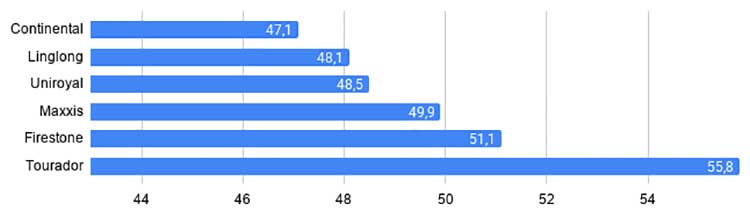
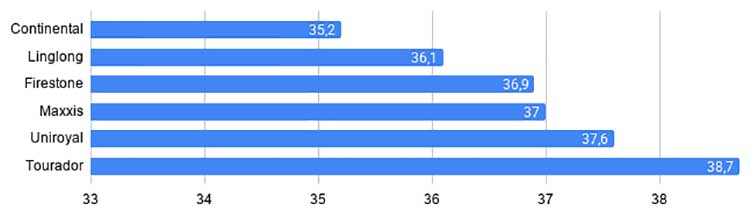
The effectiveness of tire braking is crucial for ensuring safety, and in this part of the test, Continental was the best on both dry and wet surfaces, while Tourador showed the worst results.
On the wet track, the braking distance of the Continental was almost nine meters shorter than that of the Tourador when stopping from 100 km/h, which means the remaining speed would be around 40 km/h, and this is definitely an unsatisfactory result. On dry asphalt, the differences in performance were not as significant, but the remaining speed of the car on the Tourador (also when braking from 100 km/h) was still 30 km/h.
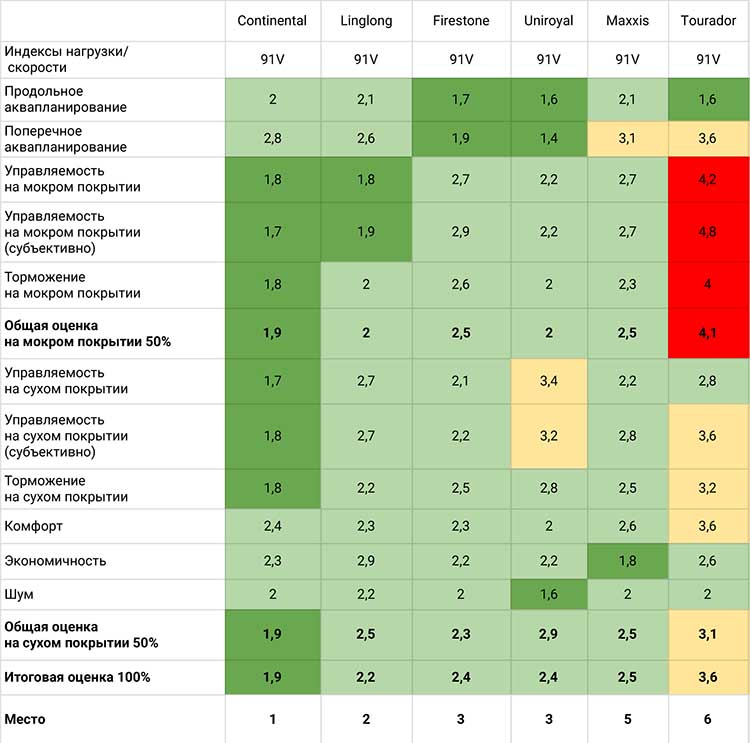
In the aquaplaning resistance test, almost all tires showed good results, and Uniroyal Rainsport 5 was the best, confirming its positioning as a "rain" tire and very effectively draining water from the contact area, including due to the deepest tread among the participants. At the same time, Tourador also has a pattern with wide and deep longitudinal grooves, but this does not help them at all, and the tires lose contact with the road much earlier than their competitors.
Uniroyal also surprised by taking first place in the external noise test, and this despite an open aggressive pattern, clearly designed to enhance grip in rainy weather. However, all tires were quite quiet, and the difference between them will be imperceptible in everyday life. The most economical were Maxxis, which can reduce fuel consumption by 2% compared to Linglong.
Results
Continental PremiumContact 7 took the expected first place in the overall test, which were the most expensive (and one of the heaviest) tires in the test, and the experts noted that they have become significantly better than the previous generation model - PremiumContact 6 - in terms of handling on both wet and dry surfaces. Thanks to reliable grip, Continental provides dynamic handling, precise response to steering wheel turns, and good informativeness, and also behaves predictably at the limit of grip. Braking distances are very short, but the resistance to aquaplaning is relatively low, and as for comfort, Continental shows its sporting character by sometimes transmitting vibrations to the cabin when driving over large transverse joints. There are no problems with noise, and the testers stated that the manufacturer has probably deliberately sacrificed comfort for the sake of improving driving qualities and safety, and this also applies to fuel economy, which was found to be average.
Chinese Linglong is currently making every effort to get rid of the image of a manufacturer of exclusively cheap products and establish itself in the European market, and, for example, since mid-2024, it has been supplying tires for Volkswagen Tiguan in the region. The seriousness of their ambitions is also evident from the fact that the company has built a plant worth over 800 million euros in Serbia, which was launched in 2022, and it was there that the Comfort Master tires were produced, which took silver in the test and outperformed products from second-line brands owned by world market leaders.
Linglong pleased with the fact that they very quickly stopped the car in any conditions (only Continental was better), and on wet surfaces, they also allowed for a good lap time, which was made possible by balanced behavior and high grip, precise reactions, and good informativeness. At the same time, on dry asphalt, handling is no longer so commendable, and Linglong responds sluggishly and requires large steering wheel angles, and lateral grip and traction can also be clearly improved. Linglong is also very quiet and comfortable, but rolling resistance is high, so fuel consumption compared to the leader (Maxxis) will increase by 0.1-0.2 l/100 km.
The Firestone Roadhawk 2 performed well in the dry surface tests, demonstrating stable reactions to steering wheel turns (although the sensitivity of the steering is not as high as one would like) and effective braking, but on wet surfaces, the grip is not so reliable, especially in sharp turns, and there is a pronounced tendency to skid. At the same time, the tires behave safely at the limit of grip on both dry and wet asphalt. Firestone also effectively resists aquaplaning, and the noise level is average, as is the rolling resistance.
Uniroyal RainSport 5 (on the European market, the brand belongs to Continental), which the manufacturer promotes as "rain" tires, also stand out for their excellent resistance to aquaplaning, and on wet surfaces, they have short braking distances and stable handling - although there is a tendency to skid in tight turns, and reactions are somewhat slow. On dry surfaces, Uniroyal clearly lacks cross-grip and informativeness, which will not please fans of sporty driving. At the same time, if comfort is important, then the tires are fine, and they also have low rolling resistance.
The Maxxis Premitra HP6 took fifth place, which has only average braking qualities on dry and wet surfaces, which means that their manufacturer - Taiwanese Cheng Shin Rubber/Maxxis International, which is working to move from the budget to the medium segment on the European market - still has something to strive for. On dry surfaces, the tires behave reliably and confidently, but on wet surfaces, there is a tendency to skid, and reactions to steering are not the sharpest, and in addition, resistance to aquaplaning was below average. Maxxis also has a relatively hard ride, and they start to hum when driving through turns at high speed, and another feature of theirs is that, although they were the heaviest in the test, the Premitra were also the most economical.
The budget Tourador X Wonder TH1 (the brand belongs to the Chinese company Qingdao Otai Tire) took the last place, whose grip was alarmingly low on both dry and wet surfaces, and in the latter case, the braking distance from 100 km/h was nine meters longer than that of Continental, which is the length of two cars. In addition, as the experts noted, Tourador also significantly worsen handling, as the response to the driver's actions is sluggish and unclear, and the tires behave very unstable on wet surfaces, and also do not resist lateral aquaplaning well enough. In the comfort tests, Tourador stood out for their poor vibration absorption on uneven surfaces and humming in turns, and while budget tires are often very heavy, the X Wonder TH1 has a surprisingly low mass. However, these tires are definitely not able to provide a good level of safety.
Source, including photos: Netzwelt