
Test of 17-inch summer tires from Die Reifentester — 2025
In 2025, experts from the Die Reifentester portal have already tested tires of the 225/40 R18 size (test results can be read here), and now it's time to compare the characteristics of tires of a more modest size 205/55 R17, which were installed on the compact crossover Volkswagen T-Cross for this purpose.
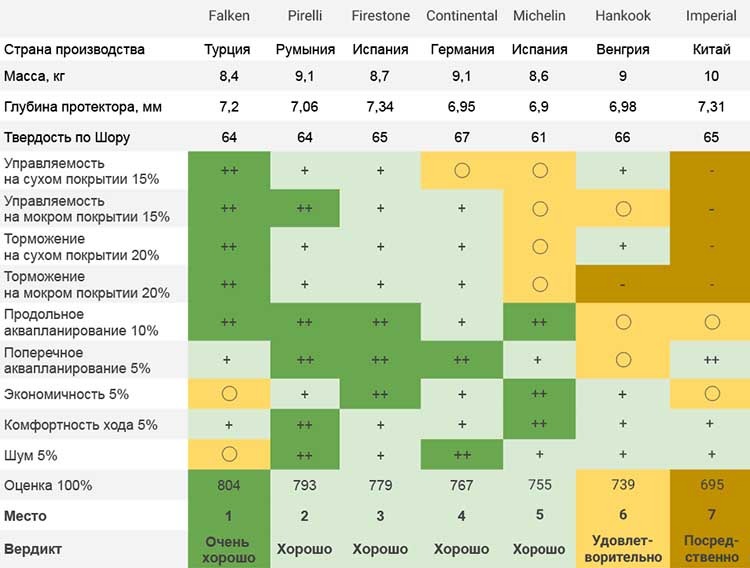
The list of participants included three novelties of the season at once: Falken Ziex ZE320, Michelin Primacy 5 and Pirelli Cinturato (C3), and they met for the first time in one test. In addition, Continental PremiumContact 7, Firestone Roadhawk 2 and Hankook Ventus Prime4 were tested, and in the budget tire category, Imperial Ecosport 2 were chosen (the brand with the loud name belongs to the Belgian trading company Deldo, and the tested tires were made in China).
The tests were carried out at the Pirelli test site in Vizzola Ticino, near Milan, which is known for its carefully thought-out configuration, allowing for a full assessment of various handling characteristics on wet pavement. It was this discipline that was the first, and the Pirelli tires, chosen as reference, showed themselves on their "home" track from the best side. On wet asphalt, the tires react accurately to steering wheel turns, and also behave in a predictable and controllable manner, including during sharp braking. In general, Pirelli easily coped with all the tasks that the driver could set for them behind the wheel of the not particularly powerful T-Roc (116 hp with a liter engine volume), for which they receive a rating of "Very good".
Continental and Michelin performed "not bad in their own way", but they clearly cannot compare with Pirelli, as they are not alien to a certain tendency to skidding, which could be considered a minor drawback, however, in DR they say that it is the full control over the car that allows you to get real pleasure from driving, and if Continental still earned a rating of "Good", then Michelin had to be content with a rating of "Satisfactory".
The Hankook company is known, among other things, for the fact that it has been supplying tires to leading automobile manufacturers for a long time, so it could be expected that the Ventus Prime4 would confidently pass the tests on wet asphalt, however, as strange as it may seem, the tires had difficulties when passing turns and the behavior was somewhat unstable, so the rating was "Satisfactory".
While Hankook did not meet expectations, Falken, on the contrary, surpassed them and demonstrated excellent stability in turns, for which they receive "Very good". At the same time, the Imperial reminded us of how much tires can differ, which clearly have reduced grip on wet pavement, so on these tires in the rain, you need to drive with increased caution.
Regarding the Firestone tires, they behaved very balanced and have no noticeable drawbacks, and the car is easily controlled in any situation, but the tires simply do not quite reach the level of Falken and Pirelli.
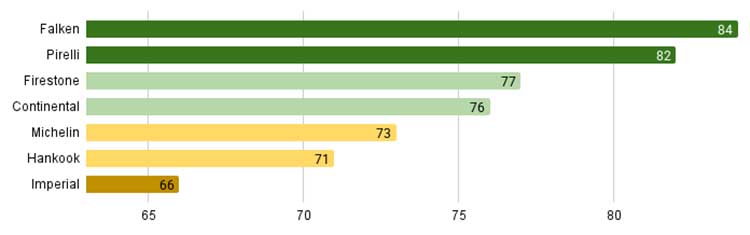
Handling on a dry surface was evaluated at the Stellantis automobile giant's test site in Balocco, about 50 km from Vizzola. This is a truly high-speed track with complex chicanes, series of turns and various radii of turns, and the best here were Falken. Next come Pirelli, which is expected, and high results are also shown by Firestone, and Hankook were able to improve their positions compared to the tests on the wet track.
All the tires in the first places behave very predictably, have good stability in turns, as well as when rearranging, including at high speeds, and all of them will provide a high level of safety in potentially emergency situations, for example, when the driver in the middle lane suddenly turns left.
Despite their premium status, Continental and Michelin again did not make it to the list of leaders, and the first tires have a tendency to skid, and the second to understeer, and in both cases, safety and driving pleasure decrease. At the same time, it should be said that in normal, not aggressive mode, these shortcomings will not be too noticeable, so both tires receive "Satisfactory".
Imperial had a chance to rehabilitate themselves after a poor performance on wet pavement, but they happily missed it and again behaved very uncertainly, forcing the ESP to activate, and it's easy to imagine what would happen without such a useful stabilization system. In addition, the tires do not inform about reaching the limit of adhesion, that is, up to a certain level of load, everything is relatively fine, but then the situation changes dramatically.

Good handling cannot be without effective braking, and on dry pavement, the Falken tires had the shortest braking distance, followed by Continental and Pirelli. Cheap Imperial tires in this discipline barely earned a rating of "Fair", and a little more and they would have received "Unsatisfactory". At the same time, if a tire receives a similar rating in a discipline related to safety, it automatically becomes its final rating according to DR rules.
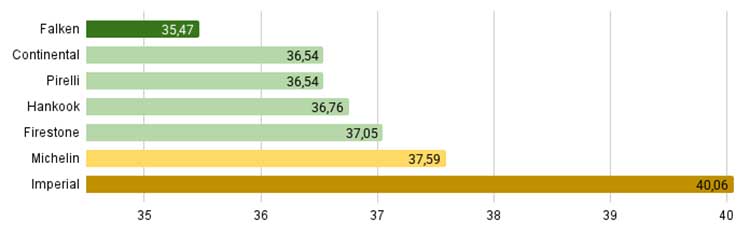
On a wet surface, the shortest braking distance was also at Falken, and the results of Continental, Pirelli and Firestone were about a meter worse (when stopping from 80 km/h). Michelin lags behind the leaders but still receives "Satisfactory", and the indicators of Hankook and Imperial were recognized as "fair".

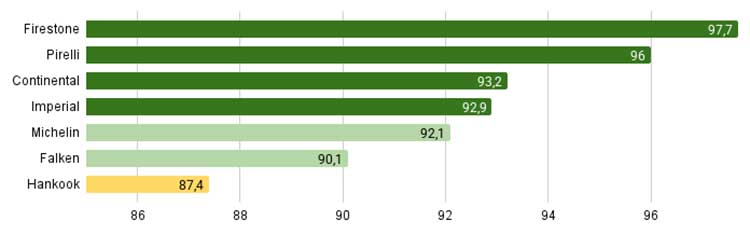
In the tests for resistance to longitudinal and lateral aquaplaning, the hour of the Firestone tires came, which in both cases took first place. In addition, Pirelli showed excellent results, and the worst of all participants this time was Hankook, but they also satisfactorily resisted aquaplaning.

Rolling resistance of car tires, which 15 years ago worried few people, now has increasing importance, since car manufacturers consider every gram of carbon dioxide emissions, as a result of which good energy efficiency occupies one of the first places in their requirements for tires for the initial equipment of new models. But this is associated with a very serious problem, since low rolling resistance and optimal grip on wet roads have long been considered incompatible. Now, tire companies are gradually finding ways to achieve a balance between these parameters, but so far they have not been able to do so completely, and in independent tests, safety remains the most important criterion, therefore, the weighting of the rating for economy in DR is only 5%.
Firestone and Michelin were the best in terms of fuel efficiency, and Falken and Imperial were on the list of lagging behind.

While the EU label indicates the level of external noise, DR specialists took into account the acoustic comfort in the car cabin, and all tires received good ratings on both smooth and rough asphalt. The quietest were Pirelli and Continental, and the last place was taken by Falken, which on rough pavement made a barely audible, but incessant hum.

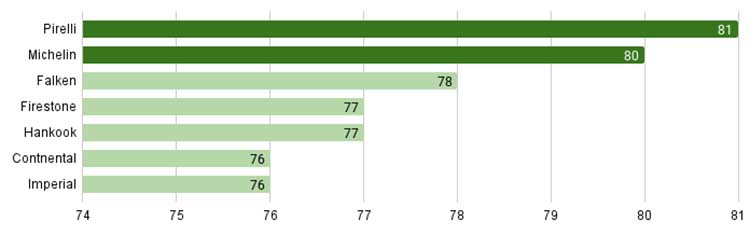
Ride comfort was evaluated on rough asphalt, cobblestone and concrete pavement with joints between sections, and again all participants easily coped with all the tasks, and the best were recognized as Pirelli and Michelin.
Verdict
Although usually in tests, premium tires from well-known manufacturers win, sometimes it happens that a surprise is presented by a product from a less well-known brand, and this is what happened this time, and the victory in the test is celebrated by the new Falken from the Japanese company Sumitomo Rubber Industries, which are very efficient on both dry and wet pavement and have only minor drawbacks, such as a relatively high noise level and not the best fuel economy.
Second and third places are taken respectively by Pirelli and Firestone, which did not allow themselves to fail in any discipline, that is, they have a commendable balance of characteristics, and Continental and Michelin - eternal rivals, accustomed to winning tests - this time do not make it to the top three, and the reason is that the PremiumContact 7 has unbalanced behavior on dry asphalt, and Michelin, in particular, had relatively long braking distances in any conditions.
Hankook tires took only sixth place, but DR emphasizes that the differences that affect the ratings become noticeable only with an aggressive driving style and in emergency situations, so in general, Ventus Prime4 can also be considered good tires, just the level of competitors was even higher.
It could be easily predicted in advance that a budget tire would take the last place, and experts noted that Imperial has low performance in any weather, and since in the test for braking efficiency on wet pavement they miraculously did not receive "Unsatisfactory", then they cannot be recommended.
Source: Die Reifentester. Photo: Dirk Vincken