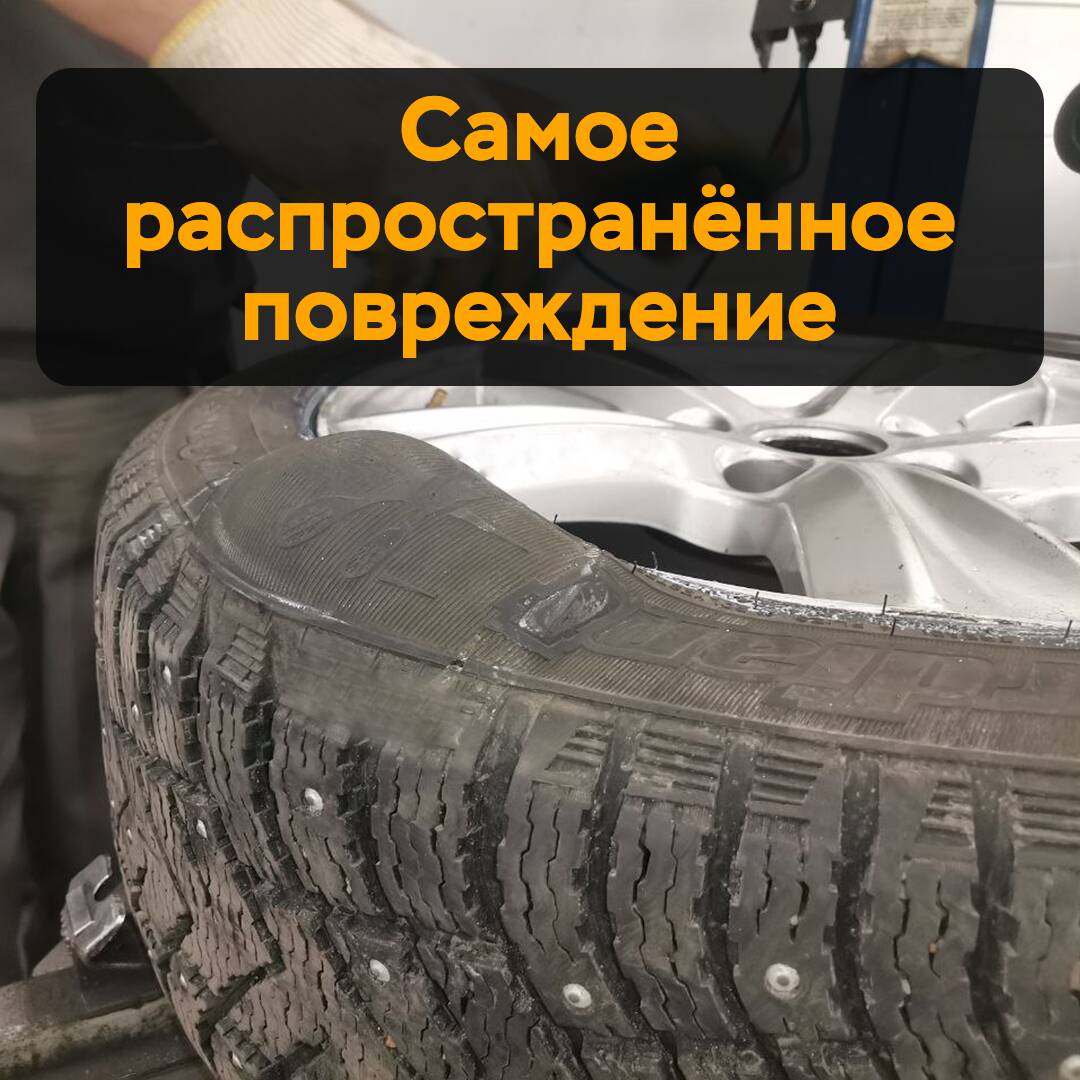
The most common damage
When buying tires, it's unlikely that any car owner plans to wear them out after only 30-40% of their intended lifespan. On one hand, it's logical, but still, a significant number of drivers do just that. The answer to the question "why" is simple and obvious - in the vast majority of cases, it's due to non-compliance with tire operating rules. Of course, along with cuts and punctures, a severe damage in the form of sidewall bulging, commonly referred to as a "bulge," is prevalent.
A "bulge" is dangerous due to its simplicity of occurrence and often irreparability. Bulges often serve as the reason for sending tires to the landfill halfway through their lifespan. Meanwhile, this can often be avoided by following a series of recommendations that tire manufacturers regularly voice. Today, we will group them together in this article.
1. First and foremost, it's, of course, adhering to the recommended pressure. Sidewall bulging is nothing but the destroyed threads of the carcass while preserving the outer rubber layer, with other layers weakening the tire in a specific area due to the pinching of the carcass threads between the rim flange and a road obstacle. Naturally, the likelihood of this pinching, even at low speeds, increases significantly. Therefore, it's crucial to follow the vehicle manufacturer's recommended pressure.
2. When driving onto curbs or obstacles, it's best to do so at as close to a 90-degree angle as possible.
Often, you have to park or use part of the road with a drive onto a curb. In this case, the drive is almost always done at an acute angle and with one sidewall. The tire is not designed for this. You should distribute the load so that the drive is done with both sidewalls, and if this is impossible, then such a drive should be done at minimal speed, so to speak "in a stretch." You can often see the completely opposite picture. The driver, often inexperienced, tries to jump onto the curb with speed. In this case, it will be difficult to avoid damaging the sidewall.
3. The worse the road, the lower the speed.
This sounds banal, but many people ignore this rule. No matter how much you're in a hurry, the rupture of the carcass threads doesn't always end with a bulge. The rubber also needs a little time to get a puncture. In this case, you'll have to stop and change the wheel, which means additional expenses not only of time but also of money.