Five studded winter tires in the "AutoReview" test
In its new test, the Russian magazine "Autoreview" compared five models of studded winter tires in the size of 215/60 R17, with one of them being tested twice with different stud protrusions. This happened because the Armstrong Ski-Trac S tires (a brand owned by Zafco from the UAE, which bought it from Pirelli) had studs protruding only 0.4-0.5 mm above the tread surface, which is clearly insufficient for effective performance on ice. For this reason, the testers turned to the supplier-distributor, who initiated the tests, and it was decided to experimentally install 11-mm studs in the tires instead of the recommended 10-mm ones, and then compare the results in the tests to see how the change in stud protrusion would affect the tire's characteristics.
The opponents of Armstrong were Hankook Winter i*pike X and Yokohama iceGUARD iG65, as well as two budget tires from Chinese manufacturers: Landsail ice Star iS37 and Triangle Icelynx TI501.
The tires were tested on ice, snow, wet, and dry asphalt, and such parameters as acoustic comfort and smoothness of ride were also evaluated. The first place was taken by the Armstrong tires with extended studs, which shared the gold with Yokohama.
On snow, Armstrong showed good results, and on ice, everything depended on the stud protrusion, and its increase led to a significant improvement in performance. In the handling test, the tires easily outperformed all competitors, including Yokohama. At the same time, there were problems with comfort, as the noise increased and the smoothness of the ride deteriorated. As a result, the company that produces the tires - the Indonesian P.T. Elangperdana Tbk - analyzed the test results and this year recommends using studs with a length of 10.3 mm (and 11 mm in larger sizes), and this option should improve the balance between comfort and safety on ice. In the AR, it is noted that in this version, Armstrong "will surely become a worthy alternative to Chinese, and maybe even Korean, competitors".
In turn, Yokohama received a large number of points due to excellent performance on ice and, especially, on snow, and they also have good results on asphalt. However, again, there were claims about comfort, primarily due to the fact that the tires produce a low-frequency hum, most audible at speeds in the range of 60-80 km/h.
Next are the Landsail tires, and the experts expected them to take the last place, since the necessary stud protrusion for high traction on ice was only on one tire in the set (which also indicates a low quality of stud installation). However, this did not happen, and the model from the Chinese company Sentury showed acceptable results on the ice track, which was probably helped by a well-chosen rubber compound: Landsail were the softest tires in the test, and, in addition, the manufacturer claims that the compound contains micro-pores that enhance traction on icy surfaces. However, it was not they who allowed the tires to take second place, but an aggressive tread pattern that provides high traction in deep snow. Despite a similar design, the tires also turned out to be quite comfortable, and in terms of smoothness of ride and acoustic comfort, only Hankook were ahead. However, the softness of the rubber compound negatively affected the properties of the tires on asphalt, and especially the effectiveness of braking on dry pavement. Thus, Landsail will be well suited for those who often drive on uncleared roads in winter, and you need to pay attention to the quality of stud installation.
The Hankook tires, which previously performed well in AR tests, and in 2020 took one place with Nokian Hakkapeliitta 9 SUV, this time surrendered even to the Chinese Landsail. The reason, as noted by the testers, may be that they are also made in China - although manufacturers, naturally, claim to adhere to uniform quality standards at all their facilities.
In contrast to all other tires in the test, the stud protrusion of the Hankook tires changed almost imperceptibly after the tests, which may be related to the design of the stud seats or the stiffness of the rubber compound. However, as it may be, the traction on ice was lacking, and the tires also showed average results on snow, and low results on wet asphalt. According to experts, this confirms the use of cheap rubber compounds. Hankook was the most comfortable tire among those tested, but also the most expensive, and in the AR, it was stated that such a price is unjustifiably high for Chinese-made tires.
The last place in the ranking is occupied by Triangle, which repeated the result of the previous year. In 2024, the Icelynx TI501 performed poorly on ice, including due to the low stud protrusion, and this year they were given another chance, but despite a different size and later production date, everything remained in its place, and on the icy surface, Triangle was declared "helpless". However, on the snow track, the tires showed themselves to be even worse, and their properties in deep snow were especially disappointing, where the car was pulled to the side, which was not the case with all other tires in the test. On asphalt, Triangle works well, which means they can only be recommended for use in large cities where the roads are well cleared in winter.
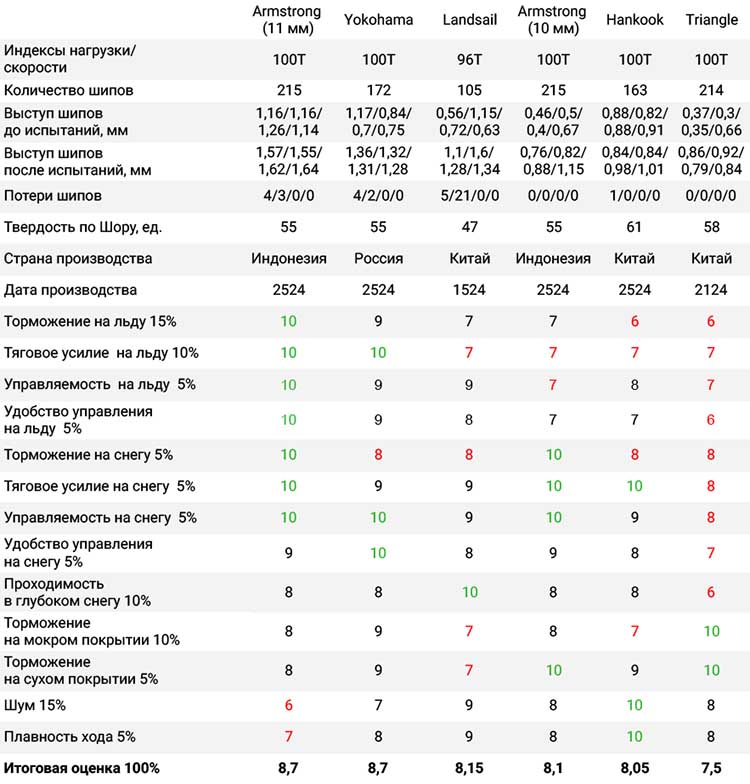
The full results of the test can be found on the Autoreview website.