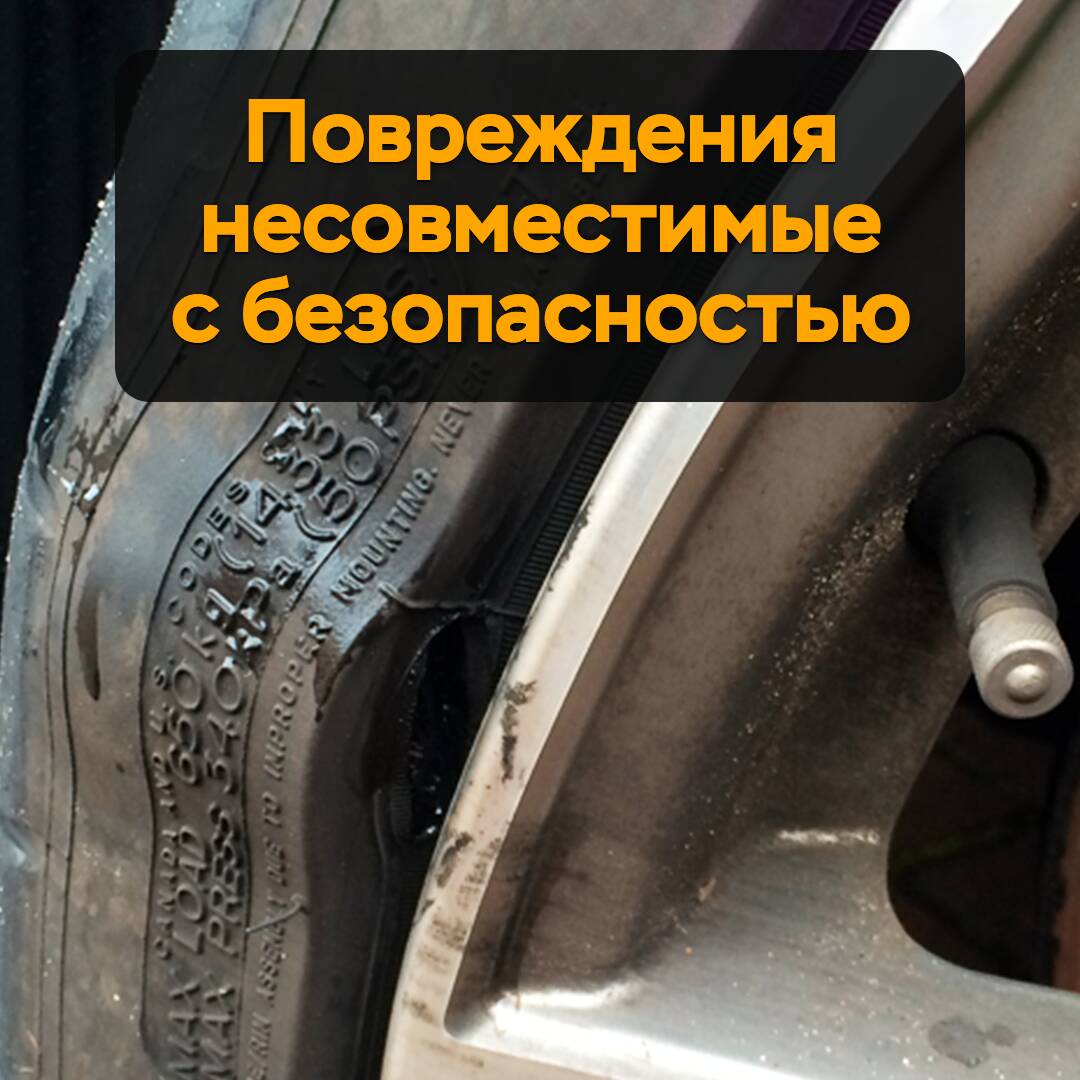
Damages incompatible with safety
Perhaps there is no car owner on our roads who has not encountered tire damage. Of course, everything depends on the total mileage, but even on perfect roads and just for one season, you can get into a situation where the tire receives an extremely unpleasant damage. At the same time, car owners do not lose hope of repairing the tire, since buying a new tire is a serious expense, and if the tire is no longer produced, it's a replacement of at least two tires on the axle! Can a serious puncture be repaired after all?
It's better not to risk it. Today we'll figure out why.
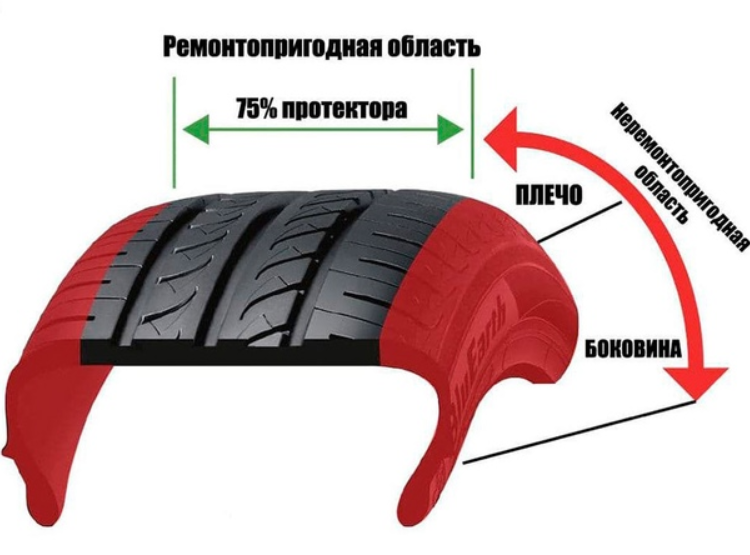
The thing is that there are non-repairable zones on the tire. In 100% of cases, these are the shoulder zone of the tread and the zone of the rim ring. Repair in this area is not only undesirable but also extremely dangerous. This is explained by the fact that the tire, despite its seeming homogeneity, consists of different materials and rubber compounds. The rubber compound at the rim ring, for example, is radically different from the rest of the tire's rubber compound. It is the least elastic and simply incompatible with repair materials. Any, even the slightest, repair of this area, especially under load, is dangerous. The same principle applies to the shoulder area of the tire. But in this case, the main factor is that this is where the junction of materials of different structures is located.
Some manufacturers do not recommend repairing even the sidewalls. On the one hand, it's strange, because "hot repair" of the sidewall of the tire is quite common. Yes, this is indeed the case, but there is a significant difference from repairing the tread. When repairing the tread running surface, everything is predictable and clear. In contrast to the sidewall, where there is often only one layer of textile carcass and a thin layer of coating rubber. When repairing this area, the tire fitter seriously changes the structure of the sidewall, and here a lot depends on the qualification and repair materials. In other words, the master who performed the repair is now responsible for the tire, and the manufacturer is no longer responsible for the further behavior of the tire.
Also, it's worth noting that a repaired tire always reduces your safety. This is explained by several factors.
Safety: repairing a tire can affect its strength and stability on the road, which can cause an accident. Even if the tire seems to be in good condition after repair, there is a chance that it will lose its reliability over time.
Not all damage can be detected: some tire damage, such as internal cuts or deformations, may not be noticeable during a superficial inspection. This damage can worsen after repair and lead to tire damage in the future.
Risk of re-breakage: a repaired tire can re-break or puncture in the same place where the repair was made. This can lead to a road accident or damage to the vehicle.
Not all damage can be repaired: if the damage is on the sidewall of the tire or in an area that cannot be repaired according to safety rules, the tire must be replaced.
In general, if you have a damaged tire, it's best to replace it with a new, safe tire to ensure reliability and safety on the road.