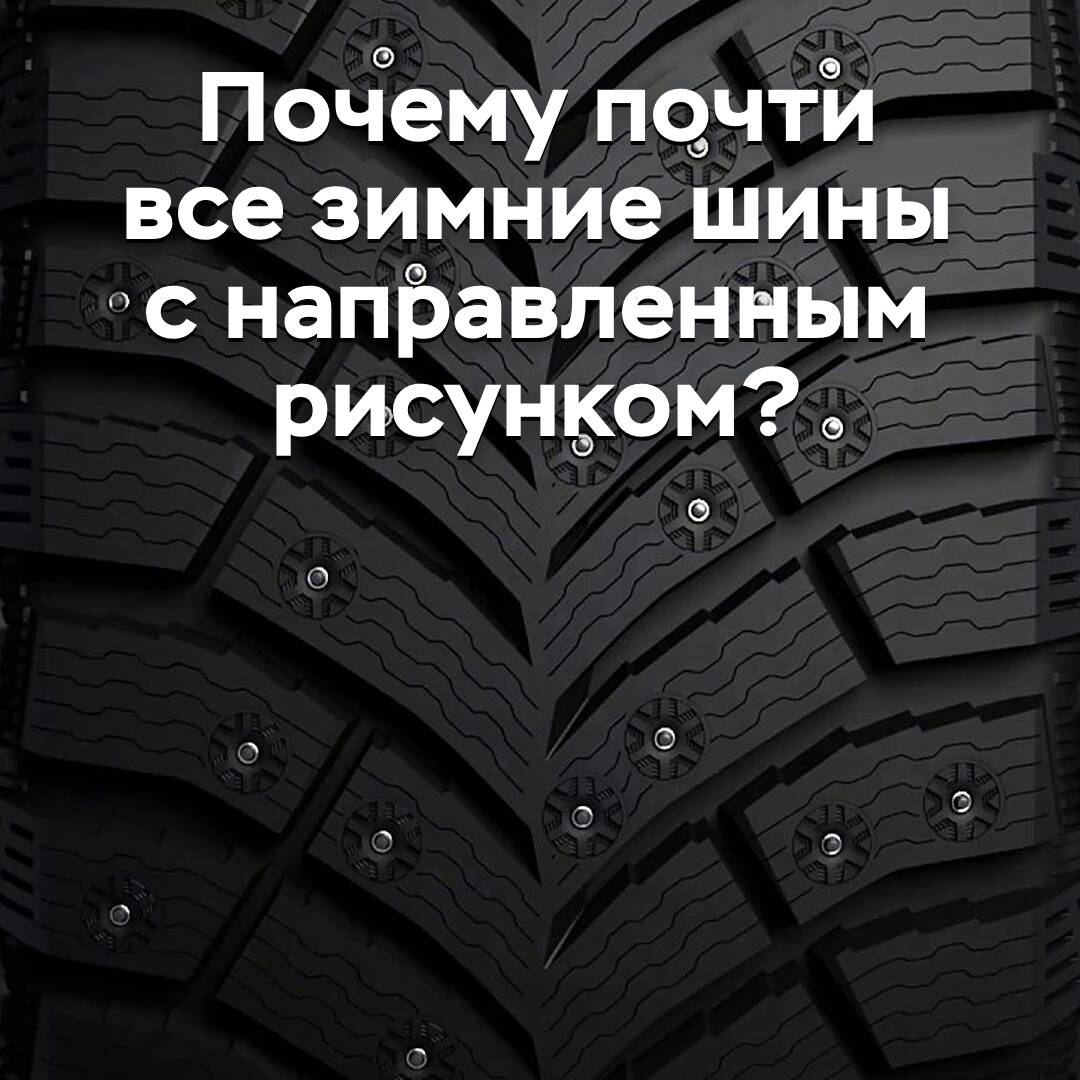
Why are almost all winter tires with directional tread pattern
The main task of a tire is to provide a contact patch with the road. The faster and more efficiently this is done, the more effective the vehicle handling will be.
At the same time, a tire can never brake on water. Even ice or loose snow has some grip, albeit minimal. Contrary to expectations, the most common road surface in urban areas is water. Yes, ice and snow are common, but when it warms up, all this turns into water.
Braking on water, as we said earlier, is impossible. If a tire brakes on a wet road, it means that part of the contact patch is dried by the negative profile. The bulk of the water and snow mass is removed by the main channels, and the lamellas remove the remaining water, drying the contact patch to the end. It becomes quite logical why the tread pattern of most winter tires is directional. This is the most effective tread pattern for water drainage. Literally, a handful of winter tire models have an asymmetric tread pattern, while directional tread is more common in commercial vehicles and off-road segment tires.
Tires are always a compromise of characteristics. A directional tread pattern is also the noisiest. This is where, among other things, lies the answer to why the majority of summer tires have an asymmetric tread pattern. But we'll tell you more about that closer to summer.