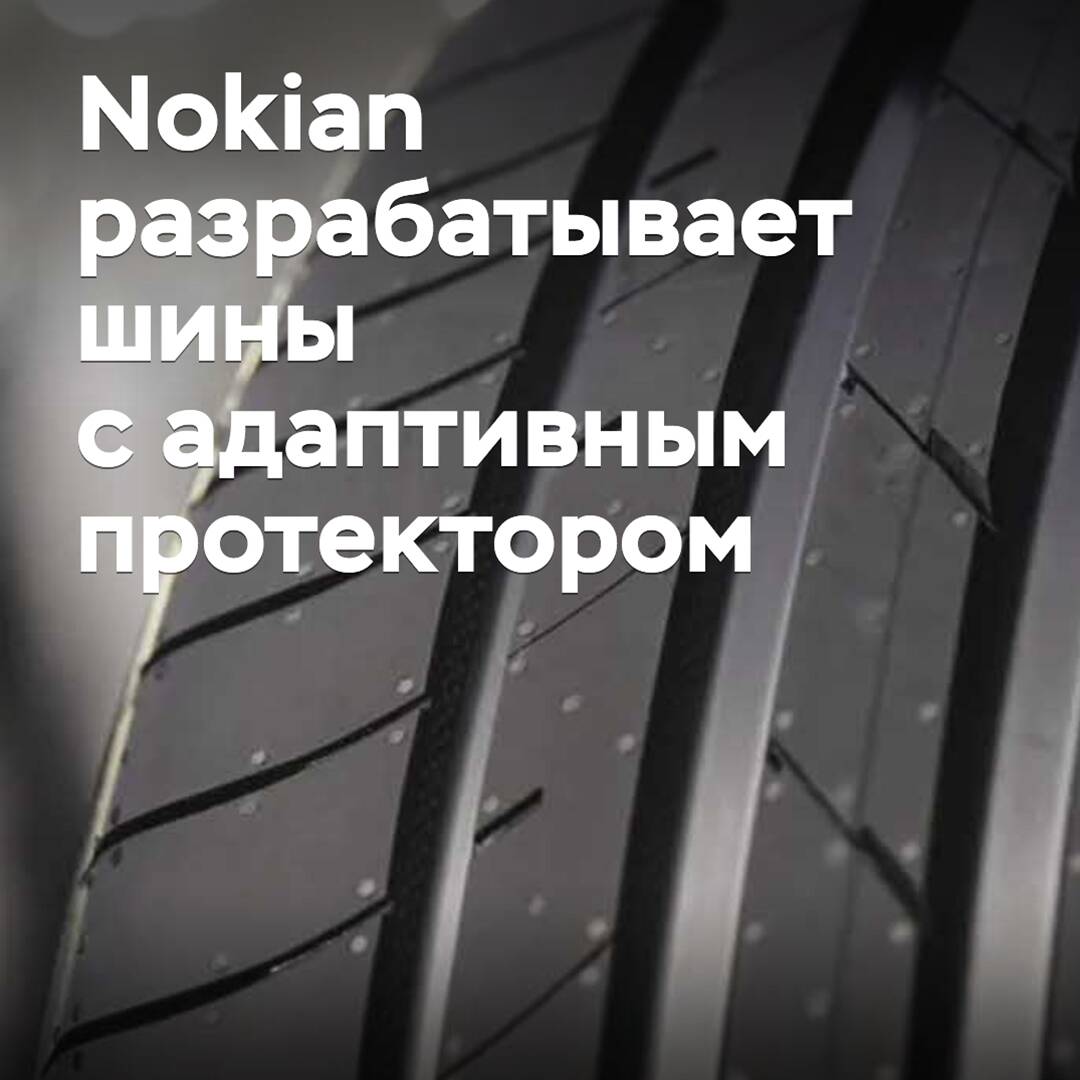
Nokian is developing tires with adaptive tread
In Nokian Tyres, they told about the key areas in which the company's research and development department is currently working.
"Safety will always be a top priority, but another important goal is to minimize the volumes of fossil raw materials used," says Teemu Soini, Nokian's Vice President of Innovation and Development. "By 2030, up to half of the raw materials we use will be either from renewable sources or recycled."
In 2024, Nokian introduced the Green Step Ligna concept tire, which features a new filler - lignin from wood - in its rubber compound, which the company calls a promising alternative to traditional carbon black, derived from a fully renewable source.
Development is also underway on so-called intelligent tires with built-in sensors that provide real-time information. The Intuitu technology is already being used in the production of tires for tractors and allows monitoring of tire pressure and temperature, transmitting information via sensors, a mobile app, and Bluetooth connection. This makes the operation of agricultural equipment safer, more efficient, and economical.
"Just five years ago, intelligent tire technology wasn't as advanced, but now we have robust and compact electronics with such low power consumption that it can operate throughout the life of the tire," Soini noted.
Another new direction that Nokian developers are exploring is the creation of tires with adaptive tread. According to the company, they are considering the possibility of changing the volume of tread grooves depending on weather conditions, and such tires may appear on the market in about ten years.
"Adjusting the flow capacity of the channels will significantly improve handling characteristics, and I believe that by 2035 we will bring to market a tire that can respond to changes in conditions," Soini predicts. "Of the individual characteristics, the tread design has the greatest impact on the tire's performance. Today, tires require a long service life and low rolling resistance, but at the same time, traction properties must also be maximized."
According to him, although tires are becoming more and more technological, they will still be black, round, and mostly inflated with air.
"Tire manufacturers have to solve many technical problems before airless tires become suitable for operation," he said. "So, tires must withstand high speeds and be resistant to heat. Airless tires are unlikely to appear on passenger cars in the near future, but they may be well suited for slow-moving equipment such as forklifts and excavators."