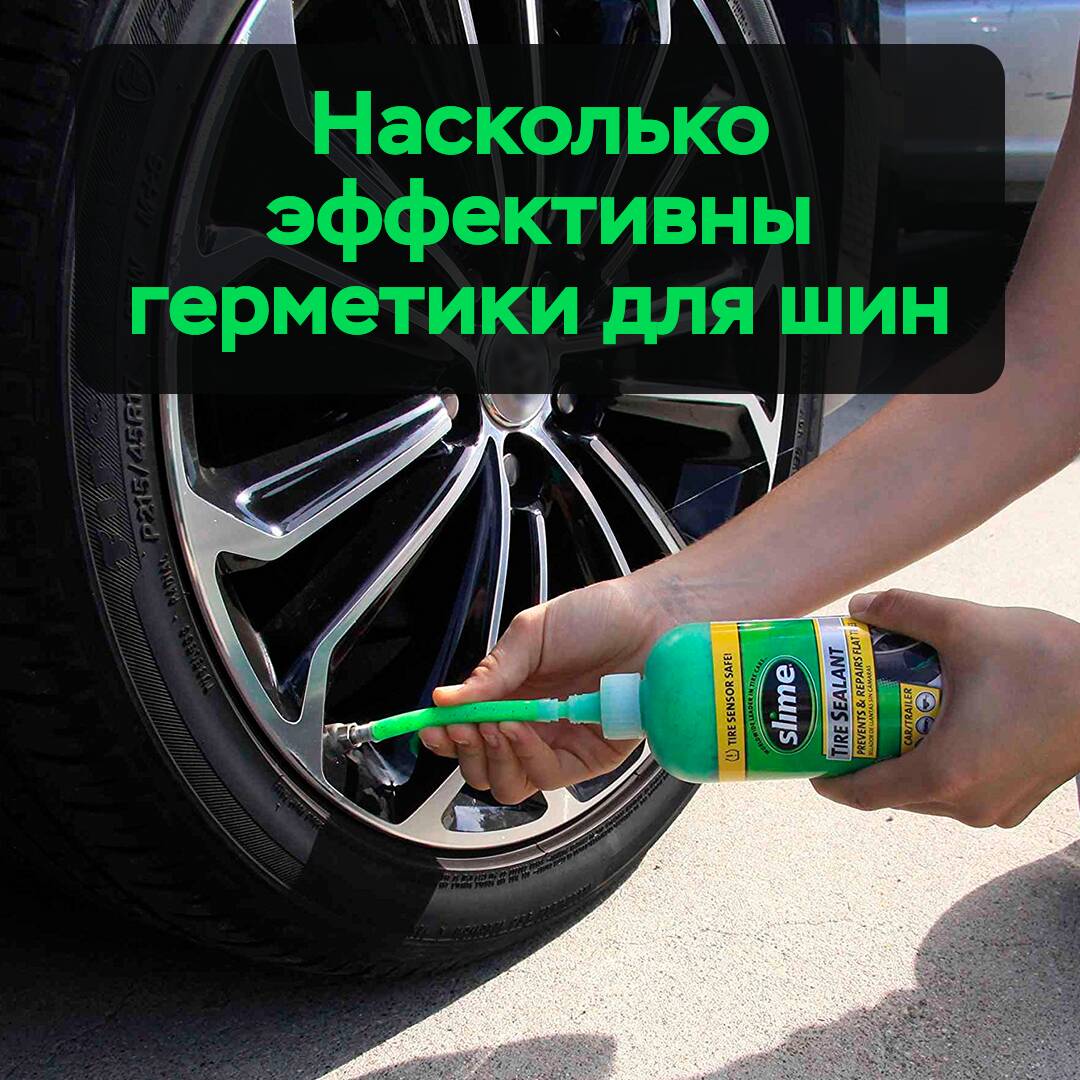
How Effective Are Tire Sealants
It can be noted that sealants for instant repair of punctures have become widely used.
The basis of the sealant is resins with additives, which after being pumped into the tire are evenly distributed over the inner surface of the tire under the action of centrifugal force.
There are two types of sealants: "aerosol" and "non-aerosol".
"Non-aerosol" sealants are simply a gel for sealing a puncture. In turn, "aerosol" sealants are in a cylinder under pressure and, together with the supply of gel, are able to pump up the wheel to 0.3-0.9 BAR, depending on the volume. This pressure will make it possible to reach the tire service at a low speed.
Does it work in real life?
Yes, but there are several important nuances:
- After using the sealant, the speed should not exceed 20 km/h for the first 2-3 km. Otherwise, the sealant may be distributed unevenly. It will be impossible to fix this, and the imbalance of the wheel is guaranteed in this case.
- The sealant is not suitable for chamber tires. Because the question of maintaining pressure in chamber tires is not suitable for the application of the sealant.
- In some cases, a slight imbalance is inevitable.
- This emergency repair is only suitable for the tread part of the tire. It will not repair damage to the sidewall;
- The maximum size of the repairable damage is 4-5 mm.
⠀
In summary, the above information suggests that the sealant is a useful thing and can help you in a difficult moment, so it's definitely worth having it in the car's trunk. But it's worth remembering that this type of emergency repair is temporary and in any case, it's worth contacting a qualified repair service at a stationary tire service.