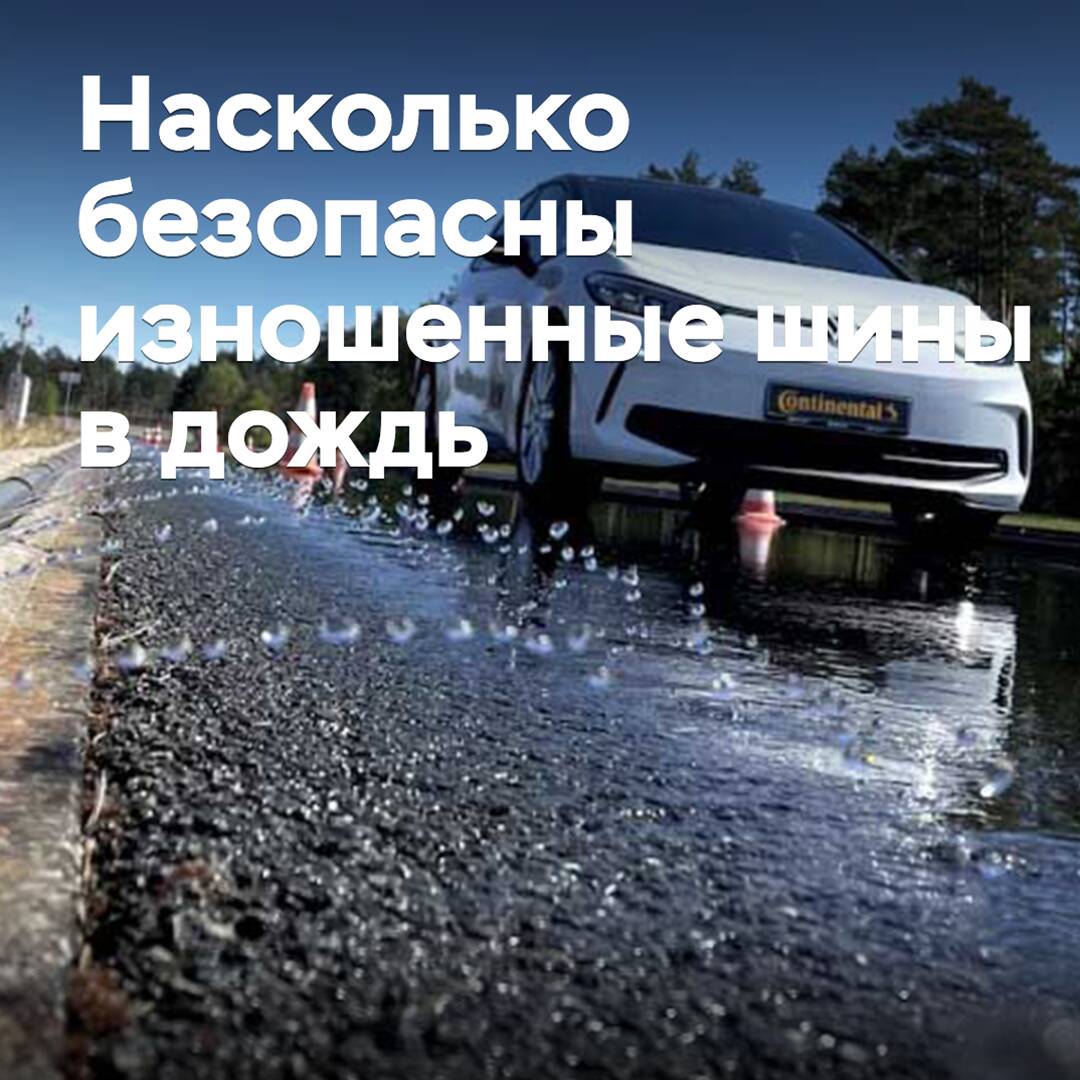
How safe are worn-out tires in the rain
New summer tires come off the assembly line with a tread depth of seven to eight millimeters, and after thousands of kilometers of travel, this indicator drops several times, and the law in many countries, including Russia, requires changing tires when the groove depth is 1.6 mm, and the Auto Bild magazine, together with Continental, decided to check how safe tires are in a similar worn-out state.
To do this, on two identical Volkswagen ID.3, summer tires Continental PremiumContact 7 in size 215/55 R18 were installed, manufactured in the same week — the same production date is important, since it was necessary to eliminate the effect of rubber aging. The only difference between the tires was the tread depth, which was approximately 7.5 mm for one set and 1.6 mm for the second.
The tests were conducted at the famous Contidrom polygon, with an area equal to 220 football fields, on which the company evaluates, among other things, the braking properties of tires on a wet surface. For this purpose, small water spray nozzles are provided, which maintain the track in the desired condition, and more than 10,000 of them are installed throughout the "Contidrom" area.
The difference between the tires was decided to be determined by emergency braking from 80 km/h, and the differences turned out to be very significant: the car on new tires stopped after 26 meters, and the car on the worn-out set needed 11.5 meters more to stop, and the residual speed was about 44 km/h. When the speed at the start of braking increases, the difference also grows, and when stopping from 100 km/h, the braking distances of new and worn-out tires were 40 and 77.5 km/h, and the residual speed of the car on tires with the minimum allowed tread depth was already 70 km/h.
As Philipp Must from Continental's research department explained, when the tread depth of summer tires decreases to 4-5 mm, the braking properties deteriorate relatively insignificantly, but when it reaches 3 mm, the process accelerates, and at 2 mm, there is a significant decrease in resistance to aquaplaning and, in particular, the effectiveness of braking on a wet road, since the tread can no longer drain water as quickly as at full depth.
According to him, "critical deterioration of safety occurs not at the legally established minimum, but significantly earlier, so a more reasonable choice is to replace tires at a 3-millimeter depth." Here, one might suspect the manufacturer of pushing the consumer to more frequent tire purchases, but experts from ADAC, known for their objectivity, have come to the same conclusions earlier. At the same time, this does not mean that you need to urgently change tires when the depth reaches 3 mm, but you should consider their deteriorated ability to drain water from the contact patch.
Interestingly, on dry pavement, worn-out tires can surpass new ones in terms of braking performance, which is due to the increased contact patch and reduced block movements of the tread. "You need to understand correctly: this happens exclusively on a dry surface, and as soon as there is water on the road, the effect changes to the opposite, and worn-out tires significantly worsen the level of safety," Must said.
Photo: Raphael Schuderer