
Best Summer Tires by Mileage
How important is tire mileage to you? For most car owners, this question is among the top three most important parameters, immediately after braking on dry and braking on wet surfaces. Of course, mileage is important, as only when the tire is fully worn out can we draw conclusions and accurately determine the cost per kilometer of a particular model. This is how the most profitable tire is determined, and often it's not the cheapest tire on the shelf, but rather the opposite.
The ADAC company, whose tests we often cite in our reviews, is one of the few that includes mileage calculation in their tests. It's worth noting that tires are multi-layered, and the rubber tread, despite its apparent monolithic nature, also consists of layers of different rubber that vary in wear resistance and grip. But still, we have what we have. Other publications don't test mileage at all.
The calculation at ADAC is done as follows. The potential mileage was estimated by driving 15,000 km on identical cars. Every 2,500 km, the tread depth was measured around the entire circumference of the tire. The calculation is based on the mileage to the minimum allowed tread depth of 1.6 mm.
Below, we provide you with the current data on the predicted mileage of popular tire models in different price categories.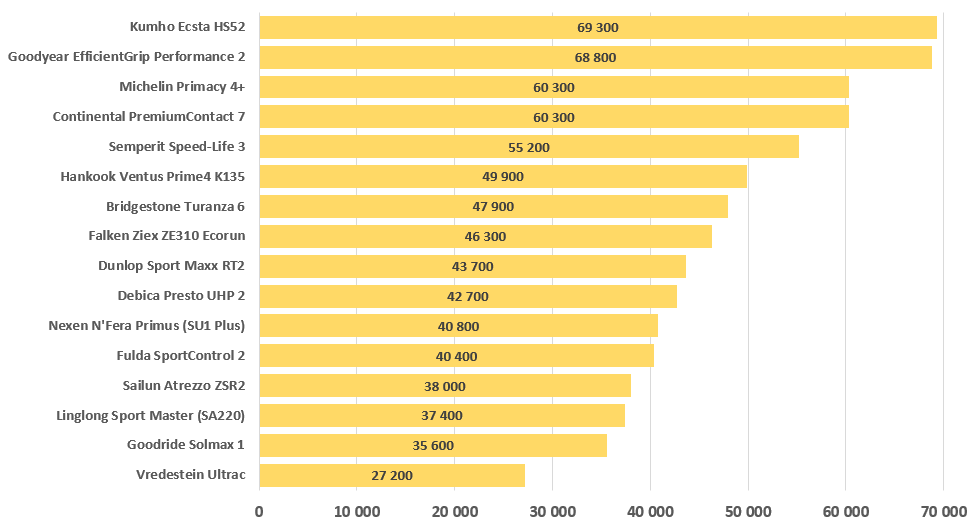
As expected, the highest mileage is found in premium models. The only exception was the Kumho Ecsta HS52. Despite the fact that we emphasized the error in the calculations, the results look very plausible. Michelin and Goodyear are indeed known for their high mileage, which cannot be said about Bridgestone. As for the tires that are 2.5 times inferior in terms of mileage, it's now clear that they're not cheaper. Over the full mileage, they're more likely to be more expensive.