
History of Winter Tire Development
We've talked a lot about lamellas and how important they are for winter tires. Indeed, lamellas are much more important than anti-skid studs in winter tires. That's why over time, they've been improved, given a complex shape and new functions, but the essence has always remained unchanged. Lamellas perform the function of fighting a thin layer of water on the surface of ice, which the main longitudinal transverse channels simply cannot cope with.
An interesting fact that complements the history of lamellas is that they were not invented by tire manufacturers at all. There are many unverified facts in history, but it is known that lamellas, namely small cuts on the rubber, first appeared on the sole of a shoe. This improvement was invented by John Sipe, which is consonant with the English pronunciation of the word lamella - Sipe. The story of his professional activity is a bit confusing, and it cannot be 100% confirmed who he worked for. According to one theory, he was a yachtsman and came up with a way to improve boat deck shoes so they wouldn't slip, according to another, he was a slaughterhouse worker and needed shoes that wouldn't slip either. But however it was, John Sipe filed a patent for anti-skid cuts on automobile tires, because cars at that time attracted the attention of all technically savvy people.
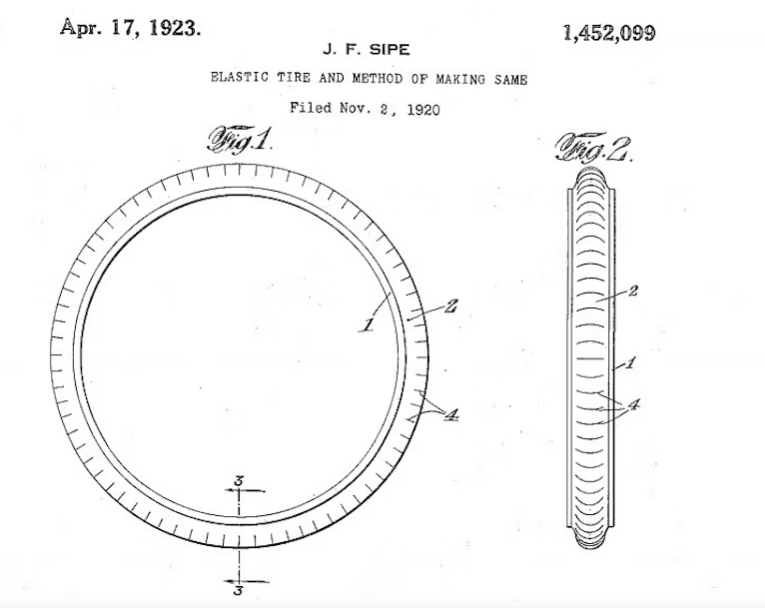
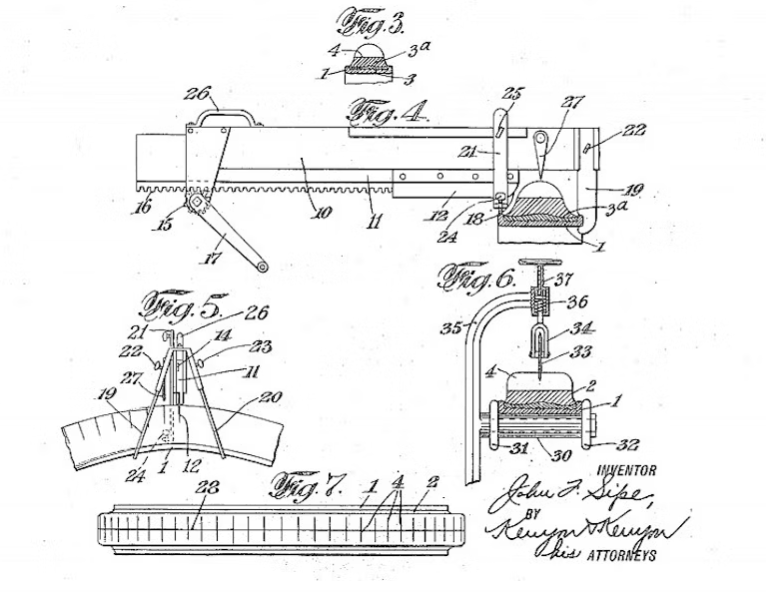
Moreover, since at that time tires made of solid rubber were developed, he also patented a device for cutting lamellas. Pay attention to the depth of the cut that was supposed to be made.
The irony of fate lies in the fact that in 1935, a certain Paul A. Sperry slipped off the deck of his boat and fell into the water. Sperry noticed that his Cocker Spaniel had no particular problems on slippery surfaces.
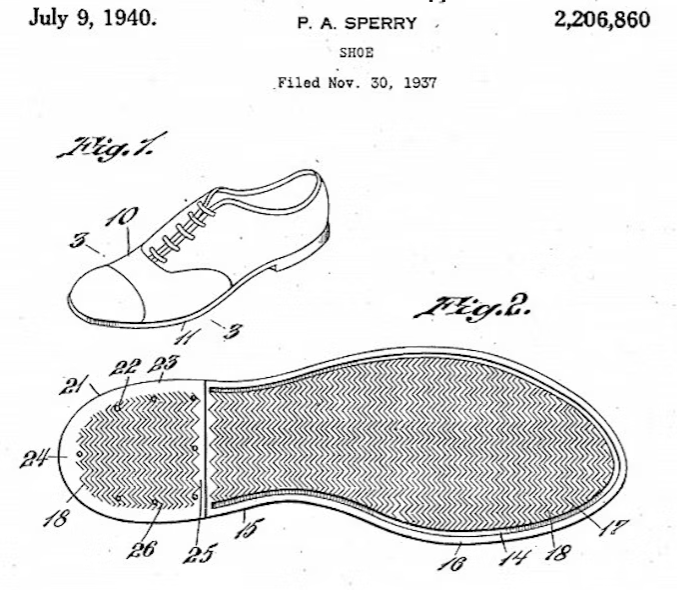
Sperry took a closer look at his dog's paws and noticed their unique texture, which he tried to reproduce on the soles of his boots. The end result was a herringbone pattern that actually helped on wet decks. Sperry filed a patent application in 1937, received it in 1940, and achieved success after "Converse" agreed to cast soles for him. The US Navy even adopted this shoe for their everyday uniform.
So, did Sperry steal Sipe's idea? Sperry claimed that he came up with it himself, and eventually got a patent because Sipe's application was focused solely on tires, not shoes.
That's an interesting story about the origins of lamellas at the very beginning of their journey.