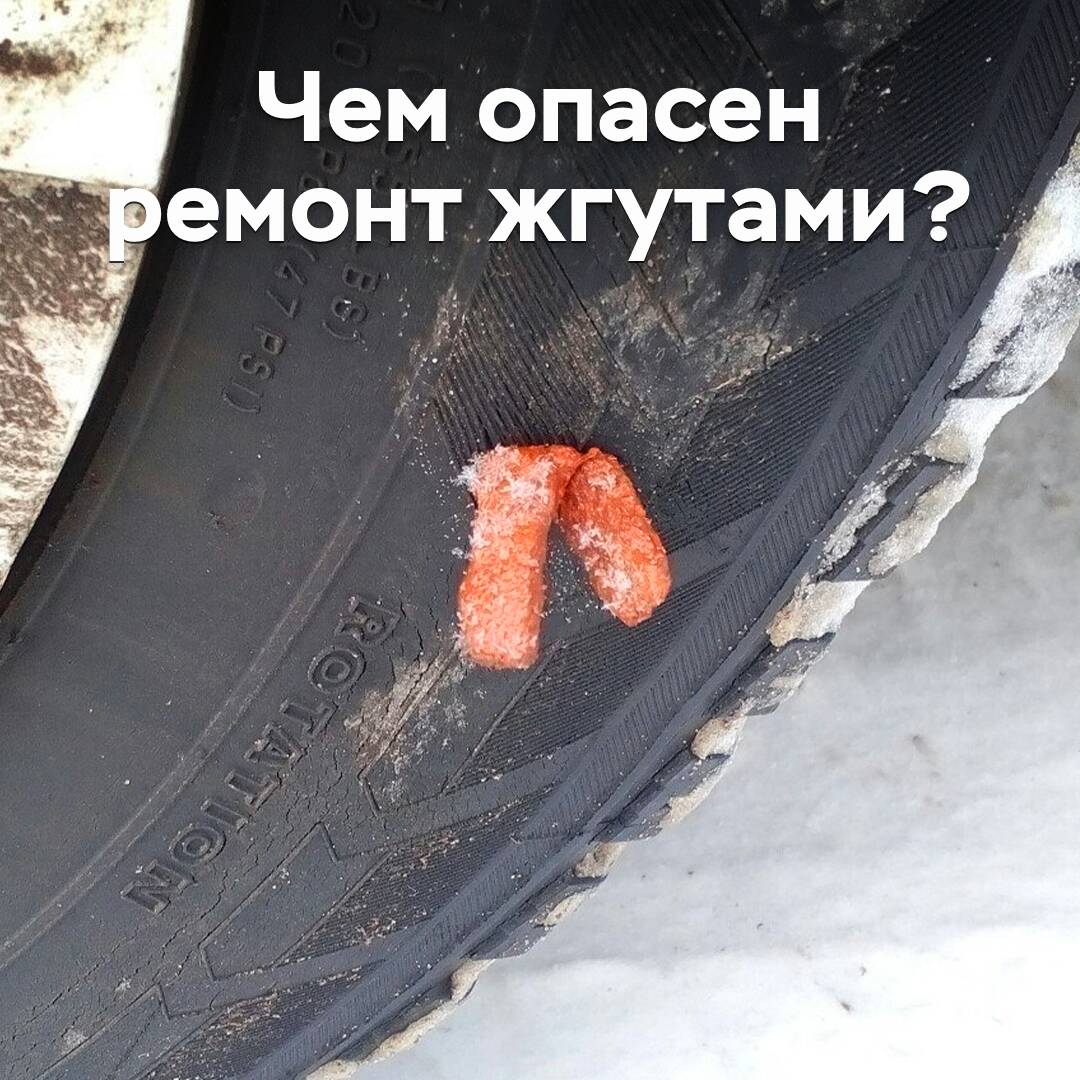
What is the danger of repairing with cables?
Tyre liners have a number of disadvantages, and one of the most obvious is the impossibility of repairing them in "field" conditions. When tyres had a special sealing layer, essentially the same liner, but which is an integral part of the tyre itself, the ability to quickly and easily repair a punctured tread became available to all car owners.
A repair plug has become a desirable element, because it's good to have a spare tyre, but it's not uncommon for a tyre to be damaged 2 or more times in one trip. A scattering of self-tapping screws is a common occurrence on a road with heavy traffic.
In its essence, a plug is synthetic threads impregnated with butyl rubber. A properly installed plug is securely held in the tread thickness due to its rigidity and low elasticity. In the case of a high-quality repair, several layers of textile and steel breakers hold the plug for a long time.
Often, cases are encountered where the repair is done poorly and the tyre's tightness is not fully restored. In such a case, even if there is no air leak, moisture can enter the multi-layer structure of the tyre, after which corrosion of the steel components occurs. Further, the tyres can become completely unusable.
It is also worth noting that there are both repairable and non-repairable areas for plug installation in a tyre: shoulder areas of the tread, sidewalls. Installation of repair plugs in these areas is not permitted due to the absence of steel breakers and high flexibility, the plug will not be able to hold securely and will simply come out. This can be unsafe due to a sharp loss of pressure in the tyre.