
-
 Enlarge
 Yokohama V100

Description Yokohama V100
Yokohama V100 — an example of a pragmatic approach to creating a summer tire. There's no pursuit of records here, but rather a well-balanced blend of resourcefulness, characteristic stability, and predictable behavior on asphalt. The model is designed so that its traction parameters do not decrease as it wears out — this is the key difference from many of its analogs.
Polymer Mix Matrix
The secret to stability lies in the recipe of the rubber mixture. The composition with silica and special polymers minimizes hysteresis losses during cyclic deformations — these are usually what lead to overheating and accelerated aging of the rubber. As a result, even after a season of intense driving, the modulus of elasticity of the tread remains close to its factory specs.
Contact Patch Engineering
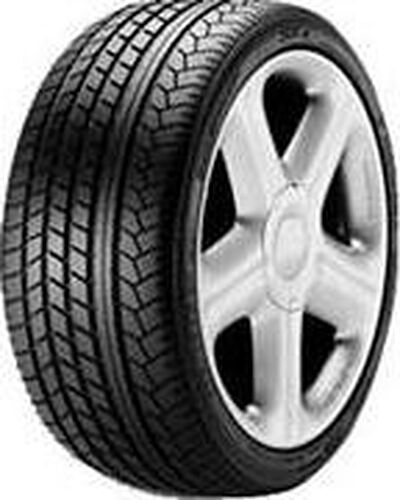
The tread pattern is a classic asymmetric design, but with several important nuances. The outer side is responsible for ultimate grip on dry pavement. Here, massive elements with an increased contact area are used. They work like honeycombs, gripping the micro-roughness of the asphalt. The inner side is tuned for wet conditions: aggressive inclined grooves evacuate water. The longitudinal ribs with a block structure are a separate engineering find. Their edges create multiple additional vectors of engagement when braking and accelerating, which is especially noticeable on a wet or slightly dirty road.
Handling and Rolling Resistance
Thanks to the optimization of the profile and the stiffness of the breaker, the tire demonstrates predictable reactions to steering wheel turns. At the same time, the designers managed to reduce the rolling resistance coefficient. The model doesn't "brake" the car's inertia, which provides fuel savings.
Key Features of Yokohama V100:
- modified rubber mixture resists aging, grip doesn't deteriorate by the end of the season;
- increased contact area with the road for confident acceleration and braking on dry asphalt;
- longitudinal ribs create an additional engagement edge during longitudinal loads;
- quick response to steering wheel turns, understandable even for an inexperienced driver, thanks to the developed rib structure.