Nokian Hakkapeliitta NRW – a winter tire from the legendary manufacturer, which stands out for its non-trivial operational characteristics, including a high degree of stability on slippery asphalt, increased traction on snowy areas, and a minimal level of lateral displacements when performing maneuvers.
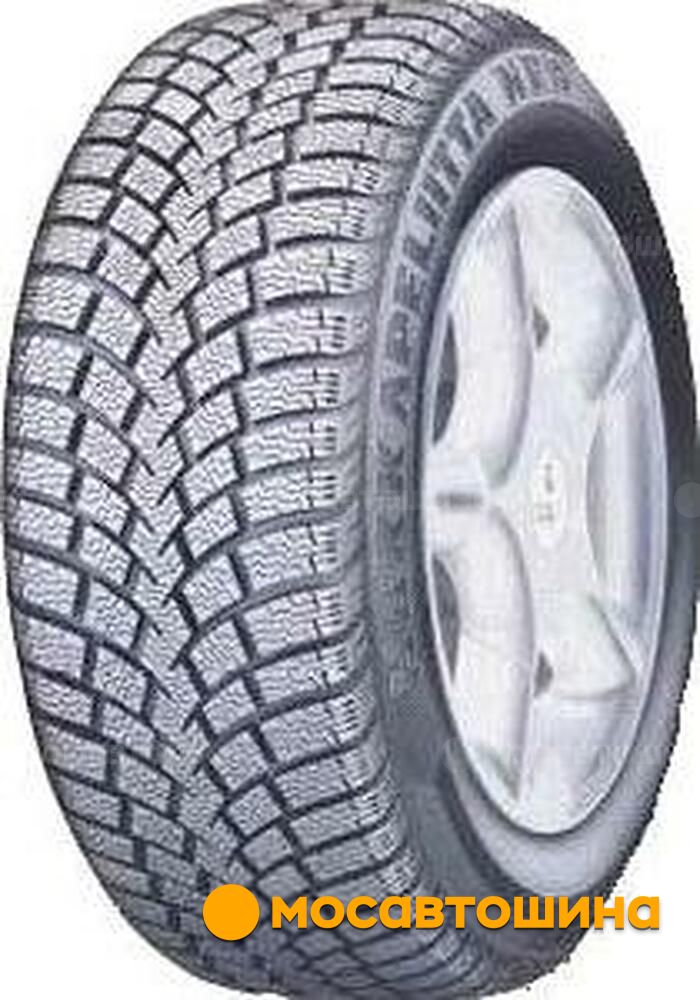
The model's tread is represented by a symmetrical structure with a V-shaped pattern. Its central zone is occupied by a solid rib with saw-toothed edges, the main task of which is to ensure precise handling. The block structures radiating from it form elongated elements that are densely covered with a large number of three-dimensional lamellas. The latter have a special structure that allows them to enhance the coupling properties on icy areas. The channels formed by the edges of the blocks ensure rapid cleaning of the contact area, quickly removing water, dirt, and slush. As a result, it was possible to increase the traction properties on winter roads, improving the overall level of driving safety.
Among the features of the model, one can highlight the use of high-tech compound, which is distinguished by its adaptive ability to negative temperature regimes. This was achieved through the inclusion of a large number of silane-containing components in the composition, which are able to maintain the elasticity of the rubber even at extremely low temperatures. As a result, the tread elements always remain in working condition, maintaining traction and grip at a high level. This factor also found reflection in the improvement of driving comfort. The compound suppresses the main mass of vibrations, not allowing them to penetrate into the cabin. To this, it is worth adding the special arrangement of block structures, which minimizes resonant noises that occur at speed.
Key features of Nokian Hakkapeliitta NRW:
- highly effective winter tire, the scope of application of which includes compact and medium-sized passenger cars of various classes;
- increased stability on icy roads due to a dense network of three-dimensional lamellas with different directions;
- minimization of lateral and longitudinal skidding due to the special arrangement of block structures;
- effective drainage system, represented by diagonally directed channels that open outward in the "shoulder" area
 Enlarge
  РОССИЯ
 Enlarge