
-
 Enlarge
 Michelin Desert

Description Michelin Desert
Few models in the vast range of the French concern can compare with the Michelin Desert motorcycle tire in terms of the number of sports victories. The sports version of this particular model has achieved a record series of 29 victories in the Dakar rally-raid, starting from 1982. Most likely, this series of winning achievements will not end there, since this tire is still used by a number of teams in various endurance races. The civilian version, with the exception of some design analogs, is virtually indistinguishable from its counterpart used in high-performance sports.
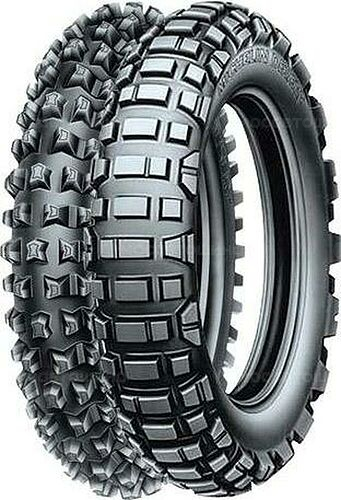
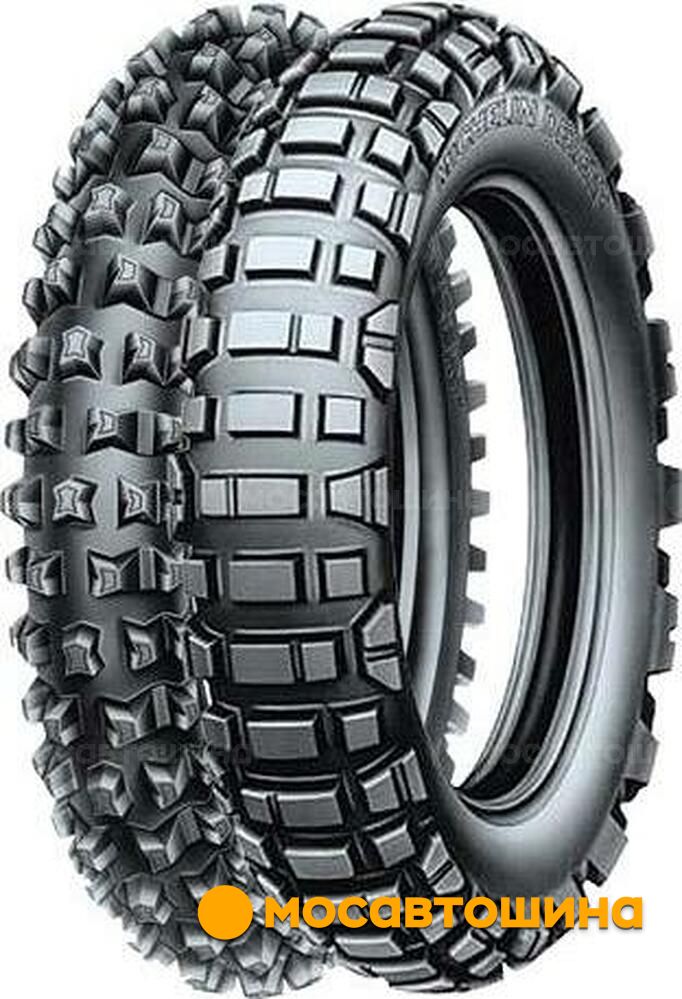
Various tread patterns for front and rear tires
Since the front and rear motorcycle tires of the Michelin Desert perform slightly different functions during movement, the French tire manufacturers, when developing this model, preferred to take into account these features, equipping this model with two tread patterns.
The tread pattern, despite its relatively narrow width, contains an increased number of small blocks. They are distinguished by a special concave shape of the edges, which provide additional directional stability regardless of the mode of movement. Moreover, the presence of a large number of formed blocks with traction edges allows the tire to grip the surface more effectively.
The rear tire is equipped with a tread pattern that contains a large number of massive blocks of a quadrangular shape, from which a multitude of transverse rows are formed. These groups of tread elements form very long edges that are perpendicular to the direction of movement. This feature allows for the realization of the engine's torque in the maximum amount.
Main features of the Michelin Desert tire
- the tire was specially designed for intensive use off paved roads, which is why it has excellent cross-country ability, strength, and wear resistance;
- the optimized tread pattern of the rear tire ensures excellent traction properties in the longitudinal direction;
- the numerous small blocks with concave edges of the front tire's tread allow it to demonstrate excellent directional stability, both when moving in a straight line and when making sharp maneuvers;
- the rubber compound, which includes components of the new generation, provides the tread with optimal elasticity over a wide temperature range, as well as resistance to aggressive external influences.