
-
 Enlarge
 Michelin Cross Terrain
Description Michelin Cross Terrain
The Michelin Cross Terrain passenger tire only partially lives up to its name, as it is primarily designed for paved surfaces. Nevertheless, it boasts fairly good versatility, as the manufacturer positions it as an all-season model. At the same time, a number of design features in its tread allow it to demonstrate fairly confident behavior on unpaved surfaces as well.
Excellent stability at any speed
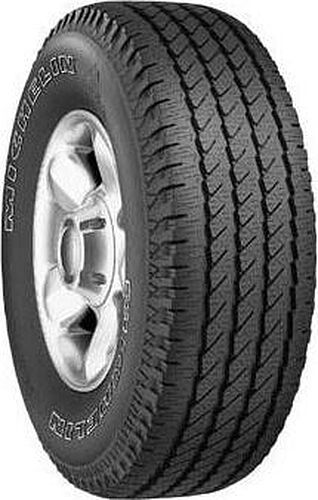
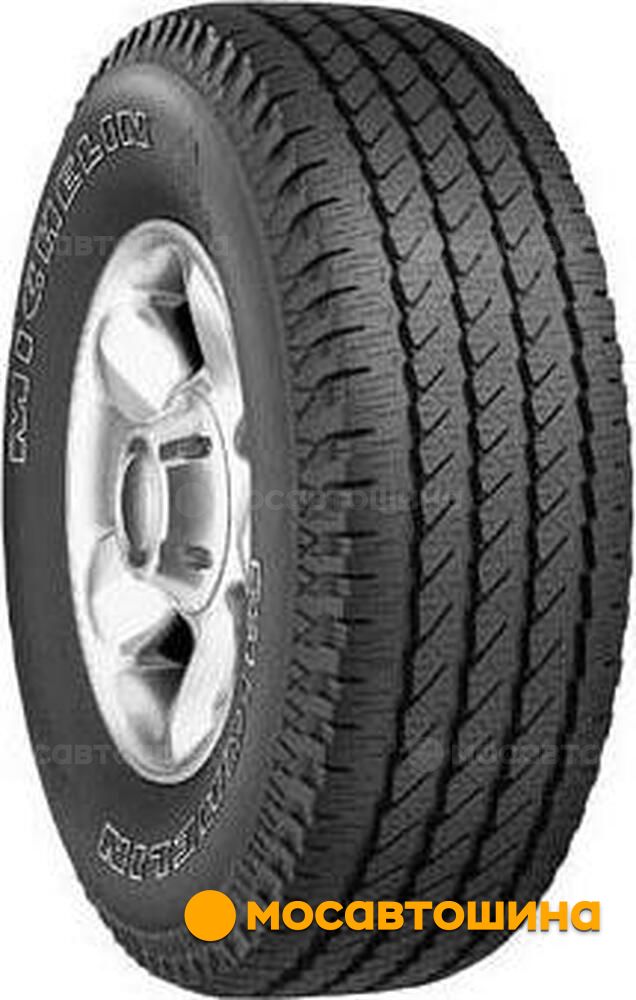
The fact that this model is designed primarily for operation on paved roads is evidenced by the design of the central part of its tread. It features three solid ribs, separated from each other by wide drainage channels. These tread elements have a composite structure consisting of many separate blocks. Their edges have a significant inclination, which allows the tread ribs in the center to perform several functions at once, thereby providing the tire with fairly good balance. First and foremost, this is a combination of good directional stability and responsiveness to handling, along with high longitudinal traction characteristics. Additionally, it's worth noting that such a design noticeably reduces rolling resistance and noise level, as well as increases resistance to uneven wear.
Multifunctionality of the shoulder areas
The shoulder areas of this tire's tread also possess no less universality. They are distinguished by their massive size and solid structure, as well as the presence of numerous protrusions on the lateral surface. Such a design, on the one hand, improves traction in turns, increases load capacity, and on the other hand, ensures confident behavior on soils with reduced carrying capacity, as well as on snow.
Main features of Michelin Cross Terrain
- the three central tread ribs have a composite structure consisting of many blocks, which improves not only directional stability, handling responsiveness, and fuel economy, but also longitudinal traction and adhesion properties;
- the closed design of the shoulder areas increases traction in turns, prevents uneven wear, and due to the numerous protrusions on the sidewalls, it also improves passability on unpaved surfaces and on snow.