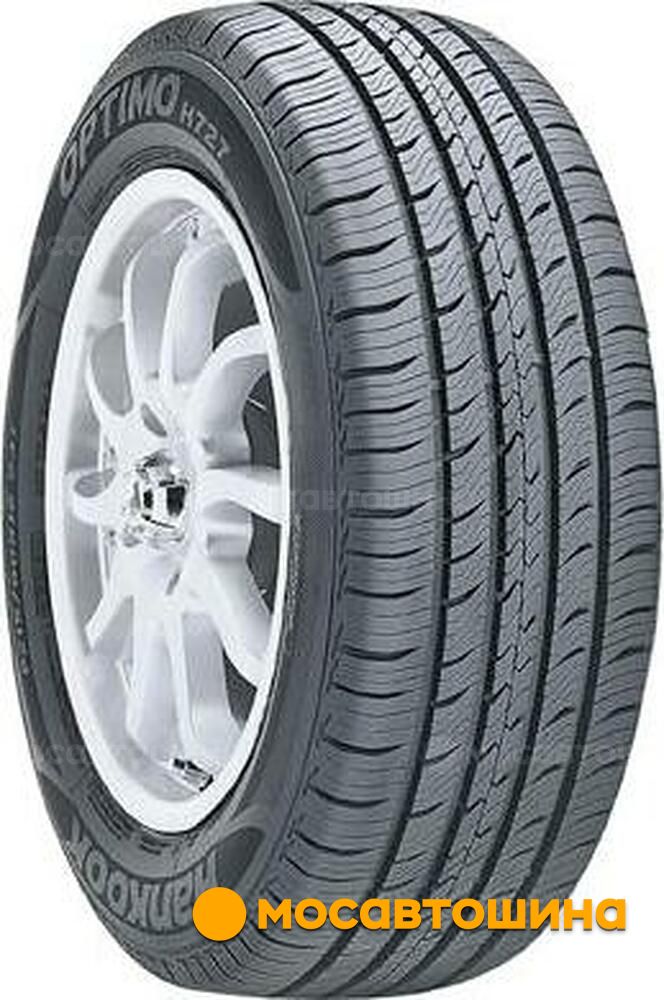
All-season passenger tire Hankook H727 Optimo came to replace the H707 model, which was distinguished by excellent durability. Like its predecessor, this model is designed for a wide range of passenger cars with a wheel mounting diameter from 15 to 18 inches. At the same time, the line of sizes includes several dozen options. A distinctive feature of this tire is the tread pattern obtained as a result of the wide use of computer modeling tools. In addition, the CCT and FSO technologies were used in this model, which made it possible to ensure uniform wear, a long service life, and a high level of comfort.
Universal tread pattern
Since the tire is designed for year-round operation on various types of surfaces, the South Korean tire makers equipped it with an S-shaped symmetrical non-directional tread pattern. This choice is due to the fact that this design can provide optimal traction on most solid surfaces, from dry asphalt to snowy surfaces.
Despite the fact that the Hankook H727 Optimo tire was presented back in 2006, its five-rib tread pattern is still relevant today. In the center of the tread, there is a longitudinal rib that, due to the absence of breaks throughout its length, is a single solid element with a very high degree of stiffness. Thanks to this, the tire demonstrates stable behavior, especially on slippery surfaces, as well as excellent handling.
The drainage system is particularly noteworthy, which consists of four longitudinal grooves that accumulate moisture and numerous transverse channels that converge to the center, through which it is removed from the tread. At the same time, the longitudinal grooves are distinguished by increased dimensions, which allows them to cope not only with water but also with snow slush, ensuring resistance to both aquaplaning and slushplaning.
As mentioned earlier, this tire is designed for year-round use, which, among other things, implies movement on snowy surfaces. To ensure traction with it, the tread is equipped with an infinite number of S-shaped lamellas. These tread elements, when in contact with the road surface, form a large number of traction edges, supplementing the edges formed by the transverse drainage grooves.
At the same time, the shoulder areas of the tread contain straight lamellas that perform several functions at once. On a wet surface, they remove moisture from the road surface, and on a snowy one, they form perpendicularly arranged traction edges that increase the effectiveness of acceleration and braking.
CCT
The CCT abbreviation literally means - Carbon Compounding Technology. I.e., this is a carbon-containing rubber compound that provides high performance, wear resistance, and excellent traction on various types of surfaces.
FSO
This abbreviation hides the phrase Footprint Shape Optimization. This technology is designed to optimize the shape of the contact patch and maintain its stability in any driving mode. This was achieved mainly due to the multi-layer design of the tire carcass.
Directly under the tread is a two-layer steel breaker covered with a nylon overlay. Thanks to this, it was possible to give the tread stiffness, limiting the amplitude of vibrations that occur due to the impact of road irregularities. Under the breaker, there are two more nylon layers wound using a seamless technology. These layers made the carcass elastic, allowing it to effectively soften the blows from road irregularities.
Another component of the FSO technology was the design of the sidewalls, which were designed to provide not only protection against punctures and cuts but also softness of the ride.
Main features of the Korean tire Hankook H727 Optimo
- S-shaped tread pattern optimized for most types of surfaces, including snowy ones;
- A multitude of transverse straight and S-shaped lamellas provide high efficiency of acceleration and braking on wet and snowy surfaces;
- Five longitudinal ribs allowed to achieve excellent directional stability and reduced rolling resistance;
- The rubber compound is characterized by high tear strength, excellent wear resistance, and the ability to remain elastic even at negative temperatures;
- The FSO technology, due to the multi-layer design of the tire carcass, ensures not only the optimal shape of the contact patch but also its invariance, regardless of the driving mode.
 Enlarge