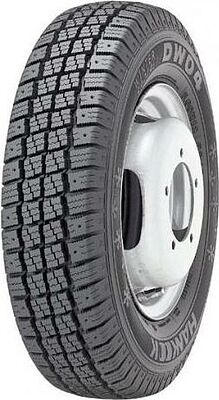
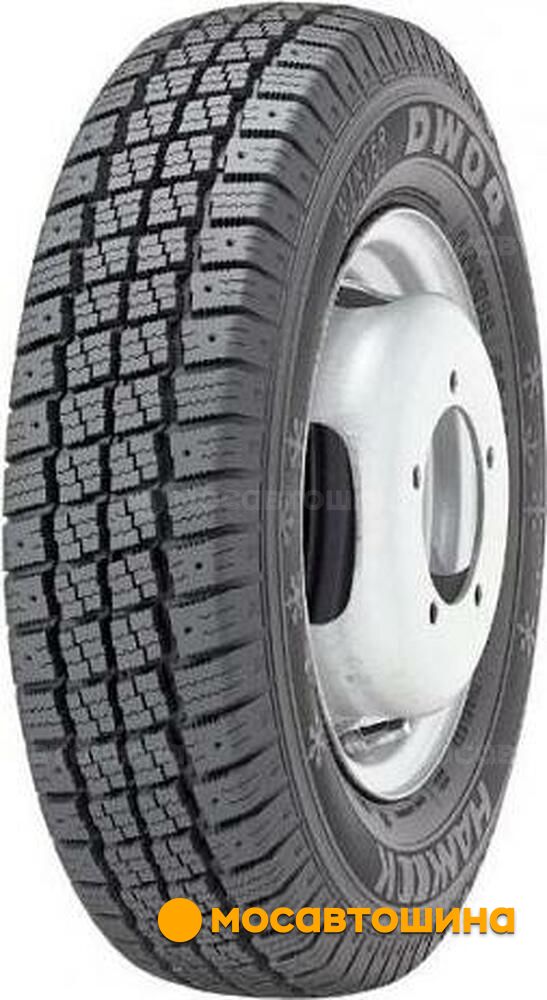
The Hankook Winter Radial DW04 studded tire is designed for use on small commercial vehicles, i.e. minivans and light trucks. The relatively low cost of this model is due to the use of simple but very effective technical solutions, which provide excellent traction on any winter roads.
Increased content of traction edges
Since this model was initially designed for use exclusively in winter, it's not surprising that during its development, the main attention was paid to ensuring maximum traction properties on snowy and icy roads. To solve this problem, an attempt was made to significantly increase the traction edges.
A fairly significant part of them is formed by numerous tread blocks that are collected in four longitudinal ribs. This design provides the tire with excellent directional stability, as well as reduced rolling resistance, which, in turn, has a very favorable effect on fuel economy indicators.
Another advantage of this block arrangement is the formation of a large number of very long transverse edges during movement. This design feature allows the Hankook Winter Radial DW04 tire to demonstrate excellent traction and adhesion properties in the longitudinal direction.
However, many more traction edges are formed by numerous wavy lamellas. These tread elements, when in contact with the road surface, open up, forming a countless number of traction edges. They easily penetrate through the water film, allowing the tire to grip even very slippery ice.
Excellent handling on asphalt
Another feature of the lamellas is the wavy shape of their walls. Due to this, they are tightly fixed between themselves when opened, which gives the block increased stiffness. Thanks to this feature, the tire demonstrates stable and predictable handling on asphalt, which significantly increases the level of driving comfort.
Studding possibility
In the basic version, this model is offered without studs, but provision is made for their installation. The scheme of their arrangement is designed so that when in contact with an icy road, the studs form six continuous rows. This provides the tire with excellent traction and directional stability when driving on ice.
Elastic rubber compound at low temperatures
As you know, a significant part of the traction properties is ensured by the physical properties of the rubber compound. At low temperatures, it loses a significant part of its elasticity, which has a very negative effect on traction properties. The specialists of the South Korean company managed to solve this problem by including special silicon-containing elements, known as silica, in the composition of the rubber compound of this model. The presence of these substances allows the tread to maintain elasticity even at very low temperatures, thereby ensuring good traction on winter roads.
Excellent resistance to aquaplaning and slush planing
The block structure of the tread pattern made it possible to equip it with a very developed drainage system, which has a large number of transverse and longitudinal grooves passing around the blocks. At the same time, it is impossible not to note their significant internal volume, which is ensured, among other things, by the increased depth of the tread. Thanks to this design feature, the drainage system easily copes with the removal of almost any amount of not only water but also more heavy snow masses from the contact patch. As a result, this model is favorably distinguished by excellent resistance to both aquaplaning and slush planing.
Main features of the Hankook Winter Radial DW04 tire
- the original design of the symmetrical non-directional tread pattern provides excellent traction on any winter surfaces;
- increased content of traction edges, thanks to the large number of blocks and wavy lamellas, allows confident movement both on snow and on ice;
- excellent acceleration and braking performance is provided by the multitude of transverse edges formed by the tread blocks;
- good handling on asphalt is achieved due to the wavy shape of the lamella walls, which, due to tight fixation between themselves, increase the stiffness of the tread blocks;
- excellent elasticity at low temperatures is achieved due to the increased silica content in the rubber compound;
- high resistance to uneven wear, increased load capacity, stable handling regardless of road and weather conditions due to the uniform distribution of external pressure over the contact patch.
 Enlarge
  Enlarge