
-
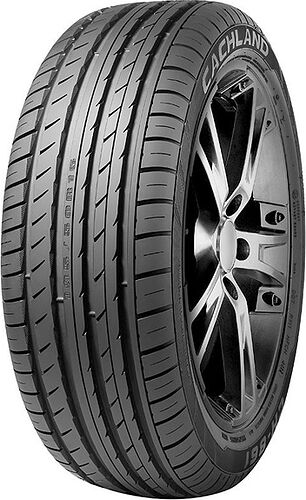 Enlarge
 Cachland CH-861

Description Cachland CH-861
The Cachland CH-861 summer tire is designed for compact passenger cars. It is distinguished by balanced characteristics due to its universal tread.
Tread with functional areas
A distinctive feature of the tread pattern is the distribution of elements into several functional areas. Each of them enhances certain operational properties, complementing each other's action. The shoulder area on the outside has wide transverse blocks. They prevent skidding during maneuvering and uneven wear, optimizing the load distribution across the contact patch. In turn, the longitudinal ribs in the central part of the tread reduce rolling resistance, increase the tire's stability during high-speed straight-line driving, and also provide quickness and precision to the driver's reactions. The inside of the tread provides the tire with efficiency during longitudinal accelerations.
Reliability on wet pavement
A significant part of the tread surface is allocated to drainage grooves. The four longitudinally arranged elements stand out with the largest volume. This allows the tire to very effectively remove water from the contact patch, thereby preventing aquaplaning. This property is further enhanced by numerous lamellas and transverse grooves that direct water out of the tread.
Acoustic comfort
The tire is characterized by a low noise level. This is largely achieved due to the design of the tread pattern. In the shoulder area on the outside, a narrow continuous longitudinal rib is used for this purpose. It prevents the spread of noise from the tread elements in the central part. Additionally, they are arranged relative to each other with a significant offset, which reduces the risk of forming low-frequency noises and vibrations.
Key features of Cachland CH-861
- an asymmetric tread with functional areas provides the tire with balanced characteristics;
- reliable behavior on wet pavement due to an effective drainage system and a silica-rich rubber compound;
- a low level of noise and vibrations is achieved by arranging the tread elements with a significant offset relative to each other.