
-
 Enlarge
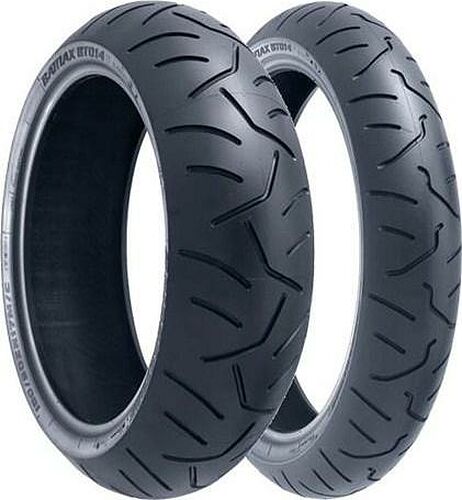
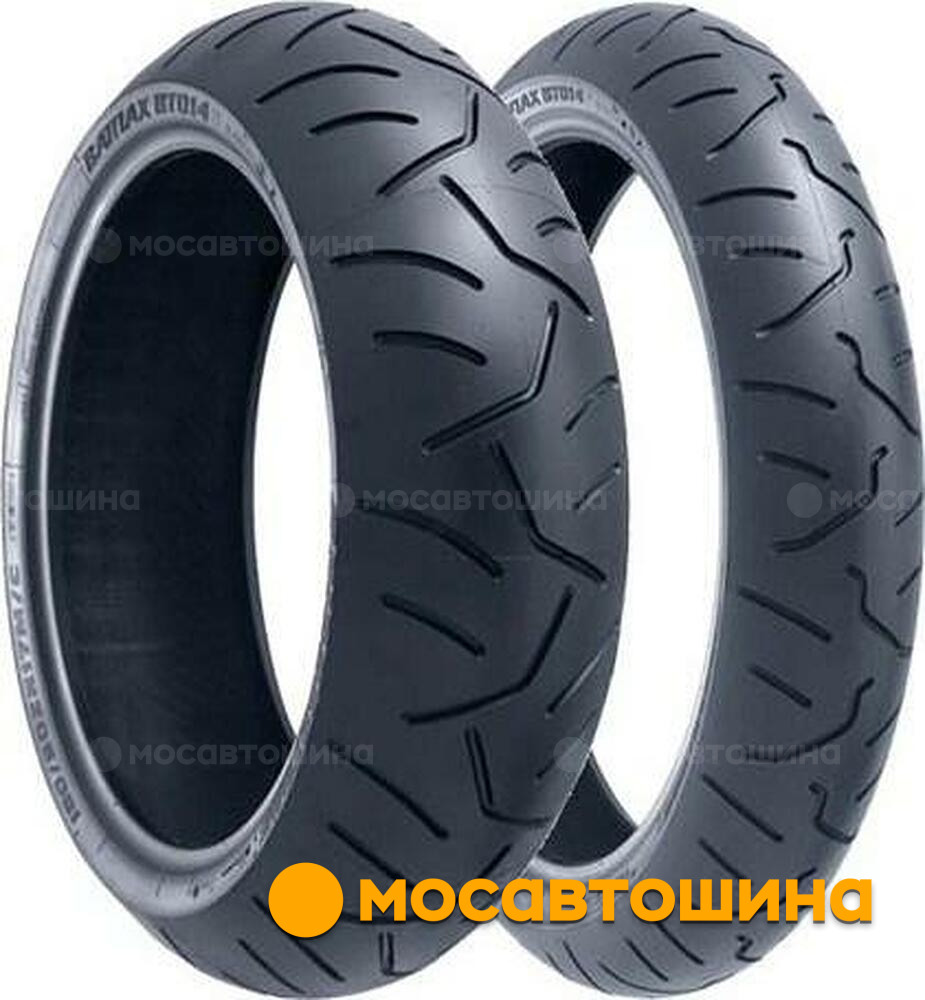
 Bridgestone Battlax BT-014
Description Bridgestone Battlax BT-014
Like all other representatives of the BT series of the Battlax line, the summer motorcycle tire Bridgestone Battlax BT-014 was specially created for operation on motorcycles in the "sport-touring" category, equipped with engines with a volume of 600 to 1000 cubic centimeters. Its design uses proprietary developments of the Japanese tire giant, allowing for the full realization of all the multifaceted capabilities of this motorcycle technology.
3D-C.T.D.M. Technology
The 3D-C.T.D.M. technology is one of the most modern and complex computer programs designed for three-dimensional design of not only motorcycle but also car tires. Thanks to its use, Japanese tire manufacturers were able to do without millions of natural tests, while selecting optimal constructive solutions in terms of efficiency.
Narrow Ply Technology
If 3D computer-aided modeling tools are used by Bridgestone when developing all new tires without exception, then Narrow Ply first appeared on the Battlax BT-014. This technology is an additional layer located directly under the shoulder areas of the tread. Due to its high rigidity, it provides increased resistance to dynamic deformation in this tread area, which has a very beneficial effect on stability when making sharp maneuvers.
Ideal Sidewall Profile
Another proprietary development of the Japanese tire giant, which has found application in this model, is a special bead filler. Thanks to it, the sidewalls of the Bridgestone Battlax BT-014 tire have been given an ideal profile, contributing to the optimal distribution of load across the entire contact patch area.
Key Features of Bridgestone Battlax BT-014
- the tire was specially created for 600-1000cc "sport-touring" bikes, combining an ideal balance between comfort and sporty handling;
- excellent efficiency in any conditions, thanks to the use of 3D computer modeling tools in development, replacing millions of kilometers of natural tests;
- excellent resistance to dynamic deformation in combination with optimal distribution of external pressure across the contact patch provides very stable behavior regardless of the driving mode.