
Tire testing with homologation and without
Sometimes, additional markings can be found on the sidewalls of tires, indicating that they have been homologated by a particular automobile manufacturer, meaning they have been adapted to meet the client's requirements for factory equipment on their vehicles. There are many such markings, and if, for example, the tires have the letters MO, they were developed for Mercedes, if there is a star - then for BMW, and so on. This raises the question: when the tires from the vehicle's equipment have exhausted their resource, is it necessary to look for a set with specialized markings, and how significantly do homologated tires differ from standard ones?
To assess the difference between tires with homologation and without it, experts from the Polish edition of Motor tested two versions of the Michelin CrossClimate 2 tires, one of which was standard (and had the SUV marking, meaning it is intended for crossovers), and the second was adapted to the requirements of Volvo, as indicated by the VOL letters on the sidewalls.
The tires were tested on snow, wet and dry asphalt, and the "winter" tests were conducted in Sweden, while the rest were conducted at a test site in Germany. In all tests, except for the aquaplaning resistance test, which required special equipment, a Volvo XC60 was used.
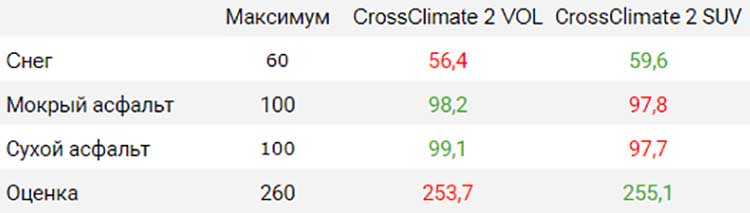
As the snow tests showed, in such conditions, non-homologated tires work better, allowing the car to accelerate faster from a standstill, reducing the braking distance, and providing higher traction when cornering on a snowy surface. Thus, for now, standard tires have the advantage.


On wet pavement, the situation changes, and here the homologated tires lead, better resisting aquaplaning and having better grip in both longitudinal and transverse directions, which was confirmed by a shorter braking distance and high lateral stability on a circular irrigated track.




On dry asphalt, standard tires also lost to homologated ones in terms of braking efficiency. In terms of noise, they win slightly, but the tires with the VOL marking have significantly lower rolling resistance, which may have been one of the requirements of the car manufacturer.




According to the results of all tests, the tires received almost identical scores, but the homologated tires work better on dry and wet asphalt and provide fuel savings. At the same time, standard tires are significantly more effective on snow and, according to experts, have more balanced characteristics in general.
Source: magazynauto.pl. Photo: Robert Magdziak / Motor