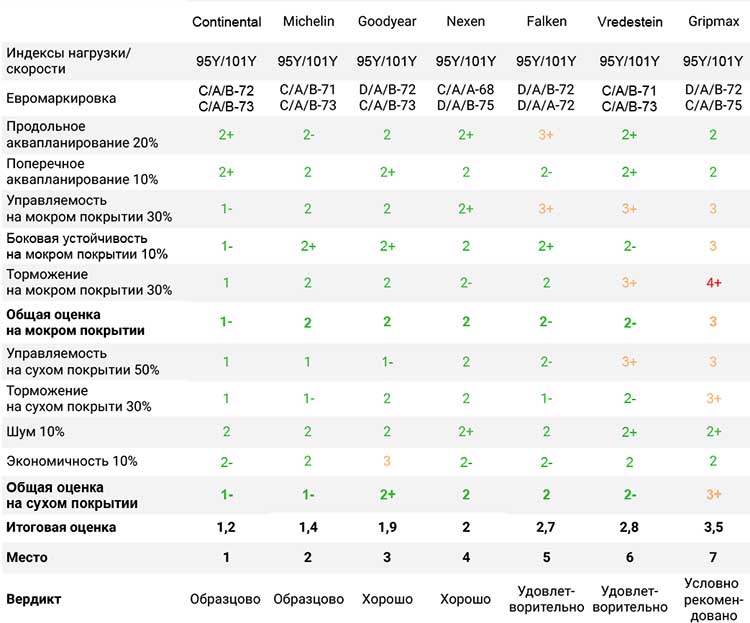
Test of asymmetric summer tyres from Auto Bild Sportscars — 2025
Many sports cars, including those from the BMW M, Mercedes-AMG, and Porsche brands, are equipped with different-sized tires as standard - narrower at the front and wider at the rear, which should improve stability, traction, and handling in corners. At the same time, such a configuration significantly increases the requirements for tires, which must work balanced on both axles so that the theoretical advantages can be felt on the road.
To test how different-sized tires behave, the Auto Bild Sportscars magazine conducted tests of seven models in the 245/35 20 size at the front and 295/30 R20 at the rear, installing them on the Lotus Emira. The tests included tires of all price categories, and premium Continental SportContact 7, Michelin Pilot Sport 4 S, and Goodyear Eagle F1 Supersport were taken, as well as Falken Azenis RS820, Vredestein Ultrac Pro, and Nexen N’Fera Sport SU2 of a lower class, while the budget product was chosen Gripmax SureGrip Pro Sport from a company from China.
Wet asphalt
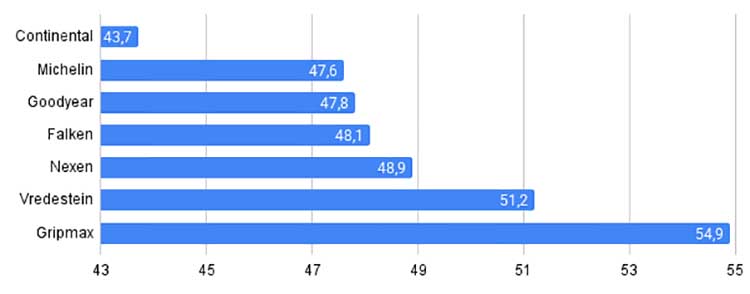
Fast braking on a wet road is crucial in an emergency, and in this discipline, Continental showed an excellent result, stopping from 100 km/h in just 43.7 meters. Michelin, Goodyear, and Falken tires need four meters more, and the cheap Gripmax does not cope with the task, and the increase in braking distance by 11 meters compared to Continental says that the tire creates a safety hazard.
When used on the powerful Lotus, the tires have to try to provide good handling on wet asphalt, and the testers stated that Continental, Goodyear, and Michelin behave the most harmoniously, while Nexen surprised with a very good result, and the grip of Falken, Vredestein, and Gripmax was not so stable.
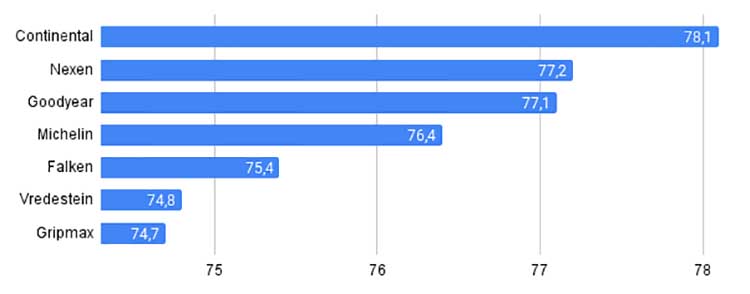
Transverse grip was evaluated on a circular track with a constant steering wheel angle, and although the differences in lap time were insignificant, Continental was clearly the best, while Vredestein and Gripmax had a noticeable tendency to skid.
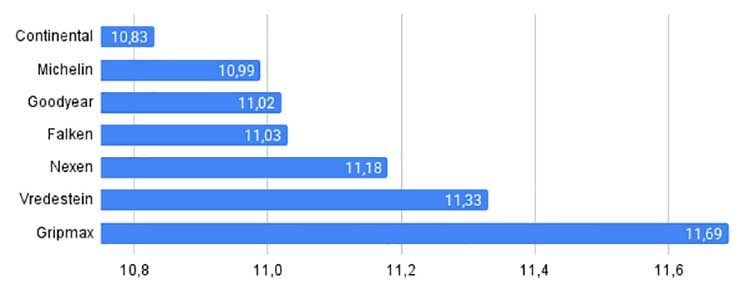
In the aquaplaning resistance test (and wide tires are particularly prone to this phenomenon), the inexpensive Nexen surprised, effectively expelling water from the contact patch. However, even Falken, who finished last, showed a good result, withstanding speeds of up to 100.5 km/h, while 15 years ago, a result of 90.5 km/h would have been enough for victory.
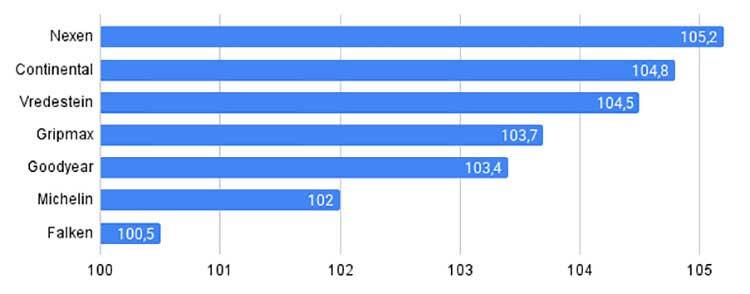
Continental showed the best resistance to transverse aquaplaning, while Vredestein, Goodyear, and Michelin also received high scores, and Falken lagged behind the others.
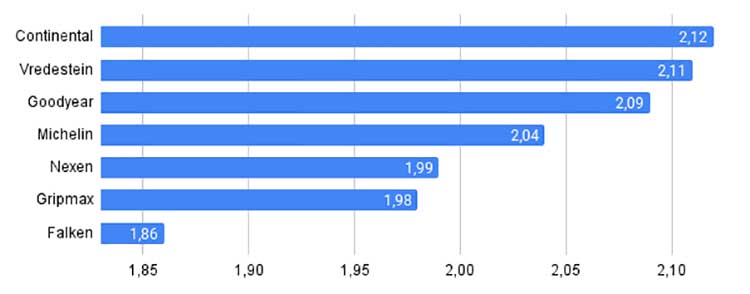
Dry asphalt
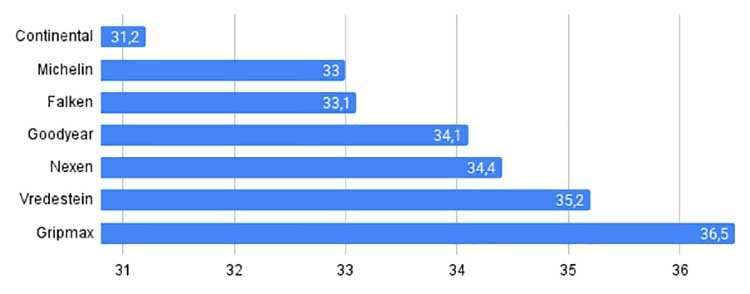
Braking on dry pavement is one of the most important parameters in summer tire tests, and Continental became the leader in this regard, stopping the Emira from 100 km/h in just 31 meters. The braking distances of Michelin and Falken are almost two meters longer, and the results of Goodyear, Nexen, and Vredestein are slightly worse but still good, while the Gripmax has an unstable ABS system and a noticeable lack of grip.
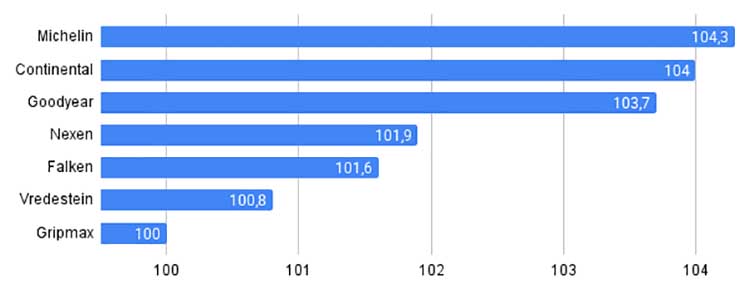
Michelin, Continental, and Goodyear were recognized as the best in terms of handling on a dry track, providing impressive lateral stability, balanced handling, and the best lap time, while Vredestein and Gripmax tires clearly lack transverse grip.
In the test for external noise level, the results of the tires differed insignificantly, and Vredestein was the quietest.
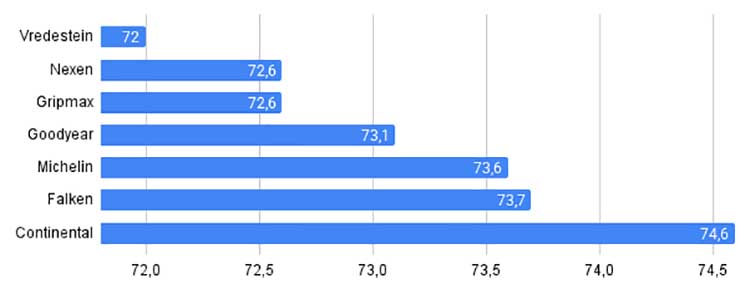
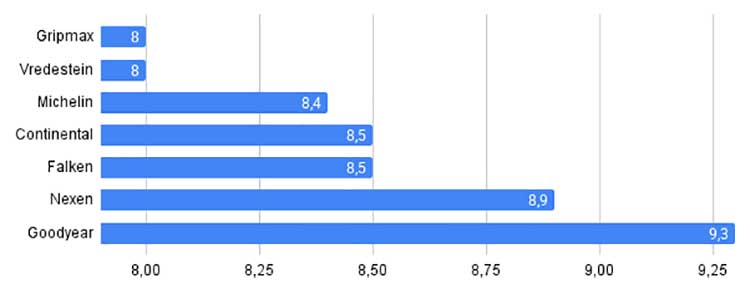
It is believed that a 5% reduction in rolling resistance reduces fuel consumption by 1%, so Gripmax and Vredestein can provide a 3% fuel savings compared to Goodyear.
Results
Continental SportContact 7 takes the first place in the overall standings, with very balanced characteristics in any conditions, and the only drawback was a slight unreliability of the rear tires' grip on a wet road, while Michelin Pilot Sport 4 S was awarded silver for stable behavior and excellent handling on dry pavement, but as a fly in the ointment, a relatively low resistance to longitudinal aquaplaning was mentioned. Goodyear Eagle F1 SuperSport closes the list of leaders, which "works great" on dry surfaces and well resists aquaplaning. In fact, Goodyear lost points only due to increased rolling resistance, which is not a priority in the UUHP segment.
Nexen N’Fera Sport tires were able to closely approach premium products due to excellent handling in rainy weather, and they also have very precise reactions to steering wheel turns, but they were let down by a long braking distance on a wet surface. In turn, Falken Azenis RS820 is very efficient on dry surfaces but has poor handling on wet ones, and in the test, they showed the lowest resistance to aquaplaning. Vredestein tires deserve praise for a short braking distance on dry surfaces, a smooth ride, and good fuel economy, but at the same time, serious drawbacks were noted on a wet road, where Vredestein has a tendency to skid.
The budget Gripmax SureGrip Pro Sport from a private brand owned by the Chinese company Qingdao Grip Tyre finished last. In addition to the low price, the advantages include good resistance to aquaplaning, low noise level, and economy, but the tires have an obviously weak grip on a wet surface, which causes them to skid and significantly increase the braking distance.