Summer UUHP Tyre Test from Tyre Reviews
In a new test by Tyre Reviews, seven ultra-high-performance (UHP) summer tires in the size 235/35 R19 competed for victory. The Michelin model, which is more oriented towards track use with an 80/20 ratio, was also added to the test for interest. Budget tires were also included, with the Kingboss selected from the Shandong Huasheng Rubber Group's range.
The list of participants includes:
Bridgestone Potenza Sport Evo
Hankook Ventus S1 evo Z (K129)
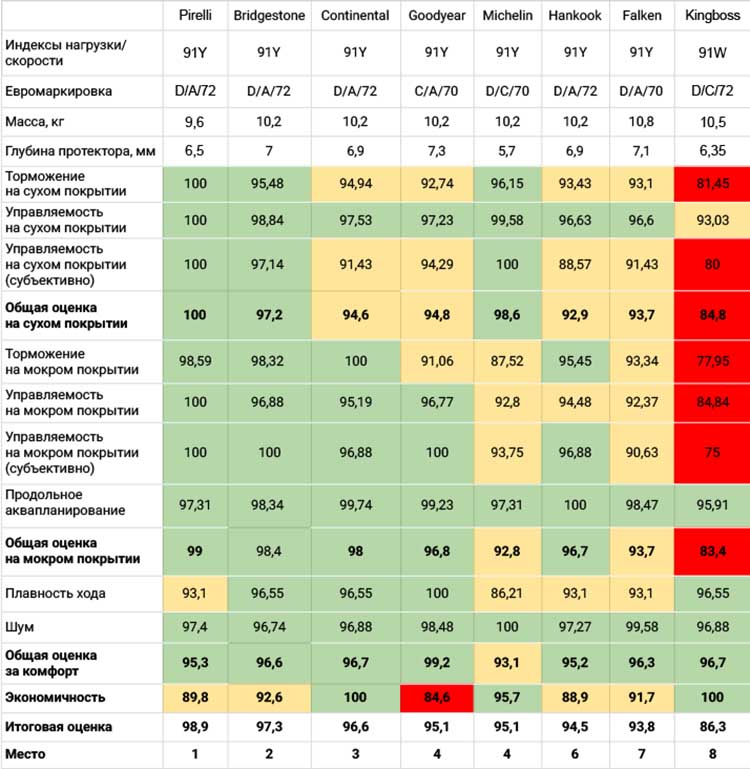
Handling on dry surfaces is a key discipline for tires of this type, and as Tyre Reviews portal creator Jonathan Benson noted, if Kingboss were tested separately, it could be said that they have decent characteristics in terms of steering response and grip. However, in this test, they were not alone, and the lag behind other tires was so significant that the situation becomes more clear. Falken took a line above with a noticeable gap, behaving balanced and allowing for stable lap times, while Hankook was very similar, although their responses to driver actions were not as straightforward as Azenis.
The Continental tires had the worst steering sensitivity at near-zero steering wheel position, but as the steering wheel turns, the response becomes faster, and the tires provide good stability, including when passing turns quickly. Goodyear had sharper responses, and grip was significantly higher than the previous three tires, and they were also among the tires that allowed for a significantly faster second lap, as they heated up to the desired temperature. The only small drawback was that before full heating, the tires responded somewhat sluggishly and lost to the leaders in terms of informativeness.
Bridgestone's behavior turned out to be non-linear, and as Benson said, "you enter a turn and at some point, you start turning faster and faster without additional effort on the steering wheel, which is not ideal, but allows you to have fun on the track even at not very high speeds". As for Michelin, the front tires respond extremely quickly, but in the first turn, the rear tires lacked grip, and even after an additional warm-up lap, Pilot Sport Cup 2, although clearly superior to competitors in high-speed turns, slightly worsened the time in slow turns, as well as in braking and acceleration zones.
Pirelli took first place in terms of lap time, reacting very straightforwardly and quickly to steering wheel turns, and also providing excellent informativeness, which allowed them to overtake even the track-oriented Michelin. "Whatever Pirelli has been doing lately, it's working," Benson summed up.
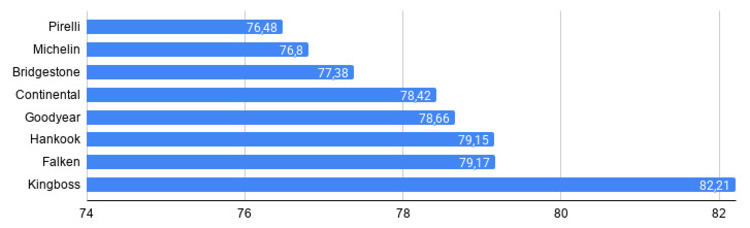
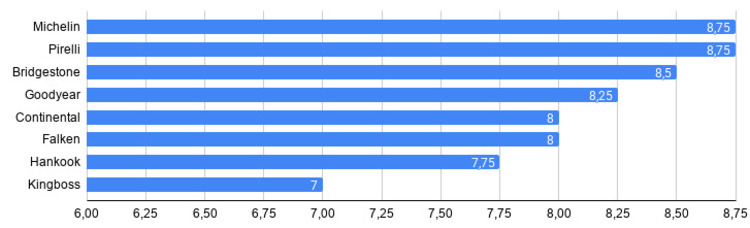
In the braking efficiency test on dry surfaces, the alignment of forces was almost the same, and the top three again consisted of Pirelli, Michelin, and Bridgestone.
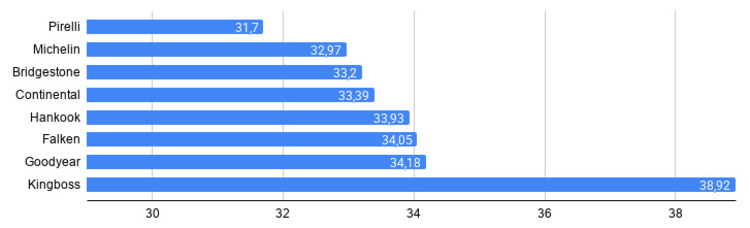
While on dry surfaces Kingboss still coped with their tasks, on wet surfaces everything was much worse, and according to the handling test results, the expert stated that the tires clearly lack grip. In turn, Falken showed a tendency to early skidding, although the lap time was generally good and the same as Michelin, which, in turn, differed in that if the contact with the asphalt was good, the tires provided excellent grip and handling, but on sections with a deeper layer of standing water, they began to behave somewhat unpredictably on the rear axle. At the same time, the air temperature was over 18 degrees, and the water on the track was sufficiently heated, so in cool weather, handling could be even more difficult.
Hankook and Continental turned out to be very similar, and although they were not among the best in terms of response sharpness, both tires guarantee pleasant ease of handling and full control over the car on both wet surfaces and sections of standing water without the occurrence of aquaplaning and with stable grip on the rear axle. Bridgestone also showed themselves from the best side, and their advantages can be considered excellent grip of the front tires, fast response when the steering wheel is in the zero position, as well as stable behavior of the rear tires with a low probability of aquaplaning. Nevertheless, Pirelli's lap time was even better, and the grip on the front axle allowed for later turning when entering a turn, and on the rear axle, it was also reliable during the execution of any maneuver. According to Benson, for a sports tire that is initially more focused on use on dry surfaces, Pirelli has "extraordinary handling characteristics on wet surfaces".
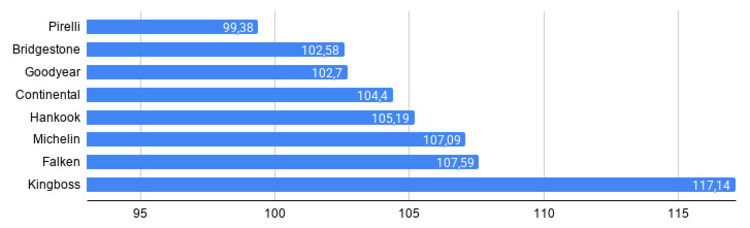
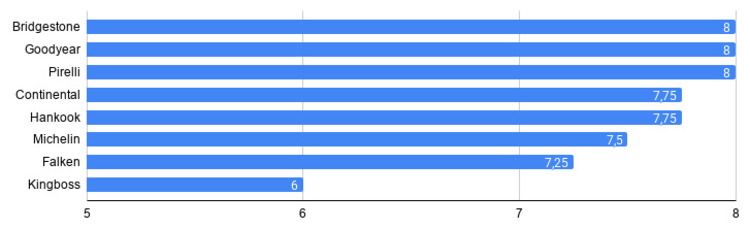
Pirelli also has excellent braking qualities on wet asphalt, although here they slightly lost to Continental. In addition, Michelin showed a very good result, considering their relatively small tread depth, and Kingboss again hopelessly lagged behind the other participants.
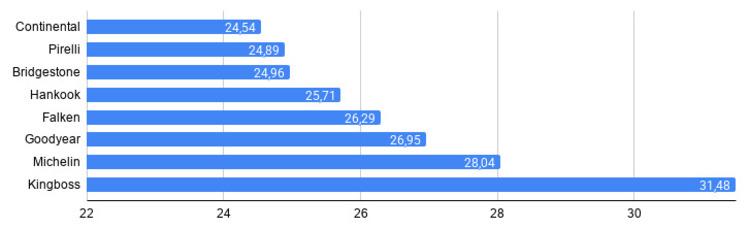
In the test for longitudinal aquaplaning resistance, the difference in results was surprisingly small, and the first places were taken by Hankook and Continental. Perhaps in tests for resistance to aquaplaning in turns, the differences would be more significant.
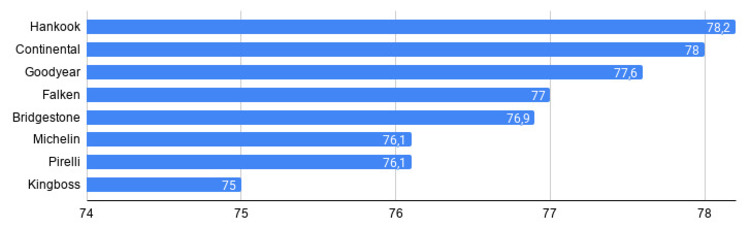
In terms of comfort, Goodyear was recognized as the best, while Michelin had a noticeably harder ride, which is not surprising given their specialization.
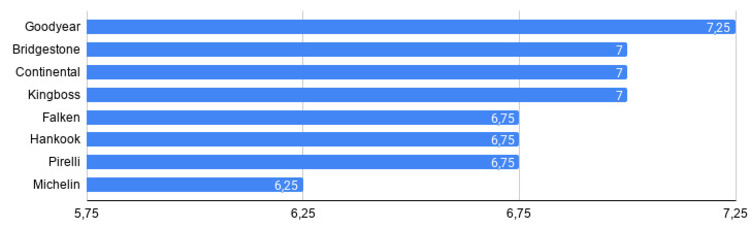
In the test for external noise level, Michelin took the first place, and although this may seem illogical, the noise level of tires depends, among other things, on the tread depth.
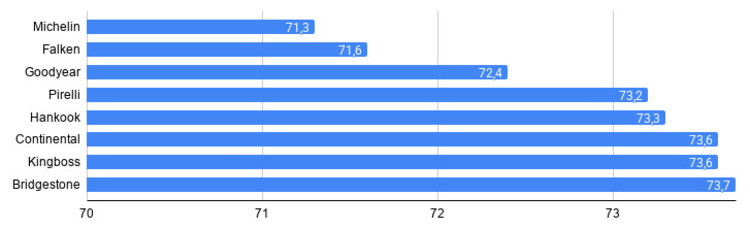
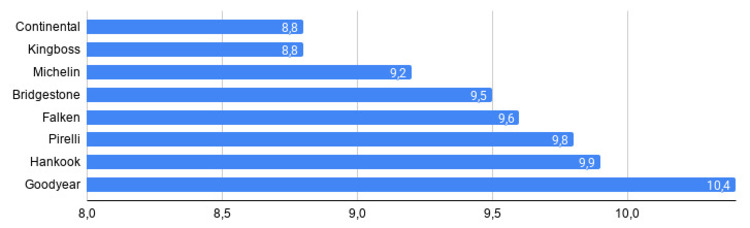
Rolling resistance in the UHP segment is not very highly valued, but since all the tested tires, with the exception of Michelin, are designed for everyday life, this factor was also evaluated, and Continental and Kingboss turned out to be the most economical. Next come Michelin, the most sports-oriented tires in the test, and the reason is again the small tread depth. The rest of the tires showed approximately similar results, and only Goodyear lagged behind, which are already beginning to show signs of aging.
Verdict
Pirelli P Zero R achieved a truly impressive victory, becoming the best in handling in any conditions (overtaking track-oriented Michelin on a dry track) and in braking properties on dry surfaces, and also taking second place in the test for braking efficiency on wet surfaces. "If I had been told before the test that the same tire would surpass Cup 2 on dry and Continental on wet tracks, I wouldn't have believed it, but we have what we have," Benson noted. "Of course, P Zero R is not the most comfortable and economical, but that doesn't bother me".
Bridgestone Potenza Sport Evo takes second place, and during their premiere, the company said that when creating the Evo version of the Potenza Sport tires, the developers aimed to eliminate two main drawbacks: high rolling resistance and rapid wear, while maintaining the sharpness of handling and reliable grip on dry and wet surfaces, and it seems they succeeded. At least, the necessary number of laps was completed on the tires without problems, and according to the tester's assessment, the wear resistance has become significantly better compared to Potenza Sport. In other respects, this is an excellent option, well suited for fast driving.
Bronze goes to Continental SportContact 7 tires, which have a "more civilian" character, i.e., they have excellent braking qualities, low rolling resistance, and a high level of comfort. At the same time, although the responsiveness of the handling is not what one would like on a racing track, the tires can still be considered urgently recommended.
Next come F1 Super Sport, which, apparently, are beginning to show their age, since on dry surfaces they are no longer keeping up with the best "classmates" and also have very high rolling resistance. Nevertheless, these are still very good sports tires.
Michelin Pilot Sport Cup 2's results were quite unexpected, and on a dry track, they were not the best in terms of lap time, and on a wet surface, they easily left Kingboss behind, despite their reduced tread depth. According to Benson, "perhaps this is not such a track tire", although for everyday use in regions with cold and rainy weather, it is also unlikely to be recommended.
Hankook Ventus S1 evo Z stood out for their high resistance to aquaplaning and slightly outperformed Falken in the wet surface tests, and the expert noted that although they occupy sixth place, these are also very good tires. In turn, Falken Azenis RS820 also have a number of advantages, such as low noise and short braking distance in the rain, but in terms of handling on wet surfaces, they lost to competitors, and only Kingboss G866 were worse, taking the last place in the overall standings. According to Benson, fans of sports driving will not like these tires - like everyone else, because they are simply not able to work well on a wet road.
Source, including photos: Tyre Reviews